
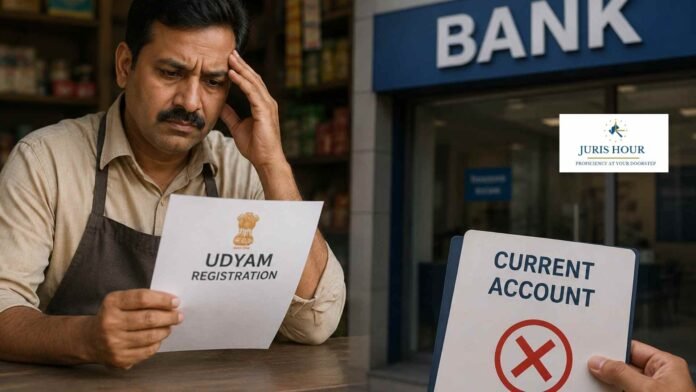
A growing number of small traders, shopkeepers, and micro-business owners across India are facing difficulties in opening current accounts with banks due to a documentation gap created by changes in regulatory requirements.
Traditionally, many small businesses that were not registered under the Goods and Services Tax (GST) regime relied on two key documents while approaching banks for opening a current account: the Udyam Registration Certificate (earlier known as Udyam Aadhaar) and the Shop & Establishment Certificate issued under state labour laws. Together, these documents generally served as proof of business existence and operational legitimacy.
However, in recent years, several states have either simplified, exempted, or effectively discontinued the requirement of obtaining Shop & Establishment registrations for many categories of small businesses. While this move was intended to reduce compliance burdens and improve the ease of doing business, it has unintentionally created a new challenge for entrepreneurs seeking banking services.
BUY NOW: GST E-Magazine Mega Combo (11 Publications)
Banks Often Seek Additional Proof
Many banks continue to insist on documentary evidence establishing the existence and place of business before opening a current account. In numerous cases, bank branches are reportedly reluctant to accept an Udyam Registration Certificate as the sole proof of business activity, particularly when applicants do not possess GST registration, trade licenses, or Shop & Establishment Certificates.
As a result, thousands of small shopkeepers, home-based businesses, self-employed professionals, and micro-enterprises find themselves trapped in a compliance dilemma. They are not legally required to obtain GST registration due to their turnover levels and may also be exempt from obtaining a Shop & Establishment Certificate. Yet, the absence of these documents often becomes an obstacle in accessing basic banking facilities.
Impact on Financial Inclusion
Current accounts are essential for carrying out business transactions, accepting digital payments, obtaining loans, participating in government schemes, and maintaining financial records. Without access to a current account, many small entrepreneurs are forced to rely on personal savings accounts, which may not be suitable for commercial operations and could create compliance concerns in the future.
Industry observers point out that the issue particularly affects first-generation entrepreneurs, street-level retailers, rural businesses, and micro-enterprises operating in the informal sector. These businesses often possess valid Udyam Registration Certificates issued by the Government of India but struggle to satisfy varying documentation requirements imposed by individual bank branches.
Need for Uniform Banking Guidelines
Experts believe that a clear and uniform policy is required to address the issue. Since Udyam Registration is a government-recognized mechanism for identifying Micro, Small and Medium Enterprises (MSMEs), many stakeholders argue that banks should be expressly permitted to accept Udyam Registration, along with basic identity and address proofs, as sufficient documentation for opening current accounts in eligible cases.
A standardized advisory from financial regulators or the government could help eliminate inconsistencies in banking practices and ensure that genuine businesses are not denied access to formal financial services merely because a particular state no longer issues Shop & Establishment Certificates.
Government Intervention Sought
Business associations and MSME representatives have urged the Central Government, the Ministry of Finance, the Ministry of MSME, and banking regulators to examine the issue and issue suitable directions to banks. They argue that the objective of simplifying business regulations should not inadvertently result in reduced access to banking infrastructure.
As India continues its push toward digital payments, formalization of the economy, and financial inclusion, ensuring seamless access to current accounts for small businesses remains a critical policy priority. Stakeholders believe that timely intervention can prevent unnecessary hardships and support the growth of millions of micro and small enterprises that form the backbone of the country’s economy.
Read More: Salary Tax Returns Under Scanner as Income Tax Dept. Detects Mismatches

