
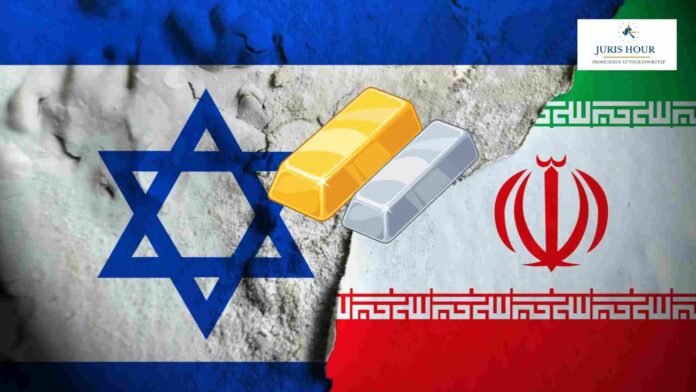
Escalating military tensions involving the United States, Israel, and Iran have triggered sharp reactions across global financial markets. Among the most sensitive assets to geopolitical risk are gold and silver, both traditionally viewed as safe-haven investments. As fears of a broader regional conflict intensify, investors have shifted capital toward precious metals, driving notable price volatility and upward momentum.
Table of Contents
Immediate Market Reaction
Following reports of military strikes and heightened regional instability, international gold prices moved higher as investors sought protection against uncertainty. Spot gold witnessed a strong upward move in early trading sessions after the escalation, reflecting classic risk-off behavior. Silver, known for being more volatile than gold, also recorded significant gains, often outperforming gold in percentage terms during sharp geopolitical shocks.
The initial surge was largely driven by institutional buying, hedge fund positioning, and increased retail participation in bullion markets. Exchange-traded funds backed by gold and silver also saw renewed inflows as risk appetite in equities weakened.
Why Gold and Silver Rise During Geopolitical Conflict
Gold and silver typically strengthen during geopolitical crises for several structural reasons. First, they are perceived as stores of value when financial markets face instability. Second, military tensions in the Middle East raise concerns about oil supply disruptions, which can push crude prices higher. Rising oil prices feed inflation expectations, and gold in particular is often used as an inflation hedge.
Another key factor is currency volatility. During periods of uncertainty, emerging market currencies tend to weaken, making precious metals more attractive domestically. Even when the US dollar strengthens due to safe-haven flows, gold can rise simultaneously if geopolitical risks are severe enough.
Oil Prices and Inflation Expectations
The Middle East plays a central role in global energy supply. Any escalation involving Iran raises concerns about disruptions in the Strait of Hormuz, a critical oil transit route. If oil prices spike meaningfully, inflationary pressures could intensify globally.
Higher inflation expectations often support gold prices, particularly if central banks are seen as slow to respond with tighter monetary policy. However, if inflation forces central banks to maintain higher interest rates for longer, rising real yields could eventually limit upside in bullion prices.
Silver’s Dual Role: Safe Haven and Industrial Metal
Unlike gold, silver has a dual character. It functions both as a precious metal and as an industrial commodity used in electronics, solar panels, and manufacturing. During geopolitical crises, silver benefits from safe-haven demand, but its industrial exposure can introduce added volatility.
If the conflict leads to broader economic slowdown fears, industrial demand expectations may soften, potentially capping silver’s rally. However, in the early stages of geopolitical shocks, silver often tracks gold higher due to speculative inflows.
Impact on Domestic Markets Such as India
In countries like India, where gold demand is structurally strong due to cultural and investment preferences, domestic prices tend to amplify international movements. A rise in global gold prices, combined with currency depreciation against the US dollar, can lead to sharper increases in local bullion rates.
Silver prices in domestic markets may show uneven movements depending on industrial demand trends and local liquidity conditions. Nonetheless, geopolitical shocks generally lead to immediate upward adjustments in retail bullion pricing.
Factors That Could Limit the Rally
While precious metals typically benefit during conflict, several factors could limit sustained gains. If diplomatic efforts de-escalate tensions quickly, safe-haven demand may recede. Additionally, a strong US dollar can reduce the pace of gold’s advance.
Interest rate policy also remains critical. If central banks maintain tight monetary conditions or signal higher-for-longer rates, rising bond yields could reduce the relative attractiveness of non-yielding assets like gold and silver.
Short-Term and Medium-Term Outlook
In the short term, gold and silver are likely to remain highly sensitive to headlines related to military developments, diplomatic negotiations, and oil market reactions. Price spikes may occur on escalation news, followed by pullbacks if tensions ease.
In the medium term, sustained upside in gold would likely require prolonged geopolitical uncertainty, persistent inflation risks, or signs of financial market instability. Silver’s trajectory will depend not only on safe-haven demand but also on global industrial activity trends.
Conclusion
The US–Israel attack on Iran has reinforced gold and silver’s traditional role as crisis hedges. Investors have responded swiftly to geopolitical uncertainty by reallocating funds into precious metals, leading to sharp price movements. While safe-haven demand remains strong amid escalating tensions, the durability of the rally will depend on the conflict’s duration, oil market dynamics, global inflation trends, and central bank policy responses.
Precious metals are likely to remain volatile in the near term, closely tracking developments in the Middle East and broader macroeconomic signals.

