
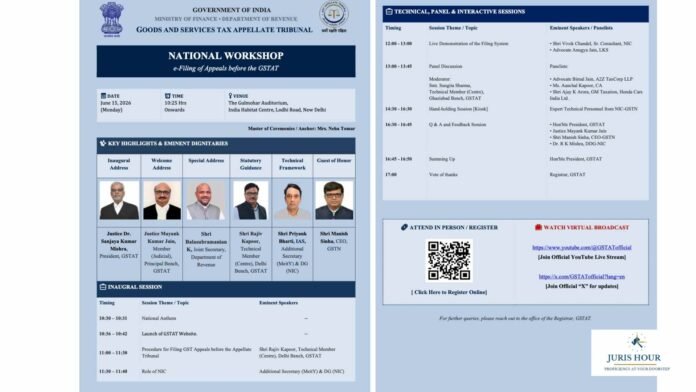
Taxpayers and professionals filing appeals before GSTAT need clarity on one thing above all else: how the tribunal expects appeals to be filed in practice. Recent official discussions around GSTAT e-filing Workshop have brought out several important points on limitation, respondent details, digital filing, wrong bench selection, cross objections, document upload requirements, translations, and unresolved issues such as personal penalty pre-deposit.
The National Workshop on e-Filing of Appeals before the GSTAT witnessed participation from senior members of the judiciary, tax administration, GSTN, NIC, industry representatives and leading tax professionals. The event was led by Justice Dr. Sanjaya Kumar Mishra, President, GSTAT, who delivered the inaugural address and later participated in the interactive feedback session.
The welcome address was delivered by Justice Mayank Kumar Jain, Member (Judicial), Principal Bench, GSTAT, while Shri Balasubramanian K, Joint Secretary, Department of Revenue, delivered the special address. Statutory guidance on GSTAT procedures was provided by Shri Rajiv Kapoor, Technical Member (Centre), Delhi Bench, GSTAT, who also conducted the detailed session on the procedure for filing GST appeals before the Tribunal.
This guide pulls those points together in a practical, search-friendly format so you can understand what is settled, what is under review, and where caution is required.
What this means for GSTAT appeal filing right now
The broad position is clear:
- GSTAT filing is intended to be fully digital.
- Manual filing is not the working process.
- Some procedural points in the rules or checklists are being revisited.
- Portal functionality is still evolving.
- Certain legal and procedural issues remain unresolved and may need bench-level handling.
For practitioners, this means the filing strategy should be both strictly compliant and practically adaptive, especially where the portal does not perfectly align with the rules.
Can GSTAT condone delay if the first appeal became time-barred?
This is one of the most important concerns.
The indicated position is that there is no direct power with the tribunal to simply condone delay in such cases as a general remedy. The tribunal’s power is not being treated as unlimited, and this approach is consistent with the broader legal understanding that tribunals, and even courts in some contexts, operate within statutory limits on condonation.
However, an important distinction is being considered in cases involving communication versus actual service. In other words, if the dispute is not simply about delay but about whether the order was properly served or only technically communicated, that issue may still be examined by the concerned bench.
There is also discussion around special handling for such matters, including possible procedural solutions because first appellate remedies in these situations may not have been effectively available.
Practical takeaway on time-barred first appeals
- Do not assume GSTAT will automatically condone delay.
- Carefully assess whether the case raises a service of order issue rather than a simple limitation issue.
- If the first appellate order flow has procedural gaps, preserve all portal records, communications, and proof of non-service or delayed service.
- Where relevant, the issue may need to be framed around when the order was actually served.
If APL-04 was not issued, can an appeal still be filed?
A useful clarification has emerged for situations where APL-04 is not directly issued. In such cases, filing on the portal may still be possible in APL-02 format before GSTAT.
That does not mean delay will be condoned automatically. It means there may still be a filing route on the portal, while issues relating to service, communication, or maintainability may be examined by the bench.
Who should be made the respondent in a GSTAT appeal?
As per the clarified position under Rule 33, the Commissioner is the mandatory respondent.
That said, a practical problem exists because the portal may ask for two mandatory respondents. This mismatch between the procedural rule and portal design is not fully resolved yet.
What filers should do
- Treat the Commissioner as the mandatory respondent in line with Rule 33.
- If the portal requires additional respondent details, comply with the portal requirement as best as possible without contradicting the legal position.
- Keep a screenshot or record of any portal compulsion that does not align neatly with the rules.
This is exactly the kind of issue where procedural documentation can help later if any objection arises.
Is manual filing allowed before GSTAT?
No. The current position is that GSTAT is functioning as a fully digital tribunal for filing purposes.
Even though some rules may still contain references to manual filing, those references are being treated as outdated and expected to be amended in due course. The practical instruction is that appeals and documents are not to be manually filed.
What “fully digital” means in practice
- Appeals are to be filed online.
- Supporting records are to be uploaded through the portal.
- Physical submission is not the standard route.
- Hearings may still take place in hybrid mode.
Can identical legal issues be consolidated before GSTAT?
Yes, but with an important limitation.
The clarification is that the Principal Bench deals with identical questions of law, not merely identical questions of fact. That distinction matters. Two cases may look similar commercially or factually, but that alone does not mean they fall within this mechanism.
Key point on Section 16(2)(c)-type disputes and common legal issues
If multiple appeals involve the same legal question, an application for consolidation can be filed. But there is reportedly no direct portal mechanism to auto-consolidate such matters.
Also, any transfer request available on the portal appears to relate to transfer from one bench to another, not automatic clubbing of legally similar matters.
Important limitation of tribunal jurisdiction
The tribunal cannot decide the constitutional validity of a statutory provision. If a dispute challenges the validity of the law itself, that issue is outside the tribunal’s role. But the tribunal can still consider the legal and factual issues that arise in applying the provision, within its jurisdiction.
What happens if an appeal is filed before the wrong bench?
This has become a common filing problem.
Where appeals are filed in the wrong bench, the tribunal may transfer them to the relevant bench. In some cases, relief in terms of procedural accommodation may also be available where the wrong bench was chosen.
Still, relying on transfer is not ideal. Wrong bench filing can delay registration and complicate the matter.
Cases requiring extra care in bench selection
- Place of supply matters
- ISD matters
These are the kinds of cases that require special attention because they may go to the Principal Bench.
Bench selection checklist
- Confirm whether the appeal involves a regular territorial bench issue or a matter for the Principal Bench.
- Review the subject matter, not just the location of the taxpayer.
- Double-check place of supply and ISD issues before filing.
- Keep a record of the basis on which the bench was selected.
When does the 45-day period for cross objections begin?
This is a very practical point for taxpayers responding to departmental appeals.
When the department files an appeal, the taxpayer may first receive an SMS intimation. That intimation is not the starting point for the 45-day period for cross objections.
The 45 days begin from the date of notice, meaning when the case is actually registered and notice is issued, not from the earlier intimation message.
Why this matters
Many taxpayers may wrongly assume the limitation clock starts with the first portal or SMS alert. The clarified position indicates that the formal notice date matters for counting cross objection time.
Will the 29-point document checklist continue as it is?
Not necessarily.
The much-discussed 29-point checklist for GSTAT filing is under reconsideration. Concerns have been noted that some of its requirements do not fully align with the rules, especially on matters such as:
- Scanning standards
- Grayscale versus color
- DPI requirements
- Affidavit-related technicalities
The expectation is that the checklist may be reduced or simplified.
What filers should do meanwhile
- Comply with the currently operational checklist as far as possible.
- Avoid over-processing documents where the requirement is unclear.
- Track updates because filing standards may become easier.
Do previously uploaded documents need to be uploaded again in GSTAT?
One of the most helpful operational clarifications is that documents already uploaded earlier on the portal, such as during adjudication or first appeal, need not necessarily be uploaded again.
This can be a major relief in cases involving large document sets, especially where there are hundreds or thousands of invoices.
What this means in practice
- If records are already available on the system from earlier stages, re-uploading all of them may not be required.
- The tribunal members are expected to have access to those existing uploads.
- You can focus on uploading the relevant documents in the proper fields, such as show cause notice and certified order.
This also helps maintain a cleaner and more logical appeal file.
Are authenticated translations mandatory?
A relaxation has been indicated regarding translations. The practical understanding is that translations are not presently being insisted upon in a rigid manner, and where translation is required, separate authentication from another person is not being treated as a mandatory universal requirement.
This relaxation appears to apply across benches for now.
Practical approach to translations
- Upload relevant translated material where genuinely necessary for clarity.
- Place it in the most relevant document category on the portal.
- Maintain a logical sequence in the appeal paper set.
- Avoid unnecessary translation filing if the record does not call for it.
What is the position on personal penalty appeals for unregistered directors or individuals?
This issue is still pending resolution.
The unresolved point concerns pre-deposit requirements in personal penalty cases, particularly where directors or other persons facing penalty are not registered persons. A clear system-side or procedural resolution is still awaited.
Until a specific clarification comes, these cases should be handled carefully and tracked closely for updates.
Common GSTAT e-filing mistakes to avoid
- Assuming delay can always be condoned
- Treating SMS intimation as the start date for cross objections
- Choosing the wrong bench without checking subject-specific rules
- Re-uploading huge document sets unnecessarily
- Relying on old manual filing references in rules
- Ignoring the distinction between identical questions of law and identical facts
- Assuming portal design always reflects the exact legal rule
Practical filing checklist before submitting a GSTAT appeal
- Check limitation carefully, especially where service of the order is in dispute.
- Confirm the correct bench, with special caution for place of supply and ISD matters.
- Name the Commissioner as respondent in line with Rule 33, while handling portal-required fields carefully.
- Use the portal only. Do not plan on manual filing.
- Upload only what is needed, especially where earlier-stage documents are already on record.
- Watch the notice date for cross objection limitation, not just SMS intimation.
- Prepare for checklist changes, but comply with current operational requirements until revised.
- Document every portal issue with screenshots and filing records.
Frequently asked questions
Is GSTAT accepting physical appeal filing?
No. The functioning position is digital filing only.
Can the tribunal decide constitutional validity of GST provisions?
No. That falls outside the tribunal’s scope.
Can similar appeals be clubbed together automatically on the portal?
No automatic portal mechanism has been indicated for that. A consolidation request may need to be filed separately.
Do I need to upload all invoices again if they were already filed earlier?
Not necessarily. If already uploaded at earlier stages and accessible on the system, fresh upload may not be required.
Does the 45-day period for cross objections start from SMS alert?
No. The period starts from the notice date after registration, not the first intimation.
Final takeaway
The current GSTAT appeal framework is moving firmly toward end-to-end digital filing, but several procedural areas are still being refined. The safest approach is to file with a strong record, use the portal carefully, and distinguish between settled requirements and issues still under clarification.
The most important live issues right now are:
- delay and service-related disputes,
- correct respondent and bench selection,
- cross objection timelines,
- simplification of document requirements, and
- pending clarity on personal penalty pre-deposit matters.
For anyone filing before GSTAT, procedural accuracy is now just as important as legal merit.
The insights are taken from Workshop on National Workshop on e-Filing of Appeals before the GSTAT.
Read More: Haryana SGST Dept. Revised Monetary Limit for Proper officers

