
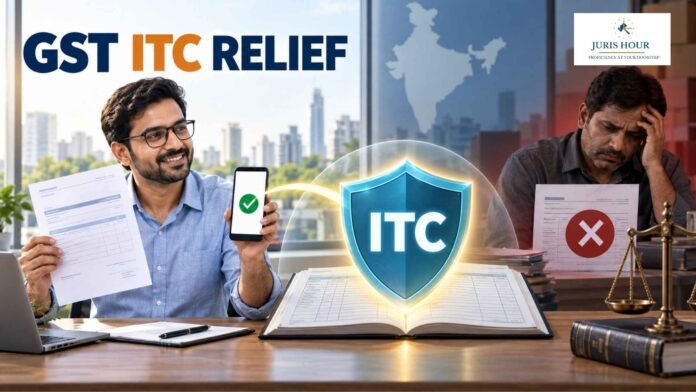
In the 57Th GST Council Meet a significant change may be on the horizon for genuine taxpayers facing denial of input tax credit merely because their suppliers failed to deposit the collected Goods and Services Tax with the government.
Under the proposal being discussed, a purchasing taxpayer may be permitted to retain input tax credit even where the supplier has not discharged the corresponding GST liability, provided the buyer can establish the genuineness of the transaction and prove that the invoice amount, including tax, was paid to the supplier through a banking channel.
The proposal is understood to be aimed at protecting bona fide recipients who have complied with their statutory obligations but are exposed to tax demands because of defaults committed independently by their suppliers.
Reports circulating among tax professionals indicate that the proposed protection could be made subject to safeguards such as the availability of the invoice in the recipient’s Form GSTR-2B, actual receipt of the goods or services, payment of the invoice consideration through an identifiable banking channel and the absence of fraud or collusion between the buyer and the supplier.
However, the proposal has not yet acquired the force of law. It would require final approval by the GST Council, followed by the necessary legislative amendment, notification, rules or clarification before taxpayers can rely upon it. No publicly available official GST Council document presently confirms the final adoption of such a relaxation.
Existing Condition Under Section 16(2)(c)
At present, Section 16(2)(c) of the Central Goods and Services Tax Act, 2017 makes the availability of input tax credit conditional upon the tax charged on the supply having actually been paid to the government.
The tax may be paid by the supplier in cash or through utilisation of admissible input tax credit. Consequently, where a supplier reports an invoice in Form GSTR-1 but does not discharge the corresponding liability through Form GSTR-3B, the purchasing taxpayer may face reversal or denial of credit.
This remains the statutory position reflected in Section 16 of the CGST Act.
The provision has generated extensive litigation because recipients ordinarily do not control the supplier’s return filing or tax-payment process. A buyer may possess a valid tax invoice, receive the goods, pay the full consideration along with GST and find the transaction reflected in GSTR-2B, yet still face proceedings if the supplier fails to remit the tax.
Banking Payment May Become Crucial Evidence
Under the reported proposal, payment through a banking channel could operate as an important safeguard for establishing the authenticity of the transaction.
Bank statements, electronic payment records, invoice-wise payment details, e-way bills, transport documents, purchase orders, goods-receipt records and proof of consumption or subsequent supply may become relevant for determining whether the buyer acted bona fide.
The mere use of a banking channel, however, may not by itself be sufficient. The recipient may also have to demonstrate that the underlying supply actually occurred and that the transaction was not part of a circular-trading, accommodation-invoice or fake-credit arrangement.
The reported relaxation is therefore expected to distinguish genuine commercial transactions from cases involving collusion, fictitious suppliers or fraudulent passing of input tax credit.
Relief Could Address Double Recovery Concerns
Taxpayers have repeatedly argued that recovering the same tax from a recipient after the buyer has already paid the amount to the supplier results in an unfair burden. They contend that the department should ordinarily initiate recovery against the defaulting supplier, particularly when the buyer has produced complete evidence of the transaction.
The proposed framework could allow the government to protect the buyer’s credit while separately pursuing the supplier for unpaid tax, interest and other statutory consequences.
Such a mechanism would be particularly significant in cases where the supplier remains registered and traceable but has defaulted in filing returns or paying tax because of financial distress, compliance failure or deliberate evasion.
It may also reduce the need for buyers to continuously monitor matters beyond their control, although businesses would still be expected to carry out reasonable vendor verification and reconcile their purchase records with GSTR-2B.
Major Impact on Pending ITC Disputes
Disputes involving supplier default constitute a substantial category of GST litigation. Tax authorities frequently issue notices seeking reversal of credit along with interest and penalty when the tax corresponding to an invoice is not found to have been deposited by the supplier.
If the proposal is approved, the manner in which it applies to past transactions will become especially important. The government will have to clarify whether the protection will operate only prospectively or will also cover pending assessments, appeals and show-cause notices.
It will also have to specify the documents required from recipients, the procedure for verifying banking payments and the circumstances in which the department may disregard the buyer’s claim of bona fides.
Until the proposed change is formally approved and notified, taxpayers remain governed by the existing conditions contained in Section 16 of the CGST Act. Businesses should therefore continue reconciling their purchase registers with GSTR-2B, retaining proof of receipt and payment, and following up with suppliers regarding the filing of returns and payment of tax.

