
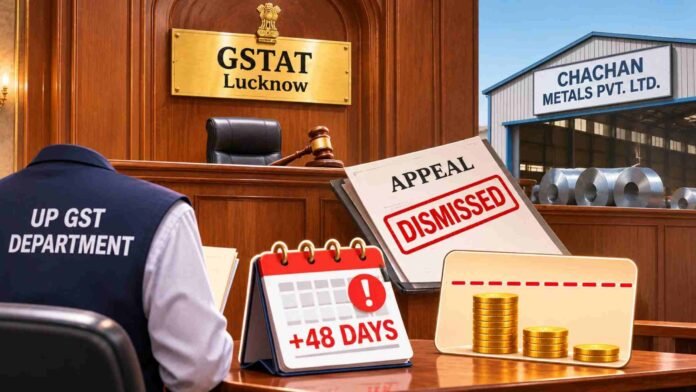
The Goods and Services Tax Appellate Tribunal (GSTAT), State Bench, Lucknow has held that departmental appeals must satisfy prescribed monetary limits and limitation requirements and directed that the order be placed before the Commissioner of State GST for necessary administrative action.
The bench of Narendra Kumar (Judicial Member) and Alok Chopra (Technical Member) expressed its shock and dismay over what it described as the apathetic, perfunctory and cavalier approach adopted by the Department while pursuing appeals before the GST Appellate Tribunal.
The dispute originated from a survey conducted by the Special Investigation Branch of the Uttar Pradesh GST Department, following which a show cause notice was issued to M/s Chachan Metals Private Limited under Section 74 of the CGST Act, alleging improper maintenance of records and a mismatch between the quantity of stock recorded in the books and the stock available during the survey, among other allegations.
Buy Now: All 200+ GSTAT Judgements Till November 2026 | Comprehensive E-Magazine
The adjudicating authority originally imposed a tax liability of ₹9,32,541.68 under CGST and an equivalent amount under SGST. Interest of ₹2,72,361 each under CGST and SGST was also imposed, along with a penalty of ₹9,32,541.68 under each head. The aggregate demand was quantified at ₹50,74,888.72.
However, the First Appellate Authority granted partial relief to the taxpayer, reducing the aggregate demand by ₹30,69,038. Aggrieved by the relief granted to the taxpayer, the Department approached GSTAT by filing an appeal under Section 112(3) of the CGST Act.
During the proceedings, the taxpayer’s counsel raised preliminary objections regarding the maintainability of the departmental appeal.
It was argued that the disputed tax amount was ₹12,04,177, comprising CGST of ₹6,02,088.50 and SGST of ₹6,02,088.50. The taxpayer contended that the amount was below the monetary threshold of ₹20 lakh prescribed for departmental appeals before GSTAT under CBIC Circular No. 207/1/2024-GST dated June 26, 2024.
Reliance was also placed on the relevant Uttar Pradesh departmental circulars, including Circular No. 2425008 dated July 5, 2024, and Circular No. 252/2026-27/State Tax dated May 22, 2026.
The taxpayer further submitted that although exceptional circumstances may permit the Department to file an appeal below the prescribed monetary limit, the authorisation accompanying the appeal did not identify any specific exception or record why the matter warranted litigation despite the monetary threshold.
It was argued that a routine authorisation under Section 112(3) could not automatically be treated as sufficient justification for disregarding the monetary limits prescribed by the Department itself.
Another significant objection concerned limitation.
The Tribunal examined the records and found that the departmental appeal in Form GST APL-07 had been digitally signed and filed on September 17, 2026.
The Government, through Notification S.O. 3502(E) dated June 30, 2026, had extended the last date for filing appeals before GSTAT to July 31, 2026.
Accordingly, the Department had filed the appeal 48 days beyond the extended deadline.
The Tribunal also considered GSTAT Order No. 156/2026 dated July 10, 2026, which had introduced a token generation facility for taxpayers facing technical or portal-related difficulties in filing appeals.
Under the facility, an appellant could generate a token on or before July 31, 2026, recording the intention to file an appeal and thereafter complete the filing within 60 days from the date of token generation.
However, the Tribunal observed that the Department had not produced any evidence of having generated such a token within the prescribed period.
The Tribunal also examined the authorisation issued under Section 112(3) of the CGST Act. It observed that the documents available on the portal did not disclose any specific opinion of the Commissioner supporting the decision to pursue the appeal.
The authorisation was found to bear only the date September 2026, without a clearly ascertainable date of issuance.
The Bench expressed serious concern over the manner in which the Department was handling appeals before the GST Appellate Tribunal and observed that departmental appeals must be pursued with proper preparation, care and diligence rather than being treated as mere formalities.
The GSTAT, Lucknow Bench, dismissed the appeal filed by the Uttar Pradesh GST Department.
The Tribunal further directed that a copy of the order be placed before the Commissioner of State GST so that necessary directions could be issued to the concerned officers to ensure that revenue appeals before GSTAT are handled with the seriousness and responsibility expected of an appellate forum.
Membership Required to Access Case Details & Order Copy
To view the complete Case Details and Download Order Copy, you must have an active membership. Please subscribe to continue.

