
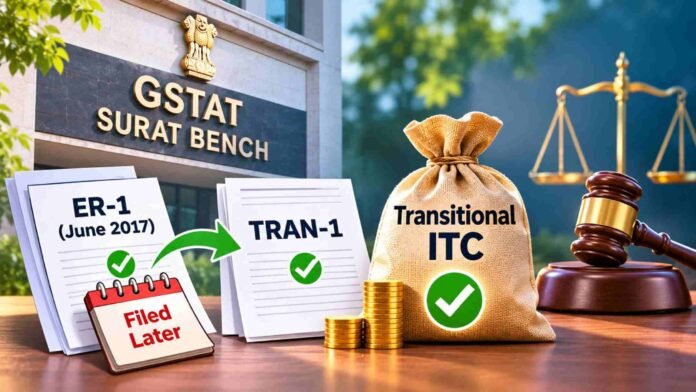
The Goods and Services Tax Appellate Tribunal (GSTAT), Surat Bench has set aside the denial of transitional Input Tax Credit (ITC) of ₹38,55,305, holding that credit cannot be denied merely because the ER-1 return for June 2017 was filed after submission of Form GST TRAN-1.
The Bench of Sanjay Kumar Dwivedi (Judicial Member) and Rameshkumar G. Hadvani (Technical Member) held that neither clause (ii) of the proviso to Section 140(1) of the CGST Act, 2017 nor the main provision bars transitional credit merely because the ER-1 return was furnished after filing Form TRAN-1.
Buy Now: All 200+ GSTAT Judgements Till November 2026 | Comprehensive E-Magazine
The assessee was engaged in setting up a factory and obtained Central Excise registration in April 2017. Machinery was purchased and installed between April and July 2017, and commercial production commenced in August 2017.
During June 2017, the assessee availed CENVAT Credit of ₹38,55,305 towards Central Excise duty paid on machinery. This amount represented the closing balance of credit as on June 30, 2017.
Although the ER-1 returns for April to June 2017 were prepared on the ACES portal, the June 2017 return remained in saved status due to technical issues and was not formally submitted. The assessee subsequently filed Form GST TRAN-1 on December 27, 2017, claiming transitional credit of ₹38,55,305.
The June 2017 ER-1 return was eventually submitted on October 1, 2018, approximately nine months after filing TRAN-1.
The department objected to the transitional credit on the ground that the assessee had not filed the ER-1 return for June 2017 before submitting Form TRAN-1.
A Show Cause Notice dated December 10, 2019, was issued proposing recovery of ₹38,55,305 under Section 73(1) of the CGST Act, along with applicable interest under Section 50 and penalty under Section 73(9).
The adjudicating authority disallowed the entire transitional credit and imposed a penalty of ₹3,85,531.
The first appellate authority also upheld the denial, observing that filing the ER-1 return was a mandatory statutory requirement and not merely a procedural formality.
Aggrieved by the decision, the assessee approached GSTAT, Surat.
The assessee contended that the CENVAT Credit had been legitimately earned under the erstwhile Central Excise regime and that its eligibility and quantum were never disputed by the department.
It was argued that the delay in filing the ER-1 return was merely procedural and could not extinguish a substantive right to transitional credit.
The assessee relied upon judicial precedents, including Brand Equity Treaties Ltd. v. Union of India, Adfert Technologies Pvt. Ltd. v. Union of India and the CBIC Circular No. 182/14/2022-GST.
It was further submitted that the amount reflected in the ER-1 return was identical to the amount transitioned through Form TRAN-1, and there was no discrepancy regarding the eligibility or quantum of credit.
The Tribunal identified the central issue as whether transitional credit under Section 140(1) could be denied merely because the ER-1 return was filed after submission of Form TRAN-1.
The Tribunal observed that both returns had ultimately been filed and that the amount of credit claimed through TRAN-1 was identical to the balance reflected in the ER-1 return.
Importantly, the department had never disputed the assessee’s substantive eligibility to claim the credit under the existing law.
Belated Filing Does Not Amount to Non-Filing
The Tribunal examined clause (ii) of the proviso to Section 140(1), which restricts transitional credit where the registered person has not furnished all returns required under the existing law for the six months immediately preceding the appointed date.
It observed that the provision does not prescribe any particular time limit or sequence for filing the ER-1 return in relation to Form TRAN-1.
According to the Tribunal, the statutory provision merely requires that all relevant returns must have been furnished. It does not state that such returns must necessarily be furnished before filing TRAN-1.
The Tribunal held that belated filing cannot be equated with non-filing.
No Requirement to File ER-1 Before TRAN-1
The Tribunal specifically observed that accepting the department’s interpretation would require adding words to the statutory provision, effectively reading it as:
“Where he has not furnished all the returns before filing the TRAN-1.”
However, Parliament had not incorporated any such language in Section 140(1).
The Tribunal further noted that wherever Parliament intended to prescribe a specific time limit under Section 140, it had expressly provided for the same. No such time limit or filing sequence had been prescribed under clause (ii) of the proviso to Section 140(1).
Rule 117 Does Not Prescribe a Time Limit for ER-1
The Tribunal also clarified that Rule 117 of the CGST Rules deals with the time limit and manner of filing Form TRAN-1.
It does not prescribe any time limit for filing ER-1 returns under the erstwhile Central Excise law, nor does it mandate that ER-1 must precede TRAN-1.
Reliance on Supreme Court and High Court Decisions
The Tribunal referred to the decision of the Supreme Court in Collector of Central Excise v. Dai Ichi Karkaria Ltd. [1999 (7) SCC 448], wherein validly taken credit was recognised as an indefeasible right.
It also referred to Tara Exports v. Union of India [2019 (20) G.S.T.L. 321] and Adfert Technologies Pvt. Ltd. v. Union of India [2020 (32) G.S.T.L. 726 (P&H.)], observing that substantive transitional credit cannot be denied on procedural or technical grounds.
The Tribunal further considered the Supreme Court’s directions in Union of India v. Filco Trade Centre Pvt. Ltd., wherein GSTN was directed to reopen the portal for filing TRAN-1 and TRAN-2.
Allowing the appeal, GSTAT, Surat Bench, held that neither clause (ii) of the proviso to Section 140(1) nor the main provision bars transitional credit merely because the ER-1 return for June 2017 was submitted after filing Form TRAN-1.
Accordingly, the Tribunal set aside the impugned appellate order and allowed transitional ITC of ₹38,55,305.
Consequently, the demands towards interest and penalty were also set aside, with consequential relief as per law.
Membership Required to Access Case Details & Order Copy
To view the complete Case Details and Download Order Copy, you must have an active membership. Please subscribe to continue.

