
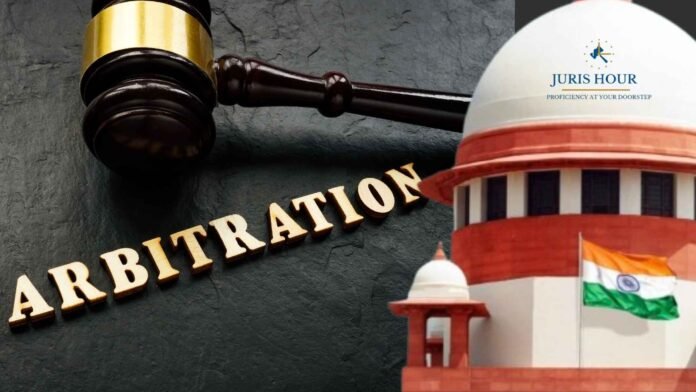
The Supreme Court has requested the Law Commission of India to undertake a focused study of the legal and procedural framework governing the enforcement and execution of arbitral awards, expressing concern that prolonged recovery proceedings can defeat the purpose of arbitration.
A Bench of Justices Vikram Nath, Sandeep Mehta and Aparesh Kumar Singh made the request while dealing with a dispute in which litigation over enforcement continued more than 24 years after the arbitral award was rendered.
Buy Now: 90+ Supreme Court Judgments – September 2026
The Court also held that parties cannot use applications seeking clarification of an earlier judgment to require the Supreme Court to supervise continuing execution proceedings or decide factual issues outside the scope of the question previously adjudicated.
The proceedings arose from an arbitral award rendered in favour of M/s Royal Construction Company Pvt. Ltd. against M/s National Projects Construction Corporation. The judgment records that the award followed an internationally seated arbitration and that the awarded amounts were denominated in Iraqi Dinars.
The award was challenged before Indian courts, eventually leading to a Supreme Court judgment dated February 24, 2015. In that decision, the Court emphasised minimal judicial intervention in arbitral awards and restored the directions contained in the award.
As recounted in the present judgment, courts should not substitute their subjective satisfaction for that of the arbitral tribunal unless the statutory grounds for interference are established.
The dispute subsequently moved into execution proceedings before the Delhi High Court.
By an order dated July 26, 2017, the High Court permitted the award-debtor to discharge its liability in Indian currency, applying the exchange rate prevailing on September 26, 1982, described in the judgment as the date of the underlying agreement.
The award-holder challenged that order before a Division Bench.
Earlier Supreme Court Ruling Required Payment In Foreign Currency
On December 17, 2019, the High Court’s Division Bench set aside the Single Judge’s order and certified a substantial question of law of general importance for consideration by the Supreme Court under Articles 134-A and 133(1)(a) of the Constitution.
The certified question concerned the relevant date for converting the awarded sum from US Dollars into Indian Rupees, having regard to the parties’ agreement and the Supreme Court’s 2015 judgment.
By its judgment dated October 10, 2023, the Supreme Court held that no occasion arose to determine or fix a date for conversion into Indian Rupees. It cautioned against disturbing the agreement, the arbitral award and the directions contained in its earlier judgment.
In the present ruling, the Court explained that its earlier determination required payment in foreign currency.
Claim Of Payment In 2009 Leads To Fresh Proceedings
As execution continued, the award-debtor contended that the principal amount had already been paid in Indian Rupees in 2009 pursuant to High Court orders.
On February 16, 2026, the High Court granted the parties liberty to seek clarification from the Supreme Court concerning why the earlier payment had not been brought to its attention when it decided the certified question.
The award-holder challenged that interim order.
The Supreme Court held that the High Court’s Division Bench had erred in appreciating the scope of the controversy decided in 2023. Its jurisdiction in the earlier appeal had been confined to answering the certified legal question, without examining factual matters beyond that question.
Consequently, the Court had no occasion in those proceedings to decide issues relating to deposits made by the award-debtor or their subsequent withdrawal.
Clarification Cannot Become Supervision Of Execution Proceedings
The Bench held that a clarification request cannot expand the scope of a concluded appeal into continuing supervision of execution proceedings.
Questions arising during execution must be determined by the competent executing court and, where appropriate, the appellate court exercising jurisdiction over its orders.
Once the Supreme Court had answered the substantial question of law referred to it, the scope of those appellate proceedings stood exhausted. The parties could not enlarge that adjudication by seeking answers to distinct questions unconnected with the issue previously decided.
The ruling thus leaves factual disputes concerning payment, adjustment and satisfaction of the award to the courts handling execution.
Arbitration’s Success Depends On Actual Recovery
In an epilogue, the Bench expressed concern over the prolonged course of the litigation.
It noted that arbitration had been invoked when the Arbitration Act, 1940 was in force. Yet, nearly three decades after the enactment of the Arbitration and Conciliation Act, 1996, and more than 24 years after the award, the parties continued to litigate over enforcement.
According to the Court, such delay undermines the rationale for adopting arbitration as an effective alternative to conventional civil litigation.
The effectiveness of arbitration, the Bench explained, cannot be assessed solely by how quickly an award is delivered or how narrowly the grounds for challenging it are framed. It must also be measured by whether the successful party can obtain the benefit of the award within a reasonable period.
A party compelled to undertake another prolonged round of litigation to recover an awarded amount does not receive the full benefit promised by arbitration.
Execution Framework Requires Focused Examination
The Court observed that legislative efforts have addressed delays in arbitral proceedings, challenges to awards and stays on enforcement. However, the actual execution process deserves equally serious consideration.
Referring to Section 36 of the Arbitration and Conciliation Act, 1996, the Bench noted that enforcement in the same manner as a court decree draws upon the ordinary execution machinery under the Code of Civil Procedure, 1908.
The experience of the present case, it said, called for closer examination of whether that framework adequately serves arbitration’s objectives.
The Court identified several matters requiring scrutiny: identification and disclosure of the award-debtor’s assets, coordination of different modes of execution, disposal of repetitive or delaying objections, and the time taken to conclude execution.
It also suggested that comparative legal systems could offer useful insights into more effective enforcement mechanisms while preserving legitimate procedural safeguards for judgment-debtors.
Law Commission Asked To Consider Domestic And Foreign Awards
The Supreme Court requested the Law Commission to study practical impediments to timely recovery and examine the experience of other jurisdictions.
The proposed study may also consider whether domestic and foreign arbitral awards require separate enforcement procedures or a common framework with appropriate safeguards.
The Commission may make legislative or procedural recommendations it considers necessary to strengthen execution and align enforcement with the objectives of the 1996 Act and India’s commitment to becoming an arbitration-friendly jurisdiction.
The Registry was directed to forward a copy of the judgment to the Chairman of the Law Commission of India.
The judgment requests a study and recommendations; it does not itself introduce a new execution procedure.
Modification Plea Dismissed; Adjustment And Set-Off Claims Kept Open
The Bench also dismissed a connected miscellaneous application seeking modification of its October 10, 2023 judgment.
The applicant, acting as the award-debtor, relied on the contention that amounts deposited in Indian Rupees pursuant to High Court orders had already been withdrawn by the award-holder in 2009.
The Supreme Court reiterated that the earlier appeal concerned the certified legal question and did not require adjudication of the facts surrounding those deposits or withdrawals.
However, it expressly preserved the applicant’s liberty to raise all objections and contentions concerning adjustment or set-off of those amounts before the executing court, in accordance with law.
The Court did not decide the merits of the claimed adjustment or set-off. It disposed of the main appeal and dismissed the connected modification application.
Membership Required to Access Case Details & Order Copy
To view the complete Case Details and Download Order Copy, you must have an active membership. Please subscribe to continue.

