
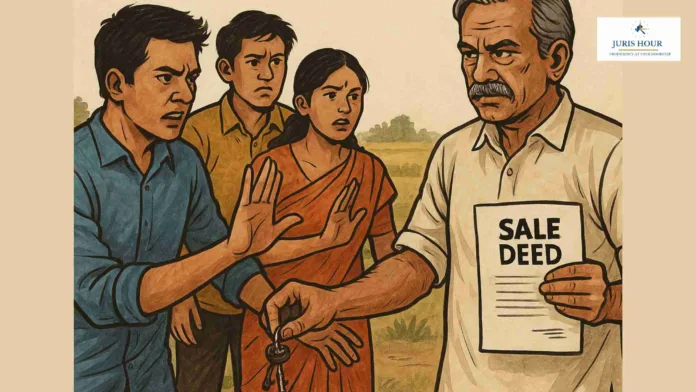
In a landmark judgment poised to impact countless property disputes across the country, the Supreme Court has held that property received by a coparcener through a partition in a joint Hindu family becomes self-acquired property, thereby granting the holder absolute rights of disposal—including sale—without requiring consent from other family members.
The apex court was adjudicating a long-standing legal battle that began over three decades ago in Karnataka, centered around a property located near Bengaluru. The dispute arose when one of three brothers, all members of a joint Hindu family, sold a portion of property that originally belonged to their father. His four children challenged the transaction, asserting that the land in question was ancestral in nature and that, as coparceners, they had a birthright to it.
The children argued that their grandfather’s property could not be alienated by their father unilaterally, maintaining that the ancestral nature of the land conferred legal entitlements upon them. In contrast, the father contended that the property was rightfully his self-acquired asset following a lawful partition among his siblings in 1986, and that he had financed its purchase using a loan, not joint family funds.
The matter passed through several judicial forums over the years. The trial court initially sided with the children, declaring the land ancestral. This decision was overturned by the first appellate court, which held the property to be self-acquired. The High Court later reinstated the trial court’s findings. Ultimately, the Supreme Court reversed the High Court’s decision, restoring the ruling of the first appellate court.
Delivering the verdict, the Supreme Court clarified the legal position:
“While it is not in dispute that the properties were originally joint family properties, upon partition, each coparcener receives a defined and separate share. Under Hindu law, such a share becomes the exclusive property of the individual, with absolute rights of alienation including sale, gift, lease, or bequest.”
The Court also observed that the plaintiffs (the children) had not contested the validity of the partition deed executed on May 9, 1986, which clearly conferred exclusive rights over the allotted shares. Furthermore, it noted that the sale proceeds were used for the welfare of the family and the property in question was acquired through an external loan, not family funds—further reinforcing its self-acquired status.
“Defendant No.1 acquired the suit property using funds borrowed from Narasimhamurthy, not from any joint family income. Therefore, the property is rightly classified as his self-acquired property,” the judgment stated.
Concluding the matter, the Court declared the father’s sale of the property to be legally valid and enforceable, setting a significant precedent in the interpretation of Hindu property law.
Case Details
Case Title: ANGADI CHANDRANNA VERSUS SHANKAR & ORS.
Case No.: CIVIL APPEAL NO. 5401 OF 2025
Date: 22/04/2025

