
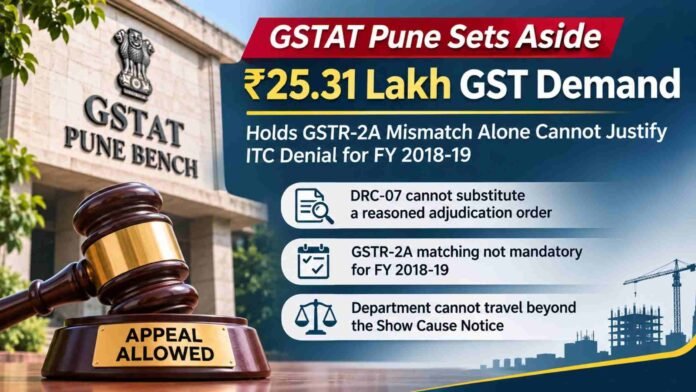
The Goods and Services Tax Appellate Tribunal (GSTAT), Pune Bench, has set aside a GST demand of ₹25,31,424, holding that mere mismatch between Input Tax Credit (ITC) claimed in GSTR-3B and the credit reflected in GSTR-2A cannot, by itself, justify denial of ITC for FY 2018-19.
The bench of Shridhar Mahadeo Bhosale (Judicial Member) and Dr. Nirmal Kumar Soren (Technical Member) ruled that FORM GST DRC-07, being merely a summary of an adjudication order, cannot substitute the mandatory reasoned order required under Sections 73(9) and 75(6) of the CGST Act, 2017.
Buy Now: E-Handbook: Draft Replies to GST Notices On 40+ Issues
The appellant, engaged in construction and works-contract activities, was subjected to scrutiny of GST returns for FY 2018-19. During verification, the department noticed that ITC of ₹14,21,833 had been claimed in GSTR-3B/GSTR-9 but was not reflected in GSTR-2A or Table 8A of GSTR-9.
The department also alleged short disclosure of Reverse Charge Mechanism (RCM) liability amounting to ₹3,560.
Accordingly, the Deputy Commissioner of State Tax issued FORM GST DRC-07 dated October 20, 2022, raising a total demand of ₹25,31,424, comprising tax of ₹14,25,392, interest of ₹9,63,494 and penalty of ₹1,42,538.
The Joint Commissioner of State Tax (Appeal), Kolhapur Division, subsequently rejected the taxpayer’s appeal through an order dated July 2, 2025, thereby confirming the demand.
Aggrieved by the appellate order, the taxpayer approached GSTAT Pune.
The appellant primarily challenged the demand on the ground that the adjudicating authority had failed to pass an independent and reasoned order under Section 73(9) read with Section 75(6) of the CGST Act.
It was submitted that the department had merely uploaded the original Show Cause Notice along with FORM GST DRC-07 without passing a separate speaking order containing relevant facts, findings and reasons for determining the tax liability.
The appellant further argued that the original Show Cause Notice was confined to the alleged mismatch between GSTR-3B and GSTR-2A. However, the First Appellate Authority subsequently relied upon additional grounds, including retrospective cancellation of the supplier’s GST registration and non-filing of statutory returns, which were never specifically incorporated into the original notice.
On the substantive issue of ITC, the appellant contended that GSTR-2A matching was not an independent mandatory condition for claiming ITC during FY 2018-19. It pointed out that Rule 36(4) of the CGST Rules became effective only from October 9, 2019, while Section 16(2)(aa) came into force from January 1, 2022.
The appellant also relied upon Circular No. 183/15/2022-GST and the Supreme Court’s decision in Union of India v. Bharti Airtel Ltd., contending that mere non-reflection of invoices in GSTR-2A could not automatically result in denial of ITC.
It was further argued that genuine transactions supported by tax invoices, banking records and proof of receipt of supplies could not be disregarded merely because of subsequent defaults by suppliers.
The department defended the demand by submitting that the taxpayer had failed to establish its eligibility for the disputed ITC under Section 16(2) of the CGST Act.
The department argued that the difference between GSTR-3B and GSTR-2A required proper reconciliation and that the taxpayer had failed to establish whether the corresponding tax had actually been paid to the Government.
Reliance was also placed upon Sections 16(2)(c) and 155 of the CGST Act, contending that the burden of proving ITC eligibility rests upon the taxpayer claiming such credit.
The department further argued that the alleged procedural defects could not invalidate the proceedings in view of Section 160 of the CGST Act.
The Tribunal observed that Section 73(9) requires the proper officer to determine the amount of tax, interest and penalty payable after considering the taxpayer’s representation.
Further, Section 75(6) mandates that the adjudication order must set out the relevant facts and the basis of the decision.
The Tribunal noted that Rule 142(5) separately provides for uploading a summary of the adjudication order in FORM GST DRC-07.
However, the summary merely communicates the result of adjudication and cannot replace the underlying reasoned decision.
Upon examining the DRC-07 dated October 20, 2022, the Tribunal found that it contained no invoice-wise findings, no evaluation of the conditions prescribed under Section 16, no reasons for rejecting the taxpayer’s explanation and no proper computation explaining the interest liability.
Despite a specific challenge, the department failed to produce a distinct speaking adjudication order under Section 73(9).
The Tribunal accordingly held that the mandatory reasoned determination had not been shown to exist.
Rejecting the department’s reliance upon Section 160 of the CGST Act, the Tribunal observed that the provision protects proceedings against mistakes, defects or omissions only when such proceedings are substantially in conformity with the requirements and objectives of the Act.
The Bench held that the absence of the very reasoned order contemplated under Sections 73(9) and 75(6) is a substantive failure and not merely a clerical defect.
It further observed that the First Appellate Authority’s subsequent reasoning cannot retrospectively create an adjudication order that the proper officer was legally required to pass.
One of the significant findings concerned the applicability of GSTR-2A matching requirements to ITC claims pertaining to FY 2018-19.
The Tribunal observed that Section 16(2)(aa) was not applicable during the relevant financial year. Similarly, the restriction under Rule 36(4), which became operational from October 9, 2019, could not be applied retrospectively.
Referring to the Supreme Court’s decision in Union of India v. Bharti Airtel Ltd., the Tribunal observed that GSTR-2A served as a facilitative mechanism for informed self-assessment under the prevailing regime.
The Bench further referred to CBIC Circular No. 183/15/2022-GST, which prescribes invoice-wise verification for differences between GSTR-3B and GSTR-2A for FY 2017-18 and FY 2018-19.
The Tribunal clarified that the circular does not dispense with the statutory conditions under Section 16(2)(a), (b) and (c). Equally, it does not permit automatic denial of ITC merely because of a mismatch between the returns.
The Bench observed, “A comparison of returns may justify inquiry under Section 61, but cannot, without more, prove that credit was wrongly availed under Section 16.”
However, the Tribunal also clarified that it was not holding the entire disputed ITC to be automatically admissible. The taxpayer must still establish fulfilment of the conditions prescribed under Section 16, and the burden under Section 155 remains upon the claimant.
The Tribunal found an independent legal infirmity in the manner in which the First Appellate Authority had confirmed the demand.
The original Show Cause Notice alleged excess ITC claimed in GSTR-3B/GSTR-9 that was not reflected in GSTR-2A or Table 8A of GSTR-9.
However, the appellate authority additionally relied upon information concerning retrospective cancellation of the supplier’s registration and non-filing of GSTR-1 and GSTR-3B.
The Tribunal observed that these additional grounds were not incorporated in the original Show Cause Notice.
Referring to Section 75(7) of the CGST Act, the Bench held that no demand can be confirmed on grounds other than those specified in the notice.
The Tribunal also relied upon the Supreme Court’s decision in Commissioner of Customs v. Toyo Engineering India Ltd., (2006) 7 SCC 592, reiterating that the Revenue cannot travel beyond the Show Cause Notice.
It further observed that retrospective cancellation of a supplier’s registration, without examination of the cancellation order and its circumstances, does not automatically establish that the purchaser acted improperly at the time of the transaction.
The Tribunal also examined the interest component of ₹9,63,494.
It noted that interest had been calculated at 24% from the date of ITC claim.
Referring to Section 50(3) of the CGST Act, as retrospectively amended with effect from July 1, 2017, the Tribunal observed that the applicable notified interest rate was 18% and that the provision concerns ITC wrongly availed and utilised.
The department had failed to produce an electronic credit ledger-based determination establishing utilisation of the disputed ITC or a legally intelligible computation of interest.
Accordingly, the interest calculation was held unsustainable.
The penalty of ₹1,42,538 was also held consequential to a determination that had not been lawfully made.
The Tribunal considered whether the matter should be remanded for fresh adjudication.
It referred to Section 113(1) of the CGST Act, which empowers the Tribunal to remand matters, and Section 75(3), which provides a separate time prescription for orders passed pursuant to appellate directions.
However, considering the peculiar facts, the Bench declined to remand the proceedings.
It observed that remanding the matter to sustain the ITC demand on newly discovered grounds would effectively permit the department to reconstruct the Show Cause Notice on an entirely different factual foundation, contrary to Section 75(7).
The Tribunal therefore exercised its discretion to annul the impugned determination rather than direct a fresh inquiry.
Membership Required to Access Case Details & Order Copy
To view the complete Case Details and Download Order Copy, you must have an active membership. Please subscribe to continue.

