
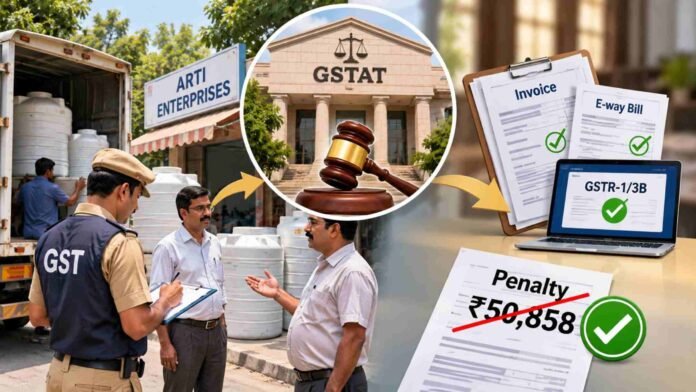
The GST Appellate Tribunal (GSTAT) Prayagraj, has held that mere violation of procedural requirements under Rules 138 and 138A of the CGST/UPGST Rules, 2017, does not automatically justify a penalty under Section 129.
The bench of Mahtab Ahmad (Judicial Member) and Ashish Varma (Technical Member) observed that intention to evade tax must be reasonably established and set aside the detention proceedings after finding that the transaction was genuine and the tax liability had been duly discharged.
Buy Now: All 200+ GSTAT Judgements Till November 2026 | Comprehensive E-Magazine
The appellant/assessee challenged the detention of goods under Section 129 of the UPGST/CGST Act, 2017.
The dispute arose on June 11, 2025, when the State Tax Mobile Squad intercepted a vehicle bearing registration No. UP70NT3682 at the premises of M/s Arti Enterprises, Shastri Nagar, Koraon, Prayagraj, while goods (cisterns) were being unloaded.
At the time of interception, the driver produced an e-tax invoice issued by M/s Birlanu Limited, an e-way bill and a transport bilty. The value of the consignment was ₹1,66,698.
The tax authorities noticed that the invoice and e-way bill reflected M/s Mishra Pipe Company as the recipient, whereas the goods were being unloaded at the premises of M/s Arti Enterprises. Considering the difference between the declared recipient’s business address and the actual delivery location, the authorities alleged contravention of Section 31 and Rules 46, 138 and 138A of the GST Rules.
Accordingly, proceedings were initiated under Section 129(3), resulting in a penalty of ₹50,858.
Before the Tribunal, the appellant explained that the goods had been purchased from M/s Birlanu Limited against a supply order received from M/s Arti Enterprises, which was a regular customer.
It was submitted that the appellant was acting as an intermediary trader and had arranged for the goods to be delivered directly to its customer. The driver was instructed to first visit the appellant’s business premises to collect the onward tax invoice and e-way bill issued in favour of M/s Arti Enterprises.
However, the driver proceeded directly to the customer’s premises and commenced unloading without collecting the onward documents.
The appellant further explained that the original supplier’s invoice and transport bilty already reflected Shastri Nagar, Koraon, as the place of supply. The appearance of the appellant’s business address in the e-way bill was attributed to the system automatically populating the registered address against the recipient’s GSTIN.
Importantly, the appellant had subsequently produced its own tax invoice and e-way bill issued in favour of M/s Arti Enterprises on the same date.
The Tribunal rejected the appellant’s contention that Section 129 could not be invoked because the vehicle was stationary and the goods were being unloaded.
It observed that the transit of goods begins when they are loaded onto a vehicle for transportation and concludes only when the goods are unloaded and delivered to the recipient at the destination.
Therefore, merely because the vehicle had stopped at the recipient’s premises, the goods could not be considered to have ceased to be in transit while unloading was still underway.
The Tribunal examined the relationship between Section 129 and Section 130 of the CGST/UPGST Act and observed that although Section 129 does not expressly use the words “intention to evade tax”, the existence of such intention is intrinsic to the provision when determining the imposition of penalty.
It observed that the penalty under Section 129 is linked to the tax payable on the goods. Where the documents and surrounding circumstances establish that the tax payable has been discharged and there is no possibility of tax evasion, a penalty cannot be imposed merely because of a procedural discrepancy.
The Tribunal emphasised that the authorities must examine the facts and circumstances of each case to determine whether there was an actual intention to evade tax.
The Tribunal reiterated the principle that mere technical errors cannot automatically result in the imposition of penalties and that the presence of mens rea for tax evasion is essential.
It also distinguished cases where goods were not accompanied by invoices or e-way bills, observing that such circumstances may raise a rebuttable presumption of tax evasion. In the present case, the consignment was accompanied by the original supplier’s tax invoice, e-way bill and transport bilty.
A significant factor considered by the Tribunal was the evidence establishing the genuineness of the onward supply.
The appellant produced its e-tax Invoice No. MPC/1231 dated June 10, 2025, issued to M/s Arti Enterprises.
The Tribunal noted that the onward supply was duly reported in the appellant’s GSTR-1 return for June 2025 as a B2B transaction. The corresponding output tax liability was discharged through the valid monthly GSTR-3B return. The appellant produced the ledger of M/s Arti Enterprises and its Bank of Baroda bank statement. Payments were received through banking channels, including NEFT and UPI, in multiple instalments between June 2025 and August 2025.
The Tribunal observed that these documents established the genuineness of the commercial transaction and demonstrated that the State had suffered no revenue loss.
It further observed that the transaction appeared to be a genuine third-party/transit supply, wherein the appellant procured goods from the original supplier for onward delivery to its customer.
Although the appellant generated its onward tax invoice and e-way bill at 09:36 AM, after the vehicle had been intercepted at 08:30 AM, the Tribunal accepted the explanation that the driver’s failure to collect the onward documents was an isolated human error.
Considering the documentary evidence, banking transactions, GST returns and the explanation furnished by the appellant, the Tribunal concluded that there was no intention to evade tax.
It held that the action initiated by the Proper Officer under Section 129(3) and subsequently confirmed by the First Appellate Authority could not be sustained.
Accordingly, the GSTAT allowed the appeal and set aside both the Order-in-Original dated June 12, 2025, and the Order-in-Appeal dated September 8, 2025.
The demand raised under the impugned orders was quashed, and the Tribunal directed the Revenue to refund the penalty amount of ₹50,858 along with statutory interest forthwith.
Membership Required to Access Case Details & Order Copy
To view the complete Case Details and Download Order Copy, you must have an active membership. Please subscribe to continue.

