
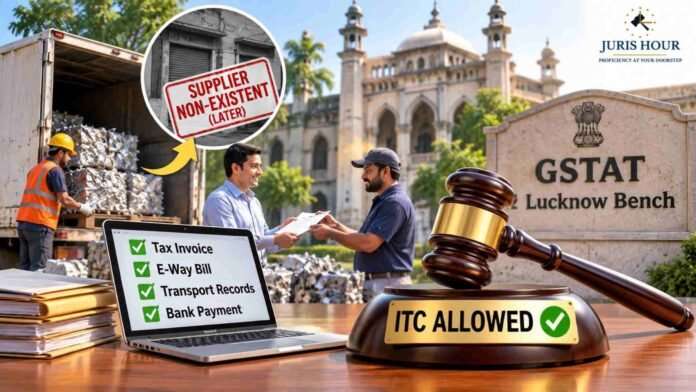
The GST Appellate Tribunal (GSTAT), Lucknow Bench rules that subsequent cancellation of supplier’s GST registration cannot retrospectively invalidate Input Tax Credit when purchases are supported by tax invoices, E-Way Bills, transport records and banking transactions; proceedings under Section 74 quashed in absence of fraud or suppression.
The Bench of Narendra Kumar (Judicial Member) and Alok Chopra (Technical Member) held that ITC cannot be denied to a bona fide purchasing dealer merely because the supplier was found non-existent during a subsequent inspection conducted more than two years after the transactions.
The Tribunal observed that the genuineness of purchases and actual movement of goods had been established through tax invoices, E-Way Bills, transporter records, transportation certificates and banking transactions.
The dispute arose when the GST Department denied ITC to a registered dealer engaged in trading ferrous and non-ferrous metals and aluminium scrap at Kanpur.
During November 2019 to January 2020, the taxpayer purchased aluminium scrap (NSR 7602) from M/s Dandi Disposal, a supplier registered under GST and shown as active on the GST portal at the time of the transactions.
The purchases were supported by nine tax invoices issued between November 2019 and January 2020, amounting to ₹12,36,160. The taxpayer made payments through banking channels and maintained the relevant E-Way Bills, transport receipts and other supporting documents.
However, on 04 February 2022, more than two years after the transactions, the GST Department conducted an inspection at the supplier’s registered premises and allegedly found the supplier non-existent. Subsequently, the supplier’s GST registration was cancelled with effect from 11 April 2023.
Relying upon the inspection report, the department initiated proceedings and passed a demand order dated 18 January 2024 under Section 74 of the UPGST Act, 2017, disallowing ITC of ₹1,54,196.10, imposing an equivalent penalty and levying interest of ₹1,48,028.16.
The First Appellate Authority also rejected the taxpayer’s appeal through an order dated 25 October 2024, prompting the taxpayer to approach GSTAT.
The taxpayer contended that all statutory conditions prescribed under Section 16(2) of the UPGST Act had been fulfilled.
It was submitted that the supplier was duly registered and active on the GST portal during the relevant period and that the taxpayer had verified the supplier’s registration before entering into the transactions.
The taxpayer produced all nine tax invoices, E-Way Bills, banking records, GSTR-2A, GSTR-3B returns and transporter documents to establish the genuineness of the purchases.
Further, a Transportation of Goods Certificate dated 4 March 2024 issued by M/s The Bharat Goods Carriers was furnished, confirming the actual transportation of goods from Allahabad to Kanpur.
The taxpayer also explained that the alleged discrepancies in the delivery slips, including missing vehicle numbers and signatures, were minor clerical omissions and could not override the substantial documentary evidence establishing the actual movement of goods.
The Tribunal examined the documentary evidence uploaded by the taxpayer and observed that the taxpayer had successfully discharged its burden under Section 155 of the UPGST Act.
It noted that all nine tax invoices issued by M/s Dandi Disposal between 1 November 2019 and 18 January 2020 were produced before the Tribunal. The total invoice value of ₹12,36,160 had been paid through banking transactions.
The Tribunal also examined the E-Way Bills generated on the GST portal and found that they contained the supplier’s and recipient’s GSTINs, dispatch details, vehicle numbers and corresponding transport documents.
Importantly, the Tribunal distinguished the present case from M/s Malik Traders v. State of U.P., where transporter-level evidence was absent.
In the present matter, the taxpayer had furnished a Transporter’s Ledger and a dedicated Transportation of Goods Certificate confirming transportation of all nine consignments, corresponding to GR/Bilty numbers.
The Tribunal held that the minor discrepancies in individual delivery slips could not outweigh the contemporaneous E-Way Bills, transporter records and transportation certificate.
One of the significant findings of the Tribunal concerned the effect of subsequent cancellation of the supplier’s GST registration.
The Tribunal noted that M/s Dandi Disposal was registered under GST from 1 July 2017 and remained active during November 2019 to January 2020, when the disputed transactions took place.
The physical inspection was conducted only on 4 February 2022, whereas the supplier’s registration was cancelled with effect from 11 April 2023.
Relying upon judicial precedents, including Commissioner, Trade & Tax, Delhi v. Shanti Kiran India (P) Ltd., the Tribunal observed that a purchasing dealer cannot be expected to foresee the subsequent existence or non-existence of a supplier over whom the dealer exercises no statutory control.
It further held that where the purchasing dealer has acted in good faith, verified the supplier’s GST registration, made payments through banking channels and maintained transportation documents, ITC cannot be denied merely because the supplier was found non-existent during a subsequent inspection or its registration was cancelled later.
The Tribunal also referred to decisions in M/s Saniya Traders, M/s Khurja Scrap Trading Company, M/s Sanghai Iron Traders and M/s Solvi Enterprises in support of its findings.
The Tribunal further examined whether the department was justified in invoking Section 74 of the UPGST Act, 2017.
It observed that Section 74 can be invoked only where tax has not been paid, short-paid or ITC has been wrongly availed or utilised by reason of fraud, wilful misstatement or suppression of facts with intent to evade tax.
In the present case, neither the original demand order nor the first appellate order recorded any specific finding of fraud, collusion, wilful misstatement or suppression of facts attributable to the taxpayer.
On the contrary, the taxpayer had disclosed all purchases in its returns, verified the supplier’s active GSTIN, made payments through banking channels and submitted supporting documentary evidence.
The Tribunal held that the foundational ingredients necessary for invoking Section 74 were absent. Consequently, the initiation of proceedings under Section 74 and the imposition of penalty were held to be wholly unsustainable in law.
It also observed that the consequential levy of interest under Section 50 automatically fell when the principal demand and ITC reversal were found unsustainable.
Membership Required to Access Case Details & Order Copy
To view the complete Case Details and Download Order Copy, you must have an active membership. Please subscribe to continue.

