
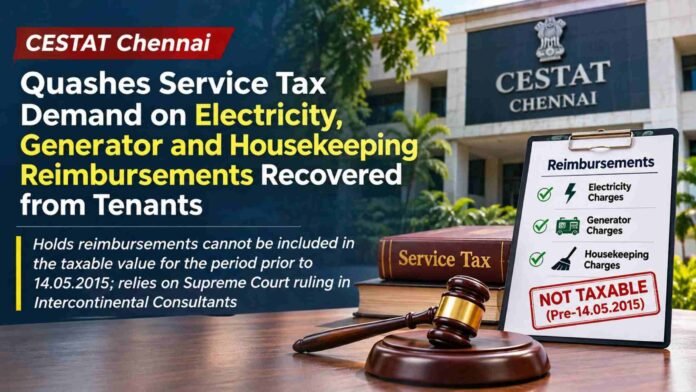
The Customs, Excise and Service Tax Appellate Tribunal (CESTAT), Chennai held that reimbursements collected from tenants towards electricity, generator and housekeeping charges cannot automatically be included in the taxable value of renting of immovable property services for the period prior to May 14, 2015, and quashed the entire demand along with interest and penalties.
The bench of P. Dinesha (Judicial Member) and M. Ajit Kumar (Technical Member) held that such reimbursements could not be subjected to service tax merely because they were recovered by the service provider, particularly when the demands related to a period prior to the amendment to Section 67 of the Finance Act, 1994, effective from May 14, 2015.
Buy Now: Indirect Tax Judgments E-Compilation – October 2026
The Tribunal relied upon the landmark ruling of the Delhi High Court in Intercontinental Consultants and Technocrats Pvt. Ltd. v. Union of India, which was subsequently affirmed by the Supreme Court, holding that Rule 5(1) of the Service Tax (Determination of Value) Rules, 2006, could not expand the scope of taxable value beyond what was authorised under Section 67 of the Finance Act, 1994.
The appellant/assessee was engaged in providing Renting of Immovable Property Service and was registered with the Service Tax Department.
During an audit, the Department noticed that the company had collected electricity charges from the Tamil Nadu Electricity Board, fixed generator charges and housekeeping charges from its tenants.
However, the company had not included electricity and generator charges in the taxable value for payment of service tax. Further, service tax had not been discharged on housekeeping charges, which the Department considered taxable under Maintenance or Repair Service in terms of Section 65(64) of the Finance Act, 1994.
The Adjudicating Authority confirmed the demands along with interest but refrained from imposing penalties.
The company challenged the demands before the Commissioner (Appeals), while the Department filed an appeal seeking imposition of penalties under Sections 76 and 78 of the Finance Act, 1994.
The Commissioner (Appeals) rejected the company’s appeal and allowed the Department’s appeal, imposing penalty under Section 78 in respect of the Show Cause Notice dated September 13, 2010 and under Section 76 in respect of the Show Cause Notice dated April 8, 2011.
Aggrieved by the order, the company approached the CESTAT, Chennai.
The appellant submitted that the entire demand related to reimbursements of expenses collected from tenants on an actual basis.
It was argued that the Show Cause Notices had invoked Section 67(1) of the Finance Act, 1994, read with Rule 5 of the Service Tax (Determination of Value) Rules, 2006, for including such reimbursements in the taxable value.
The appellant contended that the definition of consideration under Section 67 was specifically amended with effect from May 14, 2015, to include reimbursable expenditure or costs incurred by a service provider and charged in the course of providing taxable services.
Prior to this amendment, such reimbursements were not specifically included in the statutory definition.
The appellant further highlighted that similar demands for subsequent periods had already been dropped in its own case through Order-in-Original No. 18-22/2022 dated March 16, 2022, which was upheld by the Commissioner (Appeals) through Order-in-Appeal No. 190/191/2023 dated April 28, 2023.
The Department had not challenged those orders before the higher appellate forum.
Accordingly, it was argued that the Department had accepted the non-taxability of such reimbursements for the relevant pre-amendment period.
The department argued that maintenance and housekeeping charges collected from tenants were taxable under Section 65(64) of the Finance Act, 1994.
It was further submitted that all expenditure and costs incurred by the service provider in the course of providing taxable services formed part of the taxable consideration, irrespective of whether individual components were separately indicated in the invoices.
The Department also pointed out that the appellant had obtained an electricity connection from the Tamil Nadu Electricity Board and installed DG sets to provide power facilities to its tenants.
Since electricity charges were accounted for as ‘other income’ in the Profit and Loss Account, Revenue contended that these amounts were liable to be included in the taxable value of Renting of Immovable Property Service.
The Department accordingly sought dismissal of the appeals.
The Tribunal identified the central issue as whether reimbursements received from tenants towards electricity charges and housekeeping services could be included in the taxable value of the services provided by the appellant.
The Tribunal examined Rule 5(1) of the Service Tax (Determination of Value) Rules, 2006, which provided for the inclusion of expenditure or costs incurred by the service provider in the course of providing taxable services.
It also examined the scope of Section 67 of the Finance Act, 1994, as it stood during the relevant period.
The Tribunal observed that Section 66 levied service tax on the value of taxable services, while Section 67, during the material period, confined valuation to the gross amount charged for such services.
The Tribunal noted that Section 67 was subsequently amended by Section 111 of the Finance Act, 2015, with effect from May 14, 2015, to expressly include reimbursable expenditure or costs incurred by the service provider and charged to the recipient in the course of providing taxable services.
The Tribunal placed significant reliance on Intercontinental Consultants and Technocrats Pvt. Ltd. v. Union of India, reported in 2013 (29) S.T.R. 9 (Del.), which was affirmed by the Supreme Court in 2018 (10) G.S.T.L. 401 (S.C.).
In the said decision, it was held that Rule 5(1), insofar as it sought to include expenditure or costs that did not constitute consideration for the taxable service, travelled beyond the scope of Section 67 and was ultra vires Sections 66 and 67 of the Finance Act, 1994.
The Supreme Court also held that the subsequent amendment to Section 67 was substantive in nature and not merely clarificatory or declaratory. Consequently, the amendment operated prospectively.
The Tribunal observed that for the period prior to 14.05.2015, reimbursable expenditure could not be included in the taxable value merely by invoking Rule 5(1), unless it constituted consideration for the taxable service under the unamended Section 67.
The Tribunal further observed that in the absence of any contractual obligation or agreed consideration towards the reimbursement charges, such amounts could not be subjected to service tax merely because they were recovered by the appellant from its tenants.
Since the entire period of demand in the present dispute preceded the amendment to Section 67, the ratio of the Supreme Court’s decision squarely applied.
The tribunal held that the demands raised on reimbursements towards electricity, generator and housekeeping charges were unsustainable.
The Tribunal accordingly quashed the service tax demands along with consequential interest and penalties and allowed both appeals.
Membership Required to Access Case Details & Order Copy
To view the complete Case Details and Download Order Copy, you must have an active membership. Please subscribe to continue.
Read More: Penalty U/s 114A of Customs Act Can’t Include Both Duty and Interest: CESTAT

