
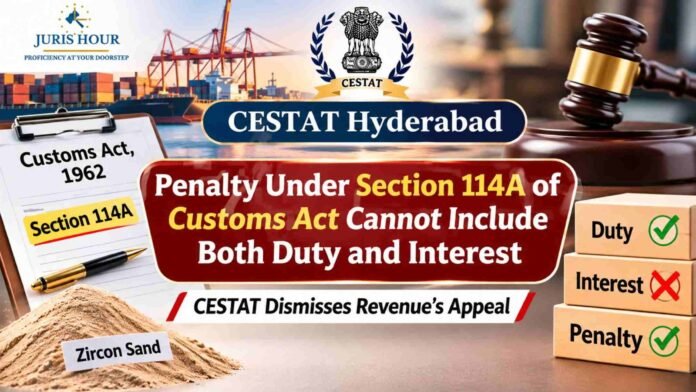
The Customs, Excise and Service Tax Appellate Tribunal (CESTAT), Hyderabad while relying on Karnataka High Court’s ruling in Sony Sales Corporation, held that the expression “duty or interest” under Section 114A of the Customs Act, 1962, cannot be interpreted as “duty and interest” merely on the basis of a CBEC Circular.
The bench of Angad Prasad (Judicial Member) and Sanjiv Srivastava (Technical Member) affirmed that the statutory expression “or” cannot be substituted with “and” to enlarge the scope of the penalty provision.
Buy Now: Indirect Tax Judgments E-Compilation – October 2026
The dispute arose from the import of Zircon Sand by the respondent/importer. The company classified the imported goods as ore and claimed the benefit of the duty exemption under Sl. No. 4 of Notification No. 04/2006-CE dated March 1, 2006, as amended, corresponding to Sl. No. 56 of Notification No. 12/2012-CE dated March 17, 2012.
Accordingly, the importer claimed a Nil rate of additional customs duty equivalent to excise duty, commonly known as Countervailing Duty (CVD).
However, following investigations conducted by the Directorate of Revenue Intelligence (DRI), the Department disputed the exemption claimed by the importer and issued a Show Cause Notice dated June 20, 2015, demanding customs duty of ₹76,82,860 along with applicable interest under Section 28AA and penalty under Section 114A of the Customs Act, 1962.
The adjudicating authority held that the exemption was not admissible and confirmed the demand of CVD amounting to ₹76,82,860 under Section 28(4) of the Customs Act, along with interest and an equivalent penalty under Section 114A.
The Revenue, however, was aggrieved by the fact that the adjudicating authority had not included the interest component while calculating the penalty under Section 114A.
The Department filed an appeal before CESTAT, contending that the penalty under Section 114A should be equivalent to the aggregate amount of customs duty and interest payable.
In support of its contention, the Revenue relied upon CBEC Circular No. 61/2002-CUS dated September 20, 2002, which clarified that the penalty under Section 114A should be equivalent to the duty and interest.
According to the Revenue, the adjudicating authority had therefore erred in restricting the penalty to the amount of duty alone.
Before the Tribunal, the respondent submitted that the substantive issue concerning the classification of Zircon Sand was pending consideration before the Supreme Court and requested that the matter be taken up only after the Supreme Court’s decision.
However, CESTAT observed that the Revenue’s appeal was not concerned with the classification of Zircon Sand or the admissibility of the exemption. The appeal was confined to the quantification of penalty under Section 114A of the Customs Act.
Accordingly, the Tribunal proceeded to examine the limited question concerning the computation of penalty.
The Tribunal rejected the Revenue’s contention by relying upon the decision of the Karnataka High Court in Sony Sales Corporation v. Commissioner of Customs, reported in 2021 (376) ELT 472 (Kar.).
The Karnataka High Court had examined the language of Section 114A and observed that the provision uses the expression “duty or interest” and not “duty and interest”.
The High Court held that the expression “or” is disjunctive and cannot be interpreted as “and”. The provision contemplates two different situations: one in which a person is liable to pay duty and another in which a person may be liable to pay interest alone.
Consequently, a person liable to duty would be liable to penalty equivalent to the duty, whereas a person liable to interest would be liable to penalty equivalent to the interest, as applicable.
The High Court further observed that the statutory language was plain and unambiguous and that the CBEC Circular dated September 20, 2002, could not override or run contrary to the express language of the statutory provision.
The High Court had also referred to the Constitution Bench decision of the Supreme Court in Indore Development Authority v. Manohar Lal, AIR 2020 SC 1496, while explaining the principles of statutory interpretation.
CESTAT further noted that the legal position laid down by the Karnataka High Court had subsequently been followed by the Allahabad Bench of CESTAT in Commissioner of Customs, Noida v. M/s Titra Trading Pvt. Ltd., Final Order No. 70087/2025 dated March 24, 2025.
Finding the principles laid down in these decisions applicable to the facts of the present case, the Tribunal held that there was no infirmity in the adjudicating authority’s order insofar as it was challenged by the Revenue.
The Hyderabad Bench of CESTAT dismissed the appeal filed by the Revenue and affirmed the impugned order to the extent challenged.
Membership Required to Access Case Details & Order Copy
To view the complete Case Details and Download Order Copy, you must have an active membership. Please subscribe to continue.

