
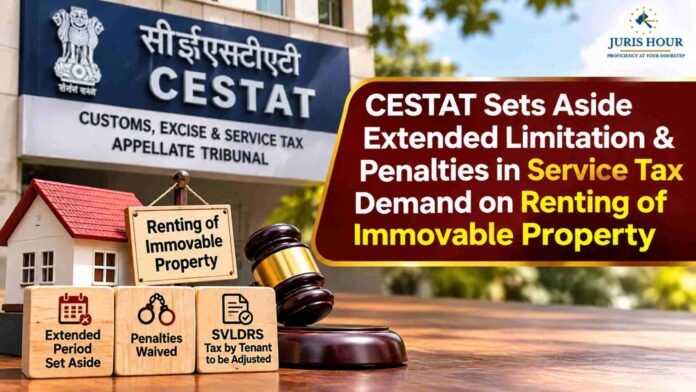
The Customs, Excise and Service Tax Appellate Tribunal (CESTAT), Hyderabad has held that retrospective validation of service tax levy on renting of immovable property does not automatically establish wilful suppression or intention to evade tax. It also directed adjustment of service tax already discharged by Spencer’s Retail Ltd. under SVLDRS to prevent double recovery.
The bench of Angad Prasad (Judicial Member) and Sanjiv Srivastava (Technical Member) has set aside the extended period of limitation and penalties under Sections 77 and 78 of the Finance Act, 1994, in respect of transactions not covered by matters pending before the Supreme Court.
Buy Now: Indirect Tax Judgments E-Compilation – October 2026
The bench directed the department to verify and adjust service tax already discharged by the tenant, M/s Spencer’s Retail Ltd., under the Sabka Vishwas (Legacy Dispute Resolution) Scheme, 2019 (SVLDRS), wherever the payment relates to identical rental transactions.
The appellant was engaged in renting out immovable properties for commercial as well as residential purposes during June 2007 to March 2012.
The department issued a Show Cause Notice dated October 20, 2012, demanding service tax of ₹21,97,155 by invoking the extended period of limitation under the proviso to Section 73(1) of the Finance Act, 1994.
The original adjudicating authority, after allowing certain deductions, determined the differential service tax liability at ₹18,75,490 and appropriated ₹16,80,683 already paid by the appellant. Penalties under Sections 77 and 78 were also imposed.
On appeal, the Commissioner (Appeals) accepted the appellant’s claim for exclusion of premises used for residential purposes, subject to factual verification, and allowed the benefit of cum-tax valuation under Section 67(2). However, the invocation of the extended period of limitation and penalties was substantially upheld.
Aggrieved by the order, the appellant approached CESTAT, Hyderabad.
Before the Tribunal, the appellant submitted that the taxability of renting of immovable property had remained a subject matter of prolonged judicial controversy.
Reliance was placed on the Delhi High Court’s decision in Home Solution Retail India Ltd. v. Union of India [2009 (14) STR 433 (Del)], wherein the Court initially held that mere renting of immovable property was not liable to service tax.
Although retrospective amendments were subsequently introduced through the Finance Act, 2010, and their validity was upheld in subsequent litigation, the appellant contended that the existence of genuine legal uncertainty ruled out allegations of wilful suppression with an intention to evade service tax.
The appellant also submitted that one of the properties had been rented to M/s Great Wholesale Club Ltd./M/s Spencer’s Retail Ltd., Chennai, and that the tenant had discharged service tax under SVLDRS, 2019, pursuant to permission granted by the Supreme Court.
Accordingly, it was argued that the department could not demand the same service tax twice in respect of an identical rental transaction.
The appellant further sought exclusion of residential rental receipts, cum-tax benefit, adjustment of property tax and waiver of penalties under Section 80(1) of the Finance Act, 1994.
The Tribunal observed that although the taxability of renting of immovable property for commercial purposes with effect from June 1, 2007, stood recognised pursuant to the retrospective amendment introduced by the Finance Act, 2010, the validity of the levy and the invocation of the extended period of limitation were two distinct issues.
The Tribunal emphasised that retrospective validation of a levy does not, by itself, establish wilful suppression or an intention to evade payment of tax.
It noted that the issue of taxability of renting of immovable property had witnessed substantial judicial controversy during the relevant period. In such circumstances, mere non-payment or short payment of service tax could not automatically be treated as deliberate suppression of facts.
The Tribunal also referred to the Supreme Court’s decisions in:
- Pushpam Pharmaceuticals Company v. CCE, Bombay [1995 (78) ELT 401 (SC)]
- Continental Foundation Jt. Venture v. CCE, Chandigarh-I [2007 (216) ELT 177 (SC)]
- Uniworth Textiles Ltd. v. CCE, Raipur [2013 (288) ELT 161 (SC)]
These decisions reiterate that invocation of the extended period requires deliberate suppression or wilful conduct contemplated under the statutory provision. Mere omission or non-payment is insufficient.
The Tribunal further relied upon Adani Enterprises v. CST, Ahmedabad (Final Order No. 12428/2023 dated November 2, 2023), Utkal Builders Ltd. v. CCCE & ST, Bhubaneswar-I (Final Order No. 77153/2023 dated September 27, 2023) and Super Electricals v. CCGST & CE, Puducherry (Final Order No. 40444/2025 dated April 17, 2025).
The Tribunal noted that the appellant’s rental transactions were recorded in regular books of accounts and that service tax had been discharged on taxable rental receipts wherever applicable.
It further observed that the demand had been quantified with reference to Income Tax Returns and financial records.
The Tribunal found that, apart from the allegation of short payment, no specific positive act of deliberate concealment or wilful misstatement with an intention to evade tax had been established in the findings placed before it.
Accordingly, the reasoning adopted by the Commissioner (Appeals), which primarily relied upon the fact that the Show Cause Notice was issued after the retrospective amendment, was held insufficient to sustain the extended period of limitation.
However, the Tribunal also noted that issues relating to the levy, including invocation of the extended period in cases involving retrospective validation, were pending consideration before the Supreme Court in Retailers Association of India v. Union of India.
It therefore directed that matters covered by the proceedings before the Supreme Court be decided in accordance with the eventual decision of the Apex Court.
One of the significant issues before the Tribunal concerned service tax discharged by M/s Spencer’s Retail Ltd. under the Sabka Vishwas (Legacy Dispute Resolution) Scheme, 2019.
The appellant relied upon the SVLDRS-4 discharge certificate dated March 15, 2022, relevant challans and the order of the Supreme Court.
The Tribunal referred to its earlier decision in Bommidala Trading Co. Pvt. Ltd. v. CCGST & CE, Guntur (Final Order No. A/30390/2025 dated October 7, 2025), which involved a substantially similar factual situation concerning the same tenant.
The Tribunal observed that payment made by Spencer’s Retail Ltd. in respect of the disputed rental liability could be treated as payment on behalf of the landlord to the extent attributable to the landlord’s rental income.
However, it clarified that the actual amount and period covered by the payment would have to be verified.
The Tribunal categorically held that the same service tax cannot be recovered twice on an identical taxable transaction. Accordingly, wherever it is established that the tax attributable to the appellant’s rental income has already been discharged by the tenant and is covered by the statutory discharge, appropriate adjustment must be granted.
On the issue of residential properties, the Tribunal upheld the finding of the Commissioner (Appeals) that premises rented for residential accommodation were outside the taxable category under the relevant exclusion.
However, the appellant would have to establish the actual residential use of the premises through relevant tenancy agreements and supporting evidence.
The Tribunal directed the original adjudicating authority to extend the benefit without reopening the settled legal issue.
The Tribunal also upheld the availability of cum-tax valuation under Section 67(2) of the Finance Act, 1994.
It directed that admissible deductions on account of property tax and adjustment of service tax already discharged should be considered while determining the correct taxable value and surviving service tax liability.
On the issue of penalties, the Tribunal held that the penalty under Section 78 was not sustainable where the ingredients necessary for invoking the extended period of limitation had not been established.
Regarding Section 77, the Tribunal examined Section 80(1) of the Finance Act, 1994, as applicable during the relevant period.
It observed that Section 80(1) provided relief from penalties under Sections 76, 77 and 78 where reasonable cause for the failure was established.
The Tribunal further clarified that the subsequent omission of Section 80 could not, by itself, justify rejection of a reasonable-cause plea relating to a period when the provision was in force.
Considering that the appellant had disclosed rental transactions in financial records, discharged substantial amounts towards service tax and operated during a period of continuing litigation concerning the levy, the Tribunal held that these circumstances cumulatively constituted reasonable cause under Section 80(1).
Consequently, the penalty under Section 77 was also set aside, insofar as it arose from the defaults forming the subject matter of the proceedings.
Membership Required to Access Case Details & Order Copy
To view the complete Case Details and Download Order Copy, you must have an active membership. Please subscribe to continue.

