
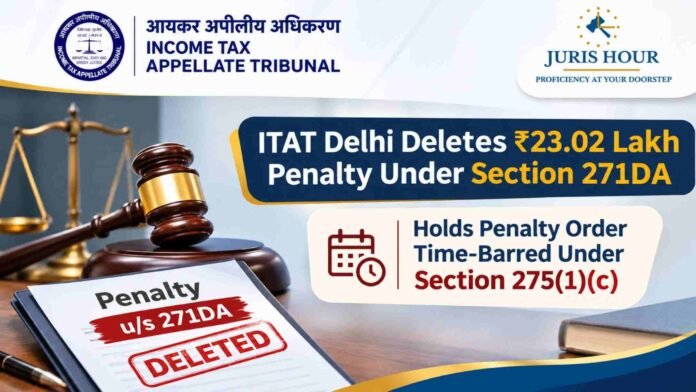
The Delhi Bench of the Income Tax Appellate Tribunal (ITAT) has held that the limitation period for imposing penalty had to be computed from the date on which the Assessing Officer initiated penalty proceedings in the assessment order and not from the subsequent issuance of the penalty notice. Since the penalty order was passed after the prescribed limitation period, the Tribunal deleted the entire penalty.
The bench of Satbeer Singh Godara (Judicial Member) and Naveen Chandra (Accountant Member) deleted a penalty of ₹23,02,500 imposed under Section 271DA of the Income Tax Act, 1961, for alleged violation of Section 269ST, holding that the penalty order was passed beyond the statutory limitation period prescribed under Section 275(1)(c) of the Act.
Buy Now: Direct tax (Income Tax) Judgments E-Magazine October 2026
A search and seizure operation under Section 132 of the Income Tax Act was conducted in the cases of Mr. Samir Modi and Ms. Shivani Modi on February 3, 2021.
Subsequently, assessment proceedings under Section 153C read with Section 143(3) were completed on January 19, 2024, for Assessment Year 2019-20, determining the assessee’s total income at ₹14,75,315.
During the assessment proceedings, the Assessing Officer alleged that Shrine Empire Gallery Pvt. Ltd. had received cash amounting to ₹23,02,500 from Mr. Samir Modi, in contravention of Section 269ST of the Income Tax Act.
Accordingly, penalty proceedings under Section 271DA read with Section 274 were initiated, and the Additional Commissioner of Income Tax imposed a penalty of ₹23,02,500. The Commissioner of Income Tax (Appeals), Delhi-26, upheld the penalty, prompting the assessee to approach the ITAT.
Before the Tribunal, the assessee challenged the penalty on both legal and factual grounds.
The assessee submitted that the alleged cash receipts included ₹5,12,500 forming part of a bona fide sale transaction, which was duly invoiced and partly paid through cheque amounting to ₹2,60,400. It was contended that the transaction arose due to the customer’s insistence on a cash discount and did not warrant the imposition of penalty.
The assessee further argued that the remaining amount of ₹16,52,500 was based entirely on loose Excel sheets and notings recovered from a third-party laptop. According to the assessee, these alleged receipts were non-existent and the material relied upon by the Assessing Officer lacked evidentiary value.
It was also argued that the penalty proceedings under Section 271DA were barred by limitation under Section 275(1)(c) of the Act.
The Tribunal admitted the additional ground challenging limitation, relying upon the Supreme Court’s decision in NTPC Ltd. v. CIT, 229 ITR 383 (SC).
The Tribunal observed that the Assessing Officer had already recorded satisfaction in the assessment order dated January 19, 2024, passed under Section 153C read with Section 143(3), that a reference would be made to the Additional Commissioner for initiation of penalty proceedings under Section 271DA for violation of Section 269ST.
The Tribunal examined Section 275(1)(c), which prescribes the limitation for passing penalty orders in cases not covered by the other clauses of the provision. Under the said provision, the penalty order must be passed within six months from the end of the month in which the action for imposition of penalty is initiated, or by the end of the relevant financial year in which the proceedings are completed, whichever period expires later.
The Tribunal referred to the Delhi High Court’s decision in PCIT v. Thapar Homes Ltd. [2024] 159 Taxmann.com 450 (Delhi HC), wherein it was held that the limitation period for imposing penalty under Section 271DA is to be computed from the date of initiation of penalty proceedings rather than the date of issuance of the penalty notice.
The Tribunal also relied upon the Delhi High Court’s decision in PCIT v. Rishikesh Buildcon (P.) Ltd. [2023] 147 Taxmann.com 220 (Delhi HC), which similarly recognised that the limitation period is to be reckoned from the date on which the Assessing Officer initiates penalty proceedings in the assessment order.
Further, the assessee had relied upon the Supreme Court’s ruling in CIT v. Jai Laxmi Rice Mills, [2015] 379 ITR 521 (SC), along with other Tribunal decisions.
Applying the above legal principles, the Tribunal noted that penalty proceedings under Section 271DA had been initiated by the Assessing Officer in the assessment order dated January 19, 2024.
Accordingly, the statutory period of six months commenced from February 1, 2024, and expired on July 31, 2024.
However, the Additional Commissioner passed the penalty order only on August 30, 2024, clearly beyond the prescribed limitation period.
The Tribunal therefore held that the penalty imposed under Section 271DA was barred by limitation under Section 275(1)(c) of the Income Tax Act.
Consequently, the Tribunal deleted the penalty of ₹23,02,500 and allowed the assessee’s additional ground of appeal.
The Delhi ITAT allowed the appeal filed by Shrine Empire Gallery Pvt. Ltd. and deleted the penalty of ₹23,02,500 imposed under Section 271DA of the Income Tax Act, 1961, on the ground that the penalty order was time-barred.
Membership Required to Access Case Details & Order Copy
To view the complete Case Details and Download Order Copy, you must have an active membership. Please subscribe to continue.

