
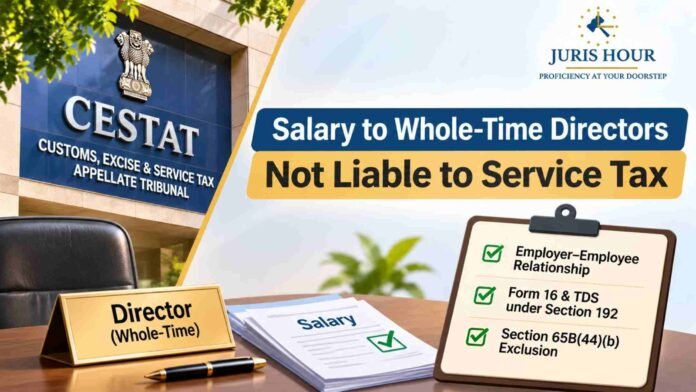
The Customs, Excise and Service Tax Appellate Tribunal (CESTAT), Chennai Regional Bench, has set aside a service tax demand of ₹1,18,656 imposed on a company for remuneration paid to its two whole-time directors during August 2012 to March 2013. The Tribunal held that where an employer-employee relationship is established, remuneration paid to directors for services rendered in the course of employment falls outside the definition of taxable service under the Finance Act, 1994.
The bench of Ajayan T.V. (Judicial Member) and Vasa Seshagiri Rao (Technical Member) has observed that the remuneration paid to whole-time directors in the capacity of employees is excluded from the definition of ‘service’ under Section 65B(44)(b) of the Finance Act, 1994, and cannot be subjected to reverse charge merely because the recipients are directors of the company.
Buy Now: Indirect Tax Judgments E-Compilation – October 2026
The dispute arose when an audit of the company’s accounts revealed that it had paid remuneration aggregating to ₹9,60,000 to its two directors during the period August 2012 to March 2013 without discharging service tax.
The remuneration comprised ₹60,000 per month to each of the two directors, namely ₹4,80,000 each over eight months.
The Department treated the payments as consideration for services rendered by the directors to the company and sought to recover service tax under the reverse charge mechanism in terms of Rule 2(1)(d)(EE) of the Service Tax Rules, 1994, read with Sl. No. 5A of Notification No. 30/2012-ST dated 20 June 2012.
A Show Cause Notice dated 7 November 2014 proposed a demand of ₹1,18,656, including service tax of ₹1,15,200 along with applicable cesses, interest and penalties. The Department also alleged suppression of the relevant remuneration in the ST-3 returns and invoked the extended period of limitation.
The company contended that both directors were its full-time employees and that the remuneration was paid in consideration of their employment and contribution towards the company’s day-to-day affairs.
It relied upon a Board Resolution dated 10 July 2009, which sanctioned consolidated monthly remuneration of ₹60,000 to each director.
The company also produced Form 16 certificates issued to both directors, evidencing deduction of tax at source under Section 192 of the Income Tax Act, 1961, applicable to salary payments.
It was further submitted that the directors had declared the amounts as salary in their respective income tax returns.
Accordingly, the company argued that the payments were covered by the exclusion under Section 65B(44)(b) of the Finance Act, 1994, which excludes services provided by an employee to an employer in the course of or in relation to employment.
The adjudicating authority rejected the company’s explanation and confirmed the service tax demand along with interest.
It imposed a penalty of ₹1,18,656 under Section 78 and another penalty of ₹10,000 under Section 77(2) of the Finance Act, 1994.
The authority reasoned that the directors held qualification shares in the company and were therefore owners rather than employees. It also relied upon provisions of the Articles of Association relating to the directors’ powers and retirement by rotation.
Further, it relied upon the Supreme Court decision in Regional Director, ESI Corporation v. Ramanuja Match Industries, observing that an individual could not simultaneously act as master and servant.
The Commissioner (Appeals) subsequently upheld the demand, holding that the company had not produced any fresh evidence to warrant interference with the adjudicating authority’s findings.
The Tribunal observed that Section 65B(44) of the Finance Act, 1994 defines service as an activity carried out by one person for another for consideration.
However, clause (b) specifically excludes services provided by an employee to an employer in the course of or in relation to employment.
The Tribunal clarified that Rule 2(1)(d)(EE) of the Service Tax Rules, 1994 and Sl. No. 5A of Notification No. 30/2012-ST merely identify the person liable to pay service tax in respect of services provided by directors.
These are machinery provisions and cannot expand the scope of the charging provisions or bring within the tax net an activity specifically excluded by the parent legislation.
The Tribunal observed that the reverse charge mechanism would apply to directors who are not employees of the company, such as non-executive or independent directors receiving sitting fees or commission.
However, it would not apply to a director who renders services to the company in the capacity of an employee.
The Tribunal rejected the contention that directors holding qualification shares could not be treated as employees.
It observed that a company is a juristic person distinct from its shareholders. Merely holding shares in a company does not prevent an individual from entering into an employer-employee relationship with that company.
In this regard, the Tribunal relied upon the Supreme Court decision in Ram Pershad v. Commissioner of Income Tax, New Delhi (1972) 2 SCC 696.
The Supreme Court had recognised that a managing director could occupy dual capacities as a director and an employee of the company.
The Tribunal observed that the control exercised by the company over an employee need not necessarily involve issuing day-to-day instructions. The relevant consideration is the overall relationship of employment and the control exercised within the company’s organisational framework.
It also distinguished the decision in Ramanuja Match Industries, observing that the legal position concerning a partnership cannot automatically be applied to a company, which has a separate legal identity.
The Tribunal placed significant reliance on the documentary evidence produced by the company.
The Form 16 certificates showed that the company was identified as the employer. Both directors were identified as employees. Each director received ₹7,20,000 during FY 2012-13. TDS of ₹57,720 was deducted from each director under Section 192 of the Income Tax Act, 1961. The tax was deposited with the Government on a monthly basis.
The Tribunal observed that the adjudicating authority had not disputed these documents but had rejected the company’s claim merely on the reasoning that remuneration paid to directors could not constitute salary.
Rejecting this distinction, the Tribunal noted that Section 17(1) of the Income Tax Act contains an inclusive definition of salary, covering fees, commissions, perquisites and profits in lieu of or in addition to salary.
The Tribunal also relied upon Maithan Alloys Ltd. v. Commissioner of C. Ex. & S.T., Bolpur, 2020 (33) G.S.T.L. 228 (Tri.-Kolkata), wherein deduction of tax under Section 192 was considered a relevant factor supporting the employer-employee relationship.
The Tribunal examined the Board Resolution dated 10 July 2009, which appointed the two directors for full-time employment and contribution towards the day-to-day affairs of the company.
The resolution provided for fixed consolidated monthly remuneration, subject to recovery of applicable taxes.
Importantly, the Revenue failed to produce any evidence demonstrating that the resolution had not been acted upon.
There was also no evidence that the directors had separately provided consultancy, advisory or other independent services to the company for which they received separate consideration.
The Tribunal further observed that the fact that directors were subject to retirement by rotation had no bearing on their separate full-time employment.
It held that the office of director and the employment relationship are distinct legal capacities.
The Tribunal also took note of an earlier Order-in-Appeal No. 05/2016-ST dated 5 January 2016 concerning the same directors and the succeeding financial year.
In that matter, the Commissioner (Appeals) had set aside a service tax demand of ₹1,77,984 after holding that an employer-employee relationship existed between the company and its directors.
The Tribunal observed that although the earlier appellate order was not binding on it, it demonstrated that the Revenue’s own appellate authority had accepted the employer-employee relationship on materially identical facts.
The Revenue had also not placed anything on record to suggest that the earlier order had been challenged.
After examining the documentary evidence and judicial precedents, the Tribunal concluded that both directors were whole-time employees of the company.
Accordingly, the remuneration paid to them was for services rendered in the course of employment and was specifically excluded from the definition of service under Section 65B(44)(b) of the Finance Act, 1994.
The Tribunal therefore held that the demand failed at the threshold itself.
It also clarified that it was not necessary to examine whether Circular No. 115/9/2009-ST dated 31 July 2009 continued to operate after the introduction of the negative list regime, since its conclusion was based on the statutory exclusion and the evidence available on record.
The company had also challenged the invocation of the extended period of limitation.
However, the Tribunal observed that since the demand itself failed on merits, examining the limitation issue would be purely academic.
Accordingly, the question of limitation was left open without recording any finding on the same.
The Tribunal held that interest under Section 75 presupposes the existence of tax payable but not discharged.
Since no service tax was payable on the remuneration in question, the interest demand could not survive.
Similarly, the penalty under Section 78, which rested on the underlying tax demand, was also liable to be set aside.
The penalty of ₹10,000 imposed under Section 77(2) for failure to amend the service tax registration was also held unsustainable, as the company was not receiving any taxable service from its directors and was therefore under no obligation to amend its registration on that account.
Membership Required to Access Case Details & Order Copy
To view the complete Case Details and Download Order Copy, you must have an active membership. Please subscribe to continue.
Read More: GST Demand Can’t Be Enhanced Beyond Amount Specified In SCN: GSTAT

