
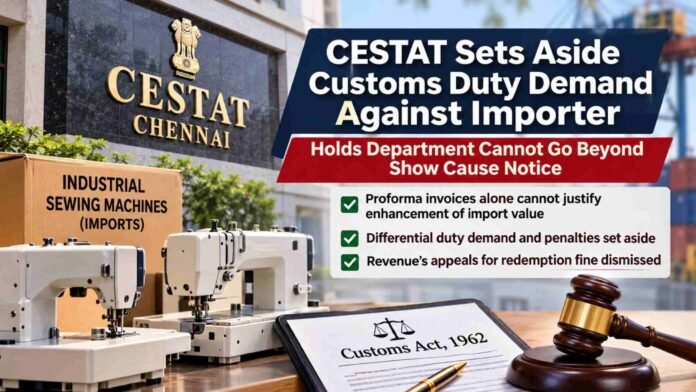
The Customs, Excise and Service Tax Appellate Tribunal (CESTAT), Chennai Bench, has set aside the customs duty demand raised against an importer of industrial sewing machines, holding that the Department cannot sustain a demand by indiscriminately enhancing the declared transaction value across 60 Bills of Entry when discrepancies were identified only in 10 Bills of Entry.
The bench of P. Dinesha (Judicial Member) and Vasa Seshagiri Rao (Technical Member) has observed that the adjudicating authority had travelled beyond the scope of the Show Cause Notice by relying on proforma invoices without properly establishing their correlation with the corresponding Bills of Entry. It also observed that the Revenue had failed to produce sufficient corroborative evidence to establish undervaluation.
Buy Now: Indirect Tax Judgments E-Compilation – October 2026
CESTAT allowed the appeals filed by the importer and its partners, set aside the differential duty demand and personal penalties, and dismissed the Revenue’s appeals seeking imposition of redemption fine.
The appellant/assessee, a partnership firm engaged in importing industrial sewing machines of brands such as GEMSY, JUKKY and KANSAI from China, was involved in the present dispute.
The firm imported industrial sewing machines and sold them to various dealers in India. Its case was that the machines were not sold in retail and were not liable for assessment on the basis of Retail Sale Price (RSP) under Section 4A of the Central Excise Act, 1944.
The Directorate of Revenue Intelligence (DRI) initiated an investigation into imports of various brands of industrial sewing machines, including those imported by the firm.
During the investigation, searches were conducted at the residential premises of the partners, namely K. Ashok and P. Nitin, as well as the firm’s office and godown.
The investigating authorities seized certain loose sheets, handwritten pocket-sized books, mobile phones, proforma invoices and other documents. Certain proforma invoices recovered from the firm’s premises allegedly reflected higher values than those declared in the commercial invoices submitted for customs assessment.
The Department also recovered unsigned blank letters bearing the seal of a Chinese supplier, Zhejiang Fanghua Sewing Machine Co. Ltd., from the premises of the firm’s accounts assistant.
Based on the investigation, Show Cause Notices were issued by the respective Customs authorities at Chennai and Nhava Sheva.
The Department proposed rejection of the declared/assessed transaction values relating to:
- 54 Bills of Entry covered under Worksheet-I;
- 4 Bills of Entry covered under Worksheet-II; and
- 2 Bills of Entry covered under Worksheet-III.
The Department also proposed recovery of differential customs duty, confiscation of the imported goods, interest and penalties.
The adjudicating authority subsequently confirmed the demands through a common Order-in-Original No. 66257/2018 dated 22.11.2018.
Before the Tribunal, the importer argued that the differential duty demand was primarily based on proforma invoices and statements recorded during the investigation, without any independent corroborative evidence.
The partners explained that although proforma invoices were initially raised by the foreign suppliers, they were not final documents determining the transaction value.
According to the importer, subsequent commercial negotiations resulted in a reduction of approximately 20% to 30% in the prices, and the final negotiated values were reflected in the commercial invoices submitted for customs clearance.
It was further contended that the proforma invoices were merely indicative and could not be treated as final transaction values.
The importer also disputed the Department’s allegations concerning freight and insurance.
It was explained that the Chinese suppliers arranged transportation and covered the risk relating to the imported goods. The commercial invoices were issued on a CIF basis, and the ocean freight was already included in the declared transaction value.
The importer further argued that the Department had not established any additional payment made over and above the commercial invoice values.
The importer submitted that the machines imported belonged to different categories, namely light-duty, medium-duty and heavy-duty machines.
It was argued that the differences in machine values were attributable to factors such as overall weight, quality of components, copper or aluminium coils, and the strength and number of strands used in the coils.
The importer challenged the Chartered Engineer’s certificate, contending that the relevant technical differences had not been properly examined.
It was also pointed out that the request for obtaining a second opinion had not been accepted by the adjudicating authority.
Another important contention was that the investigation allegedly identified evidence of discrepancies only in 10 out of 60 Bills of Entry.
The importer argued that the Department itself had no evidence regarding the remaining 50 Bills of Entry and, therefore, the entire differential duty demand could not be sustained.
After considering the rival submissions and examining the records, the Tribunal framed the following issues: Whether the demand proposed and confirmed under the proviso to Section 28(1)/Section 28(4) of the Customs Act, 1962, was justified. Whether the differential duty demand along with consequential interest and penalties was sustainable. Whether the non-imposition of redemption fine by the adjudicating authority was proper.
The Tribunal observed that the adjudicating authority had considered all 60 Bills of Entry and confirmed the differential duty demand, even though the Show Cause Notice identified discrepancies only in respect of 10 Bills of Entry vis-à-vis the proforma and commercial invoices.
The Tribunal held that the demand had been made indiscriminately without properly identifying and correlating the relevant Bills of Entry.
It observed that since the proceedings related to imports made around 2012 and the Department had failed to establish which 10 Bills of Entry were specifically referred to in the Show Cause Notice, the entire demand deserved to be set aside.
The Tribunal also examined the Department’s reliance on the proforma invoices as evidence of undervaluation.
It noted that the partners had explained the nature of the transactions and the distinction between the initial proforma invoices and the final commercial invoices issued by the foreign suppliers.
The Tribunal observed that the adjudicating authority had treated the values mentioned in the proforma invoices as the final transaction values without properly rejecting the explanation offered by the partners.
There was also no contrary finding establishing that the actual transaction value was different from the values reflected in the commercial invoices.
Further, the Department had not produced sufficient corroborative evidence to establish that the importer had made additional payments to the foreign suppliers.
The Tribunal also noted that the adjudicating authority had failed to establish the identity of consignments in respect of which additional freight was allegedly collected.
No corroborative statement from M/s. Bliss Logistics and Shipping Pvt. Ltd. was placed on record to substantiate the Department’s allegations.
The Tribunal further observed that the Show Cause Notice proposed the addition of freight and insurance without relying upon supporting evidence.
One of the most significant observations of the Tribunal concerned the settled legal principle that the adjudicating authority cannot travel beyond the allegations contained in the Show Cause Notice.
The Tribunal found force in the importer’s contention that the adjudicating authority had confirmed the differential duty demand by going beyond the scope of the Show Cause Notice.
The Tribunal concluded that there were no justifiable reasons to sustain the differential duty demand confirmed by the adjudicating authority. There was no justification for sustaining the personal penalties imposed upon the two partners under Sections 112(a) and 114AA of the Customs Act, 1962.
Membership Required to Access Case Details & Order Copy
To view the complete Case Details and Download Order Copy, you must have an active membership. Please subscribe to continue.

