
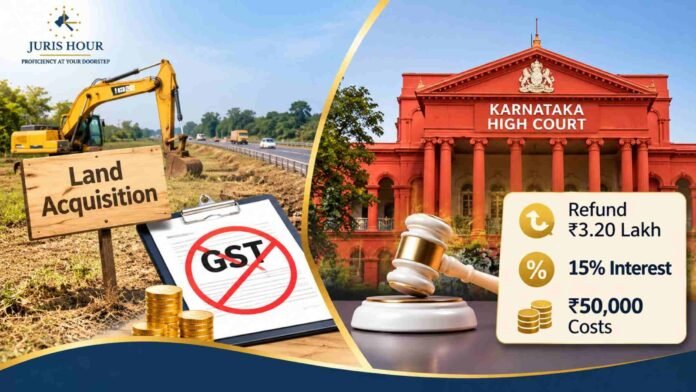
The Karnataka High Court has held that compulsory acquisition of land and structures by the State under its statutory power of eminent domain does not constitute a supply of goods or services under GST.
The bench of Justice R. Nataraj directed the authorities to refund ₹3,20,585.80 deducted towards GST from land acquisition compensation, along with interest at 15% per annum, and imposed costs of ₹50,000 and ruled that GST cannot be deducted from compensation paid to a landowner for compulsory acquisition of land and structures for highway expansion.
Buy Now: 210+ GST Judgments E-Magazine – October 2026
The bench observed that acquisition of immovable property by the State in exercise of its power of eminent domain cannot be treated as a supply of goods or services under the GST law.
The Court further held that the authorities had acted in excess of their powers by deducting GST from the compensation payable to the landowner.
The petitioner owned land measuring 1,187 square metres in Survey No. 40 of Mellahalli Village, Periyapatna Taluk, Mysuru District. The land was acquired for widening the Mysuru–Madikeri Highway.
An award was passed determining compensation payable to the petitioner at ₹38,10,744.88. However, the authorities deducted ₹3,20,585.80 towards GST at the rate of 18% from the compensation amount.
The petitioner approached the Karnataka High Court under Articles 226 and 227 of the Constitution of India, seeking a direction to the authorities to reimburse the GST amount along with interest from the date of the award until payment.
The petitioner contended that the acquisition of land under the statutory land acquisition framework does not constitute a sale of goods or provision of services.
It was argued that GST is leviable only on the supply of goods or services, whereas compulsory acquisition of land by the State is an exercise of statutory power and cannot be equated with a voluntary commercial transaction.
The petitioner further submitted that the deduction of GST from the compensation amount was arbitrary and amounted to an unauthorised exercise of power.
The NHAI contended that GST was applicable to the works contract and structural valuation component of the compensation.
The NHAI argued that the GST deduction had been applied uniformly to all landowners whose properties were acquired for the highway project.
The NHAI maintained that although compensation attributable to the land might not attract GST, the structural component assessed under the award was liable to GST under the applicable law.
After considering the rival submissions, the High Court examined the nature of compulsory acquisition and the scope of GST under the constitutional framework.
The Court referred to Article 366(12A) of the Constitution of India, which defines GST as a tax on the supply of goods or services or both.
It also referred to Section 3 of the Transfer of Property Act, 1882, which defines immovable property to include things attached to or embedded in the earth for the beneficial enjoyment of the property.
The Court observed that buildings constructed on land are also treated as immovable property. Accordingly, immovable property cannot be construed as goods for the purposes of GST.
Justice R. Nataraj observed that “There is neither supply of goods nor services, but an expropriation of the property of a citizen using statutory power.”
The Court emphasised that the landowner had neither sold any goods nor provided any service by surrendering the property pursuant to compulsory acquisition.
It further held that even if a wide interpretation is given to the expression “supply of goods or services”, acquisition of property by the State in exercise of its power of eminent domain cannot fall within its scope.
The High Court specifically rejected the respondents’ contention that GST could be deducted on the structural component of the compensation.
The Court noted that the respondents had failed to explain under which provision of the GST Act acquisition of land or structures would amount to a supply of goods or provision of services.
The Court also referred to a decision of the Madras High Court in W.P. No. 3278 of 2024, which considered a similar issue concerning GST deduction from land acquisition compensation.
Holding that the authorities had acted in excess of their powers, the Karnataka High Court quashed the award notice dated 29 October 2024, to the extent that it provided for deduction of GST from the compensation payable to the petitioner.
The Court accordingly disposed of the writ petition.
Membership Required to Access Case Details & Order Copy
To view the complete Case Details and Download Order Copy, you must have an active membership. Please subscribe to continue.
Read More: GST Adjudication by Additional Commissioner Valid Despite Proper Officer Objection: Telangana HC

