
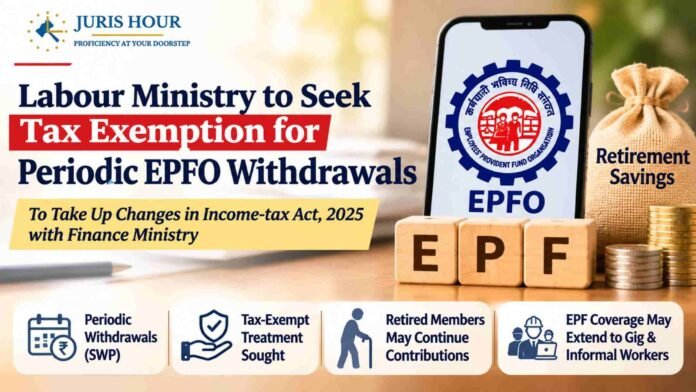
The Ministry of Labour and Employment is preparing to approach the Ministry of Finance to seek tax-exempt treatment for periodic withdrawals under the Employees’ Provident Fund Organisation’s (EPFO) proposed Systematic Withdrawal Plan (SWP). The proposed changes may also facilitate continued EPF contributions by retired members and extend the provident fund framework to informal and gig workers.
The Ministry of Labour and Employment is set to initiate discussions with the Ministry of Finance to address the tax implications of the new Systematic Withdrawal Plan (SWP) approved by the Central Board of Trustees (CBT) of the Employees’ Provident Fund Organisation (EPFO). The discussions are expected to focus on amendments to the Income-tax Act, 2025, to ensure that periodic withdrawals under the proposed mechanism receive tax treatment similar to that available for qualifying lump-sum provident fund withdrawals.
The EPFO’s Central Board of Trustees approved the SWP at its 240th meeting held on November 19, 2026, and authorised consultations with the Labour Ministry regarding the plan’s tax implications.
According to officials, the Labour Ministry has already initiated discussions with the Finance Ministry and intends to deliberate on the amendments required under the Income-tax Act, 2025.
Buy Now: 210+ GST Judgments E-Magazine – October 2026
EPFO’s New Systematic Withdrawal Plan: Periodic Withdrawals Instead of Lump-Sum Payments
Under the proposed SWP, retiring EPF members will be able to withdraw their accumulated provident fund savings in instalments instead of withdrawing the entire corpus at once.
Members may be given the option to receive periodic payouts on a monthly, quarterly or half-yearly basis. The remaining balance in their provident fund accounts will continue to earn interest.
The proposed mechanism is intended to provide greater flexibility to retirees in managing their retirement savings while allowing them to retain a portion of their accumulated funds in the EPFO system.
However, the tax treatment of such periodic withdrawals remains an important issue requiring clarification.
Tax Exemption for Periodic EPF Withdrawals Under Consideration
Under the existing provisions, withdrawals from the Employees’ Provident Fund after five years of continuous service are generally exempt from income tax, subject to prescribed conditions.
The Labour Ministry is keen to ensure that periodic withdrawals under the SWP receive the same tax-exempt treatment as qualifying lump-sum withdrawals.
The issue arises because the existing tax framework primarily addresses withdrawals from provident fund accounts and may require specific provisions to accommodate systematic periodic payouts.
Tax experts have suggested that the Income-tax Act, 2025, should expressly clarify the tax treatment of withdrawals made monthly, quarterly, half-yearly or annually under the SWP.
The government is therefore expected to examine the relevant provisions and determine whether legislative amendments or clarifications are necessary to provide certainty to EPF subscribers.
Tax Treatment of Interest After Retirement Also Under Discussion
Another significant issue likely to be taken up during consultations concerns the tax treatment of interest earned on provident fund balances after an employee’s retirement.
Under the existing framework, interest attributable to employee contributions exceeding ₹2.5 lakh annually is taxable. A higher threshold of ₹5 lakh applies in cases where there is no employer contribution.
The government is expected to examine whether the higher threshold can be extended to voluntary contributions and other situations covered under the proposed changes.
The treatment of interest earned on accumulated PF balances after retirement is also likely to be discussed between the Labour Ministry and the Finance Ministry.
Retired Members May Be Allowed to Continue EPF Contributions
The proposed reforms may also permit retired individuals to continue contributing to their provident fund accounts even after retirement.
At present, the existing tax framework is largely structured around the conventional employer-employee relationship. Consequently, enabling retired individuals to make voluntary contributions without an employer may require changes to the applicable provisions.
The proposed amendments may also address direct contributions made by individuals who do not have a formal employer.
Experts have pointed out that Section 123, read with Schedule XV of the Income-tax Act, 2025, may need to recognise direct contributions by retired members.
Such contributions could potentially qualify for deductions within the existing annual limit of ₹1.5 lakh, subject to the applicable statutory provisions and any amendments introduced by the government.
Extension of EPF Framework to Gig and Informal Workers
The Labour Ministry is also examining the possibility of extending the provident fund contribution framework to informal workers, gig workers, freelancers and other individuals who are not engaged in conventional employer-employee arrangements.
However, extending the framework would require changes to the existing EPF scheme to accommodate individuals who make contributions independently without an employer.
The proposed reforms would also need to address practical issues such as tracking contributions received from multiple sources, determining applicable tax-exemption thresholds, ensuring tax-free interest treatment and facilitating appropriate tax reporting.
What Lies Ahead?
The proposed changes are still at the consultation and deliberation stage. The Labour Ministry is expected to take up the matter with the Finance Ministry to examine the necessary amendments to the Income-tax Act, 2025.
If implemented, the proposed reforms could significantly alter the way EPF retirement savings are accessed and managed by subscribers.
The proposed SWP could provide retirees with a structured income stream instead of requiring them to withdraw their entire provident fund corpus at retirement. However, its practical benefits will depend substantially on the tax treatment ultimately prescribed by the government.
The final tax treatment of periodic EPF withdrawals, post-retirement contributions and interest income will become clear only after the government takes a decision and introduces the necessary legislative or administrative changes.

