
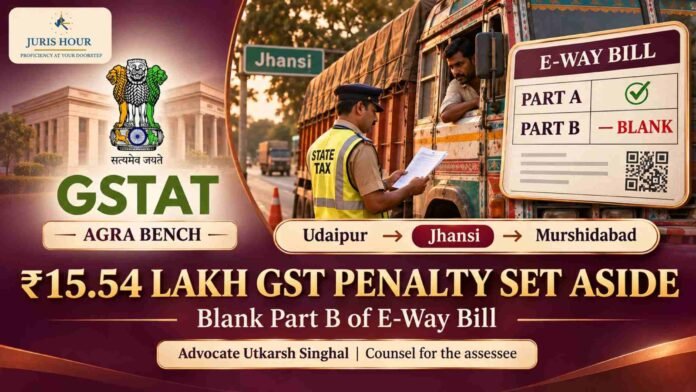
The Goods and Services Tax Appellate Tribunal (GSTAT), Agra Bench, has upheld the cancellation of a ₹15,53,764 penalty imposed under Section 129(3) of the CGST and UPGST Acts after a mobile squad found that Part B of one e-way bill had been left blank and found that the e-invoice had been generated before dispatch and that the Uttar Pradesh State Tax Department had identified no material showing an intention to evade tax.
The bench of Ajeet Singh (Judicial Member) and Vivek Kumar (Technical Member) found no evidence of intent to evade tax and held that Uttar Pradesh had limited powers to verify the consignment because the Rajasthan-to-West Bengal shipment was merely passing through the state.
Buy Now: All 200+ GSTAT Judgements Till November 2026 | Comprehensive E-Magazine
The goods were being transported from Udaipur, Rajasthan, to Murshidabad, West Bengal, when a Uttar Pradesh State Tax mobile squad intercepted the truck at Raksha in Jhansi on 6 July 2024. The person in charge produced four tax invoices and the corresponding e-way bill records. For one invoice dated 29 June 2024, the e-way bill number had been generated after Part A was filled, but the vehicle details in Part B had yet to be entered.
The officer detained the goods and the vehicle under Section 129(1) through Form GST MOV-06. The company submitted an updated e-way bill and a written explanation after receiving a notice under Section 129(3). The officer rejected the explanation and imposed the penalty on 9 July 2024. The goods and vehicle were released after payment. The first appellate authority later set aside the penalty, prompting the Department to appeal to GSTAT under Section 112.
The Department argued that Part B was a substantive requirement under Rule 138 because vehicle details allow officers to track the movement of goods and prevent evasion. The Department contended that the incomplete e-way bill was invalid for the movement and that the first appellate authority had erred in treating the omission as a technical lapse.
The taxpayer has observed that the e-invoice carried a valid Invoice Reference Number, IGST had been charged and paid, and the truck’s registration number was recorded in the transport bilty. He said the goods and vehicle matched the accompanying documents and that the notice and penalty order contained no allegation of undervaluation, misdescription, non-payment of tax, diversion of goods or reuse of the e-way bill. He relied on the Allahabad High Court’s ruling in Citykart Retail Pvt. Ltd. v. Commissioner Commercial Tax, which concerned a penalty for an unfilled Part B.
The Tribunal observed that the Department relied on the breach of Rule 138 and pointed to no evidence of intent to evade tax. Drawing on the Allahabad High Court’s decisions in Satyam Traders and Hindustan Herbal Cosmetics, the Bench held that a Section 129 penalty for a documentation error requires material supporting a finding of intent to evade tax.
The Bench found that both parties to the transaction were registered dealers and that the e-invoice had been generated on the GST portal before the goods moved. The invoice details had auto-populated in GSTR-1. On those facts, the Tribunal concluded that the genuine documents accompanying the consignment rebutted the inference of evasion and that the first appellate authority was justified in quashing the penalty.
The Tribunal separately noted that the supply originated in Rajasthan and was destined for West Bengal, with no taxable event in Uttar Pradesh. It relied on the Allahabad High Court’s decision in Maruti Enterprises v. State of U.P., which distinguished a transit state’s power to inspect and verify goods from its power to impose penalties under Section 129. Under that ruling, transit officers who spot a documentation deficiency may flag it to the jurisdictional GST authorities in the state of origin or destination.
The taxpayer also argued that the ₹15.54 lakh dispute fell below the monetary limit for departmental appeals under Uttar Pradesh State Tax Circular No. 2425008 dated 5 July 2024.
The Tribunal rejected that objection under Clause 4(vi), which permits an appeal where the Commissioner considers it necessary to contest a case in the interest of justice or revenue. The Bench then dismissed the Department’s appeal on merits and made no order as to costs.
Membership Required to Access Case Details & Order Copy
To view the complete Case Details and Download Order Copy, you must have an active membership. Please subscribe to continue.
Read More: E-Way Bill Must Be Updated When Goods Change Trucks: GSTAT

