
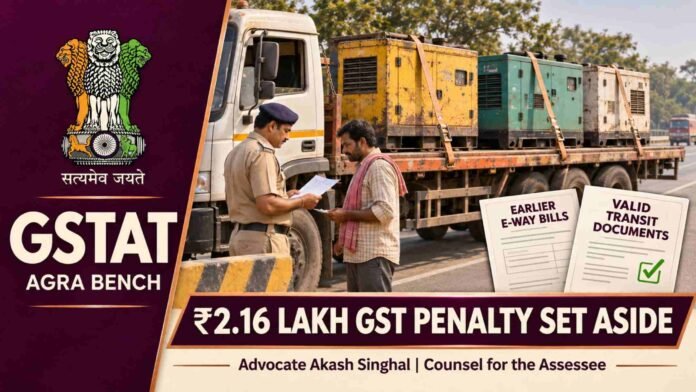
The Goods and Services Tax Appellate Tribunal (GSTAT), Agra State Bench, has set aside a ₹2.16 lakh penalty imposed on a consignment of used generators and held that earlier e-way bills still appearing on the portal did not establish a contravention under Section 129 of the CGST and UPGST Acts when the goods matched the valid tax invoices and e-way bills produced at interception.
The bench of Ajeet Singh (Judicial Member) and Vivek Kumar (Technical Member) also held that a mobile squad officer has no jurisdiction to adjudicate the availment of input tax credit (ITC). Allegations of wrongful credit must be examined by the competent jurisdictional authority in appropriate proceedings.
Buy Now: All 200+ GSTAT Judgements Till November 2026 | Comprehensive E-Magazine
The Agra Mobile Squad intercepted a vehicle carrying three used generators from Sonipat, Haryana, to Hyderabad, Telangana. The driver produced three tax invoices and their corresponding e-way bills. A portal check showed that two suppliers, Mahalaxmi Generator Services and WAE Limited, had previously generated invoices and e-way bills for the same transactions.
The officer inferred an intention to evade tax from the existence of multiple sets of documents. Two of the three generators were detained and subsequently seized. The company paid ₹2.16 lakh to secure their release. The first appellate authority dismissed the company’s appeal on 25 September 2025, prompting a second appeal before the GSTAT.
The taxpayer, submitted that the two suppliers had issued fresh invoices and e-way bills because the generators were not dispatched on the dates originally planned. The suppliers could not cancel the earlier e-way bills, counsel said, so those bills remained visible on the portal even though the generators moved under the later documents.
The department defended the seizure and penalty. It argued that multiple invoices and e-way bills for the same transactions and vehicle indicated an attempt to evade tax.
The tribunal held that action under Section 129 requires the department to establish a contravention of the Act or the rules in relation to the transport of goods. The driver had produced an invoice and a corresponding e-way bill for each generator, and the mobile squad officer had recorded no discrepancy between the generators found in the vehicle and the accompanying documents. The bench found that the consignment complied with Rules 138 and 138A.
The bench also noted that the first appellate authority had recorded that the earlier bills did not appear in GSTR-2B. The department produced no evidence that the taxpayer had claimed ITC twice on the same supply or that either supplier had passed on duplicate credit. The tribunal held that the possibility of duplicate credit, without supporting evidence, could not by itself justify detention or seizure under Section 129.
The GSTAT allowed the second appeal and set aside both the original penalty order and the first appellate order. It held that the taxpayer was entitled to a consequential refund of the ₹2.16 lakh already deposited, subject to verification and any adjustment permitted by law.
Membership Required to Access Case Details & Order Copy
To view the complete Case Details and Download Order Copy, you must have an active membership. Please subscribe to continue.
Read More: Blank Part B of E-Way Bill Alone Can’t Justify GST Penalty: GSTAT

