
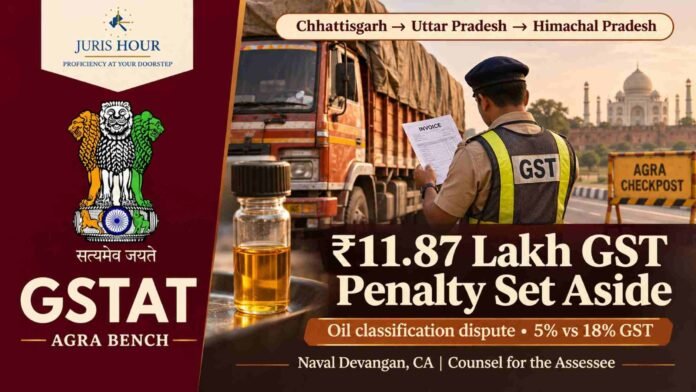
The Goods and Services Tax Appellate Tribunal (GSTAT), Agra Bench, has upheld the cancellation of a Rs. 11,87,525 penalty on an oil consignment travelling from Chhattisgarh to Himachal Pradesh through Uttar Pradesh.
The bench of Ajeet Singh (Judicial Member) and Vivek Kumar (Technical Member) has observed that Uttar Pradesh’s role as a transit state did not give its officers jurisdiction to impose the penalty in this case. It also held that deciding whether the goods attracted 5% or 18% GST required regular tax adjudication because the classification dispute called for chemical analysis.
Buy Now: All 200+ GSTAT Judgements Till November 2026 | Comprehensive E-Magazine
An Uttar Pradesh State Tax mobile squad intercepted the vehicle at Saiyan in Agra district. The supplier was registered in Chhattisgarh, the recipient was registered in Himachal Pradesh, and the consignment carried a tax invoice and an e-way bill.
The invoice described the goods as second-grade rice bran oil under HSN 15159040, attracting 5% GST. The intercepting officer took the view that the consignment contained industrial fatty acids or acid oils classifiable under HSN 3823 at 18% GST. Alleging that the goods had deliberately been declared at the lower rate, the officer detained the consignment and vehicle under Section 129(1) of the CGST Act. After issuing a show-cause notice, the officer imposed a penalty of ₹11,87,525 under Section 129(3).
The first appellate authority set aside the enforcement order and the penalty. The Uttar Pradesh State Tax Department challenged that decision before GSTAT under Section 112(1) of the CGST and UPGST Acts.
The Bench relied on the Allahabad High Court’s decision in Maruti Enterprises v. State of U.P. The Tribunal explained that Section 68 and Rule 138B allow officers to intercept vehicles and verify documents accompanying goods in transit. For this consignment, the Tribunal found that the goods’ passage through Uttar Pradesh did not confer jurisdiction to levy the disputed penalty because no taxable event or revenue accrual arose in the state.
The Tribunal said a transit-state officer who identifies a discrepancy may record it in the verification report and forward it to the jurisdictional authorities in the originating or destination state for appropriate action.
The Tribunal separately examined whether Section 129 could be used to decide the rate dispute. It described Section 129 as a summary mechanism for enforcing compliance during the movement of goods. Here, the consignment carried valid documents, and deciding between the competing tariff headings required chemical analysis.
The Bench held that the proper officer having jurisdiction over the taxpayer must resolve that classification question through regular assessment or adjudication under the applicable demand provision.
The order referred to Sections 73, 74 and 74A. GSTAT dismissed the department’s appeal and upheld the cancellation of the penalty. The applicable GST rate for the consignment remained undecided.
Membership Required to Access Case Details & Order Copy
To view the complete Case Details and Download Order Copy, you must have an active membership. Please subscribe to continue.

