
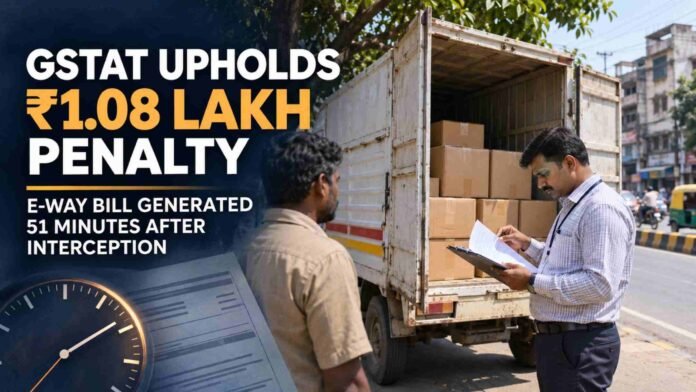
The Goods and Services Tax Appellate Tribunal (GSTAT), Lucknow, has upheld a penalty of ₹1.08 lakh under Section 129 of the Central and Uttar Pradesh GST Acts after a vehicle carrying 900 kg of kattha was found with documents covering only 600 kg. The e-way bill for the remaining 300 kg was generated after the State Tax Mobile Squad intercepted the vehicle.
The bench of Judicial Member Santosh Kumar Srivastava and Technical Member Arvind Kumar dismissed the trader’s second appeal and held that generating the e-way bill on the same day did not resolve the discrepancy because the timing of generation had to be examined against the movement of the goods. It also found that the trader had produced no independent technical evidence to support its claim that a GST portal problem had delayed generation.
Buy Now: All 200+ GSTAT Judgements Till November 2026 | Comprehensive E-Magazine
The bench found that the trader failed to substantiate its claim of a GST portal glitch. The e-way bill for the second consignment was generated 51 minutes after the vehicle was stopped.
The Assistant Commissioner of Mobile Squad-II, State Tax, Kanpur, intercepted the vehicle at Juhi Nahariya in Kanpur Nagar at 12:58 p.m. The driver produced a transport receipt, Invoice No. 355 and an e-way bill for 600 kg of kattha, also known as catechu. Physical verification showed that the vehicle also carried 15 cartons of premium Indian kattha weighing 20 kg each. The driver did not produce the corresponding invoice or e-way bill for those cartons at the time of interception.
The proper officer recorded the driver’s statement and issued a notice in Form GST MOV-07 on February 19, 2024. The trader responded with Invoice No. 356, dated February 17, and the corresponding e-way bill. The departmental record showed that this e-way bill was generated at 1:49 p.m. on February 17, 51 minutes after the vehicle was intercepted.
The adjudicating authority imposed the penalty through Form GST MOV-09 on February 19, 2024. The Additional Commissioner, Grade-II (Appeal), Second, State Tax, Kanpur, upheld it on May 30, 2024.
The trader said the vehicle carried two consignments for separate registered buyers in Kanpur. The first was for De & Company and the second for Sevakram Aditya Kumar. It said the invoice for the second buyer had been prepared, but its accountant could not generate the e-way bill in time because of a technical problem with the GST portal. According to the trader, the driver inadvertently left before collecting the remaining documents.
The trader argued that both supplies were genuine and that the delay was a procedural lapse without any intention to evade GST. The department pointed to the e-way bill timestamp and argued that the company had supplied no independent evidence of a portal outage. It also maintained that each consignment needed the prescribed documents even when both travelled in one vehicle.
The bench examined Section 68, which governs inspection of goods in movement, and Rule 138, which requires the prescribed information to be furnished and an e-way bill to be generated before movement begins wherever the requirement applies. It said that the trader was responsible for generating the necessary documents for both consignments and making them available to the driver before dispatch.
The tribunal found no technical report, portal error record or other contemporaneous material showing that the portal was unavailable at the relevant time. It also found that the explanation about the driver’s departure lacked supporting material about the circumstances of dispatch. The identification of a separate buyer explained the second consignment’s intended destination, but left the documentation gap unresolved.
The bench distinguished the Allahabad High Court’s ruling in Falguni Steels v. State of U.P. It acknowledged the distinction between a technical error and deliberate evasion, then held that the facts here did not support treating the lapse as technical. The tribunal also referred to Jhansi Enterprises and Akhilesh Traders, decisions the first appellate authority had relied on when considering documents furnished after interception and the inference that can arise when goods travel without the prescribed documents.
On the facts of this case, the tribunal found that intent to evade tax was established. It relied on the discrepancy between the quantity carried and the quantity documented at interception, the later generation of the e-way bill and the absence of independent evidence supporting the claimed technical failure.
The GSTAT dismissed the second appeal and confirmed the ₹1.08 lakh penalty. The order summary records ₹54,000 under CGST and ₹54,000 under UPGST. It records zero tax and interest.
Membership Required to Access Case Details & Order Copy
To view the complete Case Details and Download Order Copy, you must have an active membership. Please subscribe to continue.
Read More: GSTAT Rejects Rs. 19.89 Lakh Refund of GST Paid on NHAI Road Restoration Charges as Time-Barred

