
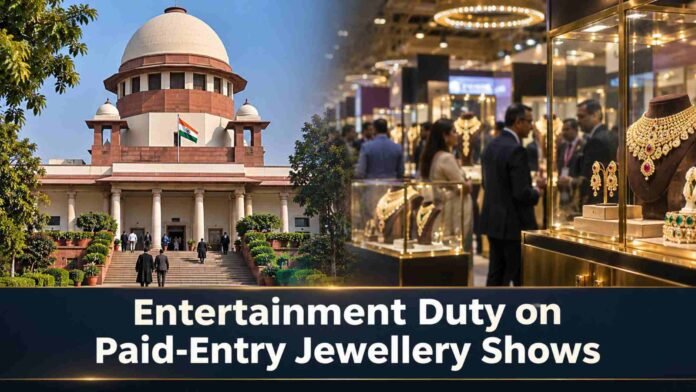
The Supreme Court has held that the India International Jewellery Show (IIJS) and IIJS Signature qualified as “entertainment” under Section 2(a) of the Bombay Entertainments Duty Act, 1923. The Court found that the shows displayed merchandise and charged eligible visitors for admission. Their business-to-business format and screening of visitors did not take them outside the statutory definition.
The bench of Justices S.V.N. Bhatti and N.V. Anjaria upheld the levy on the India International Jewellery Show and IIJS Signature. It held that charging for admission brought the exhibitions within Maharashtra’s 1923 entertainment duty law, even though the events were designed for trade buyers.
Buy Now: 90+ Supreme Court Judgments E-Magazine – October 2026
How the dispute began
The Council, set up under the aegis of the Union Ministry of Commerce, organises the shows to bring Indian jewellery exporters and manufacturers together with domestic and overseas buyers. Before IIJS 2011, the police licensing process required a no-objection certificate from the Additional Collector. The Council initially deposited ₹38,91,250 under protest to secure that clearance. Further demands brought the total deposit for the event to ₹62,76,875.
For IIJS Signature 2012, the Council sought clearance on the ground that the exhibition fell outside Section 2(a). It told the authorities that it was disputing the levy itself and had made no request for an exemption under Section 6(3). After the police insisted on the clearance, the Council deposited ₹11,96,938 under protest and sought a refund after the event.
Assessment for IIJS 2011 reduced on appeal
After the Bombay High Court twice set aside assessments seeking a further ₹1,32,47,750 for IIJS 2011, the Additional Collector issued a fresh order on July 31, 2012. It fixed the gross liability at ₹97,09,500 and sought to recover ₹34,32,625 after adjusting the amount already deposited under protest.
The Divisional Commissioner upheld the levy on November 30, 2012, but reduced the assessment to ₹45,40,125. The Commissioner accepted audited records showing that the Council had distributed 6,081 exhibitor passes. That finding led to the cancellation of the duty and penalty imposed in respect of another 919 passes. The Commissioner ordered a refund of the excess and directed that the duty for IIJS 2012 be adjusted against the ₹60 lakh advance deposit for that event. The Bombay High Court subsequently dismissed the Council’s challenge to the levy.
Council argued that admission was restricted to trade visitors
The Council said visitors had to submit business credentials and pass a screening process before they could pay the registration fee and enter. It argued that the shows were commercial meetings for traders and manufacturers, closed to the general public and individual consumers. It also relied on Geeta Enterprises v. State of U.P., arguing that a fee alone could not establish that the shows provided amusement or diversion.
Maharashtra relied on the wording of Section 2(a), which expressly covers exhibitions to which people are admitted for payment. The State argued that the screening process and the activities visitors pursued inside the exhibition did not change the fact that attendees paid to gain admission.
Supreme Court found the admission fee decisive
Section 2(a) uses the word “includes” and expressly covers exhibitions, performances, amusements, games and sports to which people are admitted for payment. The bench read the provision as extending the ordinary meaning of entertainment to the categories the legislature expressly included. For the exhibitions before it, the decisive question was whether visitors had to pay to enter.
The Court discussed Geeta Enterprises, where visitors could enter the premises free of charge and paid to activate a video game. At the jewellery exhibitions, visitors paid at the point of admission. The bench held that displaying traders’ merchandise at paid-entry exhibitions brought the shows within Section 2(a), even when attendees came to conduct business. It added that requiring an application form, which can serve purposes such as security, did not displace the statutory test.
Membership Required to Access Case Details & Order Copy
To view the complete Case Details and Download Order Copy, you must have an active membership. Please subscribe to continue.
Read More: GST Moves Towards ‘Trust First, Verify Later’ With Fewer Transit Checks, Says CBIC Chairman

