
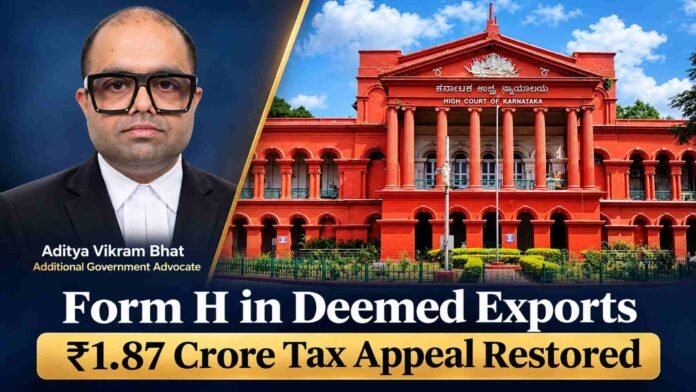
The Karnataka High Court has set aside orders granting tax relief to Karnataka State Beverages Corporation Limited (KSBCL) in a ₹1.87 crore dispute over exports of denatured ethanol. The court restored KSBCL’s appeal before the Karnataka Appellate Tribunal (KAT) for a fresh decision on whether the corporation had to furnish Form H to claim the deemed export benefit.
The Bench of Chief Justice Vibhu Bakhru and Justice K.S. Hemalekha has observed that a Single Judge had erred in directing the tribunal to decide the pending appeal in KSBCL’s favour without addressing the Form H issue. The Bench left both the applicability of the Form H requirement and KSBCL’s entitlement to the exemption open for the tribunal.
Buy Now: Indirect Tax Judgments E-Compilation – October 2026
The respondent/assessee received an order dated July 23, 2013, from Switzerland-based Kolmar Group AG for 3,000 metric tonnes of denatured anhydrous ethanol, to be delivered FOB Mumbai Port. At the time, Rule 4 of the Karnataka Excise (Denatured Spirit and Denatured Spirituous Preparations) Rules, 1967 required exports of denatured spirit to go through KSBCL.
Under KSBCL’s sourcing policy, manufacturers could negotiate directly with customers, while the corporation would place the supply order in accordance with the Excise Commissioner’s allotment. The policy placed responsibility for compliance, losses and taxes on the manufacturer and required it to indemnify KSBCL against liabilities arising from the supply and subsequent disposal of the spirit.
The assessee obtained a no-objection certificate from the Excise Commissioner and furnished an indemnity dated August 17, 2013. The company said it transported the ethanol from its manufacturing unit in Athani taluk, Belagavi district, to Mumbai Port between August 21 and September 13, 2013. It raised 263 invoices showing KSBCL as consignee. KSBCL, in turn, issued invoice-cum-delivery challans in favour of the overseas buyer.
The Commercial Taxes Department issued a reassessment notice to KSBCL on February 25, 2016, under Section 9(2) of the Central Sales Tax Act, 1956. The department said that the corporation had claimed deemed export turnover of ₹25,26,86,250 for August and September 2013 without furnishing the supporting declarations in Form H.
On October 21, 2016, the assessing officer determined a liability of ₹1,86,92,460, inclusive of tax and interest. The first appellate authority upheld the reassessment on March 31, 2017, rejecting KSBCL’s contention that Form H was unnecessary. KSBCL filed a second appeal before the Karnataka Appellate Tribunal.
Section 5(1) of the Central Sales Tax Act addresses sales that occasion an export or are effected by transfer of documents of title after goods cross India’s customs frontiers. Section 5(3) extends export treatment to the last sale or purchase preceding the sale that occasions the export, subject to the conditions in that provision. Section 5(4) addresses the prescribed declaration for a claim under Section 5(3). The dispute was whether the Form H requirement applied to KSBCL’s claim on these facts.
The assessee argued in an affidavit that KSBCL had acted as a channel for the export and had invoiced the foreign buyer. On that basis, the manufacturer characterised KSBCL’s sale as an export sale under Section 5(1). It claimed that KSBCL had originally reported direct exports and later classified them as deemed exports in revised returns. The Revenue disputed that account and produced returns showing zero direct exports in both the original and revised filings.
After KSBCL invoked the indemnity, the assessee moved the High Court seeking a refund of ₹56,07,738 recovered under the bond and release of a further ₹1,32,97,074 it claimed was outstanding. The Single Judge concluded on October 21, 2024, that the tax demand was unsustainable because the goods had been exported and directed the tribunal to allow KSBCL’s pending appeal. A second order dated September 4, 2025, directed the tribunal to implement that ruling. The tribunal allowed the appeal on September 12, 2025, in compliance with the High Court’s directions.
The Division Bench held that the manufacturer’s writ petition concerned KSBCL’s invocation of the indemnity and withholding of amounts. The correctness of the reassessment was already before the tribunal in a statutory appeal under Section 63 of the Karnataka Value Added Tax Act, 2003. The Bench found that the Single Judge had treated the fact of export as sufficient to grant relief without examining whether the prescribed declaration was required.
The High Court allowed the department’s two writ appeals and its sales tax revision petition. It set aside both Single Judge orders and the consequential tribunal order, restoring KSBCL’s tax appeal for an independent decision. It separately remanded the manufacturer’s writ petition for the Single Judge to consider the parties’ contractual dispute and whether it should be entertained under Article 226 of the Constitution. The Bench noted that the sourcing policy provided for arbitration and directed reversal of any consequential benefits the manufacturer had received under the original order.
Membership Required to Access Case Details & Order Copy
To view the complete Case Details and Download Order Copy, you must have an active membership. Please subscribe to continue.
Read More: Refusal to Refund Recovered GST: Supreme Court Declines to Interfere, Asks GSTAT to Expedite Appeal

