
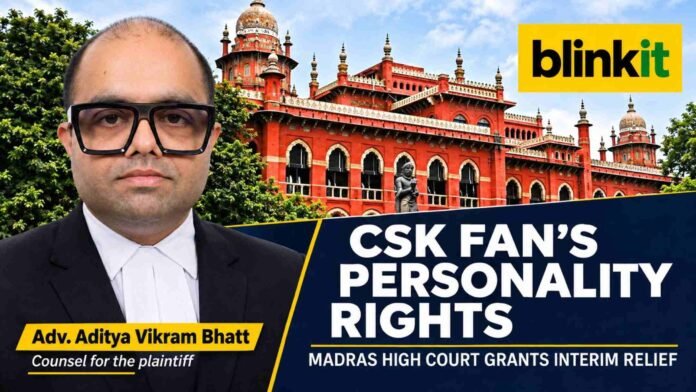
The Madras High Court has granted an interim injunction against Blink Commerce Private Limited, which operates Blinkit, in a personality rights suit filed by Chennai Super Kings (CSK) fan Saravanan Hari and found a front-page advertisement could lead readers to believe the Chennai Super Kings fan had endorsed Blinkit. It also directed the advertiser and the newspaper publisher to preserve the materials used to create the ad.
The bench of Justice P.B. Balaji found that the figure in a Blinkit advertisement closely resembled Hari and that readers could reasonably believe he had participated in the campaign.
Buy Now: Complete Tax & Supreme Court Judgments E-Magazine Combo – October 2026
In its November 16, 2026 order, the court observed that constitutional protection extends to every individual, including people who are recognisable to the public without being film stars or professional athletes. At this preliminary stage, the judge found that Blink Commerce could not use the recognisable persona Hari had developed as a cricket fan for commercial gain without his prior permission.
Hari has attended CSK matches in India and abroad, becoming recognisable through his yellow body paint and his display of M.S. Dhoni’s name and jersey number 7. His counsel, Aditya Vikram Bhatt, pointed to newspaper reports, interviews and television coverage featuring Hari at cricket matches.
Hari alleged that Blink Commerce used his likeness without consent in an advertisement on the front page of the Chennai edition of Sunday Times on March 23, 2025. His counsel told the court that the ad remained available in the online edition of The Times of India and that acquaintances had asked Hari whether he endorsed the advertised offering. The complaint concerned that single advertisement.
Hari sent pre-suit notices to Blink Commerce and Bennett Coleman, publisher of The Times of India. Blink Commerce replied that the characters in the advertisement were fictional and bore no connection to Hari. The publisher said it had carried the advertisement and disputed responsibility for its contents.
Justice Balaji compared the advertisement with the way Hari appeared in published coverage. The judge found a clear resemblance at first sight, including in the pose shown in the ad, and concluded that readers were likely to believe Hari had taken part in the campaign. The commercial nature of the advertisement and the likelihood of that impression supported the interim injunction against Blink Commerce.
The court left the publisher’s liability for determination at trial. Although Hari had sought an injunction against multiple respondents, including unidentified parties named as John Doe, the court granted that relief against Blink Commerce alone.
The court granted a separate interim direction requiring Blink Commerce and the publisher to preserve and produce materials relating to the advertisement, including artwork, samples, design correspondence and emails. The judge said the loss of those materials while the suit was pending could impair Hari’s ability to prove his claim for damages arising from the alleged commercial use of his likeness.
Membership Required to Access Case Details & Order Copy
To view the complete Case Details and Download Order Copy, you must have an active membership. Please subscribe to continue.

