
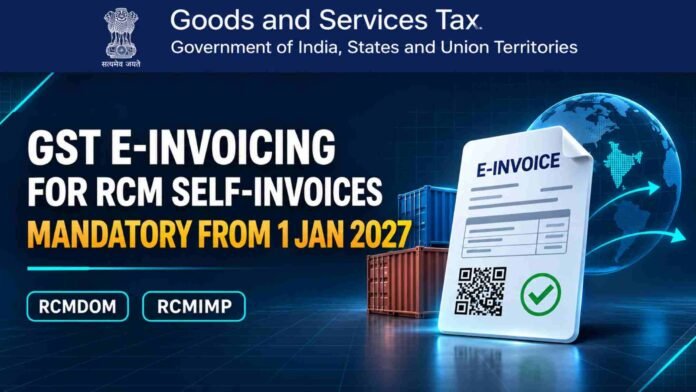
The Goods and Services Tax Network (GSTN) has issued a November 17, 2026 advisory detailing the rollout of e-invoicing for recipient-generated self-invoices under the Reverse Charge Mechanism (RCM).
From January 1, 2027, taxpayers covered by the notified provisions will have to generate an Invoice Reference Number (IRN) for self-invoices in two categories: domestic supplies received from unregistered persons where GST is payable under reverse charge, and imports of services subject to reverse charge.
GSTN proposes voluntary Invoice Reference Number generation from December 15 for eligible taxpayers receiving domestic supplies from unregistered persons under reverse charge or importing services under reverse charge.
Buy Now: All 200+ GSTAT Judgements Till November 2026 | Comprehensive E-Magazine
Two New Supply Types for RCM Self-Invoices
The e-invoice system will use the code RCMDOM for covered domestic supplies received from unregistered persons and RCMIMP for covered imports of services. In both categories, the recipient generates the self-invoice and submits its details to an Invoice Registration Portal (IRP) to obtain an IRN.
The advisory follows GSTN’s October 16 guidance. Notification No. 04/2026-Central Tax, dated October 26, 2026, extends e-invoicing to the two categories from January 1, 2027. Notification No. 05/2026-Central Tax, issued on the same date, makes the corresponding changes to the CGST Rules and the e-invoice schema. The notifications and related government circulars govern applicability, exemptions and compliance requirements.
Voluntary IRN Generation Proposed From December 15
GSTN proposes to enable both supply types on the live IRPs from December 15, 2026. Under the proposed rollout, eligible taxpayers can voluntarily generate IRNs for genuine transactions from December 15 through December 31. The mandatory requirement begins on January 1, 2027.
GSTN also specified a document-date cutoff. For RCMDOM and RCMIMP, the live system will accept documents dated December 15, 2026 or later for IRN generation. A self-invoice dated December 14 would therefore fall outside the production system’s acceptance window for these categories even if it were submitted after the proposed rollout.
Testing Available Across All Six Invoice Registration Portals
GSTN said the two supply types are already available for testing in the sandbox environments of all six authorised IRPs. Taxpayers can use sample data in the sandbox to test how their accounting or ERP systems classify the transactions, transmit self-invoice details and handle IRP validation errors. GSTN has asked stakeholders to reserve the live system for genuine transactions.
GSTN urged taxpayers, GST Suvidha Providers, Application Service Providers, ERP vendors and other integration partners to complete development and testing ahead of January 1 and brief the businesses and teams that depend on their systems. The NIC e-Invoice API Developer Portal provides the technical specifications, validation codes and IRP-1 release notes.
Membership Required to Access Notification Details & Copy
To view the complete Notification Details and Download Copy, you must have an active membership. Please subscribe to continue.

