
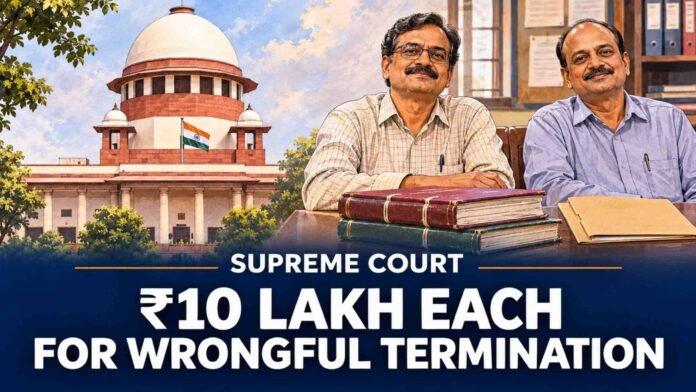
The Supreme Court has directed a Maharashtra private school to pay ₹10 lakh each to two former clerks for wrongful termination, invoking Article 142 of the Constitution after finding that the school failed to substantiate the misconduct charges before the School Tribunal and had withheld the final inquiry reports before terminating their services.
The Bench of Justices Dipankar Datta and Sheel Nagu granted lump-sum compensation even though the clerks’ writ petitions had failed to plead the grounds on which the Supreme Court ultimately found their case meritorious. The Court made the compensation a full and final settlement of all dues and directed the school to pay interest at 12% per annum if it missed the three-month payment deadline.
Buy Now: 90+ Supreme Court Judgments E-Magazine – October 2026
The two employees worked as a senior clerk and a head clerk at a school run by a trust. The management began disciplinary proceedings against them and the school’s in-charge headmaster over allegations of misappropriation of public money and related misconduct.
The school constituted an inquiry committee under the Maharashtra Employees of Private Schools (Conditions of Service) Rules, 1981. It replaced one committee member after the clerks objected to his inclusion. The clerks also objected to the replacement. When the school rejected that objection, they stopped attending the inquiry in protest, and the committee proceeded ex parte.
The committee prepared separate reports in November 2004. The school terminated both employees without furnishing either the inquiry minutes or the final reports to them.
The clerks challenged their termination before the School Tribunal, Mumbai, under Section 9 of the Maharashtra Employees of Private Schools (Conditions of Service) Regulation Act, 1977. On 10 March 2005, the Tribunal stayed the termination orders and directed the school to allow the clerks to resume work and pay them 50% of their salary.
The Bombay High Court replaced those interim directions with a consent order on 17 March 2005. It provided for payment of an amount equivalent to subsistence allowance during the appeals and gave the school liberty to apply to the Tribunal to lead evidence in support of the misconduct charges. The school filed no such application, and the Tribunal did not insist on further evidence.
On 19 July 2006, the Tribunal dismissed both appeals. It reasoned that the clerks had deliberately stayed away from the inquiry and could have taken extracts from the relied-upon school records had they participated. The Tribunal acknowledged that the committee had recorded no finding on the misappropriation charge because criminal proceedings were pending and that the school had called no witnesses before it. It nevertheless relied on entries in service books and cash registers to deny relief.
The clerks then moved the Bombay High Court under Article 226. Their writ petitions chiefly sought the same treatment as the in-charge headmaster, whose termination the Tribunal had converted to compulsory retirement. They did not specifically plead that the school’s failure to lead evidence before the Tribunal made their termination unsustainable.
The High Court dismissed the petitions on 17 June 2016. It held that the clerks and the headmaster were differently situated. The Tribunal had shown leniency to the headmaster because he was nearing retirement after about 35 years of service, while the clerks had completed only a few years when the alleged misconduct occurred.
The Supreme Court agreed that the arguments challenging the Tribunal’s findings on the merits went beyond the writ pleadings. It reiterated that a litigant must plead the facts and grounds supporting the relief sought. The Bench therefore found no fault with the High Court for failing to address the school’s omission to lead evidence when the clerks had not properly raised that issue before it.
Even so, the Supreme Court found that the Tribunal had no adequate evidence before it to treat the charges as established. It also treated the school’s failure to furnish the final inquiry reports before termination as a serious flaw in the disciplinary process. The Bench invoked the principle that an action or order wholly contrary to an express judicial order passed by a court of competent jurisdiction is a nullity, citing Ram Saran Varshney v. State of U.P., (2016) 3 SCC 724.
The Court observed that the clerks could have obtained greater relief had their writ petitions been properly drafted and the relevant issues argued. It exercised its power under Article 142 to award lump-sum compensation and disposed of the appeals on those terms.
Membership Required to Access Case Details & Order Copy
To view the complete Case Details and Download Order Copy, you must have an active membership. Please subscribe to continue.

