
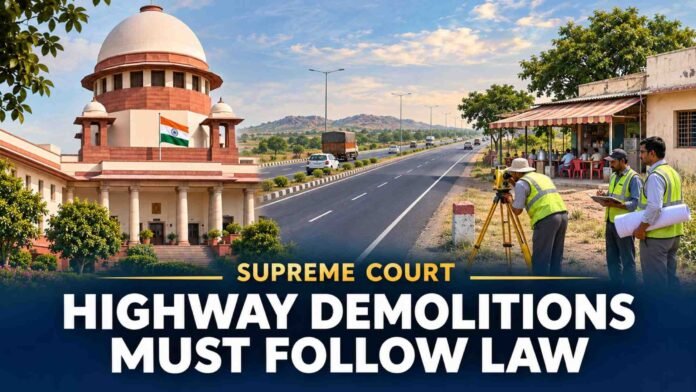
The Supreme Court clarified that its nationwide road safety directions do not, by themselves, establish that any particular structure encroaches on a National Highway. The National Highways Authority of India (NHAI) and other authorities must determine whether a structure unlawfully occupies highway land and follow the applicable statutory procedure before removing it.
The Bench of Justices Vikram Nath and Aparesh Kumar Singh issued the clarification in the suo motu proceedings initiated after road accidents at Phalodi in Rajasthan and elsewhere. It disposed of a batch of applications challenging proposed demolitions and permitted the applicants to take their individual disputes to the jurisdictional High Courts. Applicants who had already filed proceedings before those courts may pursue them.
Buy Now: 90+ Supreme Court Judgments E-Magazine – October 2026
The bench allowed landowners and occupiers to approach their jurisdictional High Courts and barred coercive action against the disputed structures covered by the applications until those proceedings are decided.
The Supreme Court issued interim directions covering highway inspections, surveys, encroachment reporting and removal. The order prohibited the construction or operation of new dhabas, eateries and commercial structures within the right of way of National Highways. It also directed district magistrates to secure removal of unauthorised structures within 60 days in accordance with the Control of National Highways (Land and Traffic) Act, 2002 and the standard operating procedure dated August 7, 2025.
As authorities began acting on those directions, several landowners and occupiers challenged the proposed removal of structures they claimed stood on private property. Applications concerning National Highway 48 in Gujarat included disputes over the highway boundary in Valsad and Navsari. One applicant operating a hotel in Navsari challenged NHAI’s demarcation and claimed the affected land had never been acquired or compensated for. Other applicants relied on sale deeds or challenged the notice and survey process.
NHAI maintained that clearing encroachments was necessary for road safety and that, in several cases, notices and measurements supported its action under the 2002 Act. It also argued that disputes over ownership and boundaries raised factual questions for a competent court.
The Supreme Court held that its April directions imposed a duty to identify and clear unauthorised encroachments. Whether a particular structure fell within the highway’s right of way still required a determination under the applicable law. A claim of private ownership alone could not prevent lawful action, and an authority’s assertion that a structure lay within the right of way could not substitute for the required determination when the boundary itself was disputed.
The Bench explained that Section 26(2) to (6) provides for notice identifying the highway land concerned, an opportunity to make a representation and consideration of the affected person’s response. It referred to Gyan Prakash v. Union of India and Others, 2025 SCC OnLine SC 1189, on the importance of this procedure to natural justice.
Section 26(7) and (8) allow removal without prior notice in specified circumstances. The Court said authorities invoking those provisions must satisfy their statutory conditions. The April road safety directions provide no independent basis for dispensing with those requirements.
Membership Required to Access Case Details & Order Copy
To view the complete Case Details and Download Order Copy, you must have an active membership. Please subscribe to continue.

