
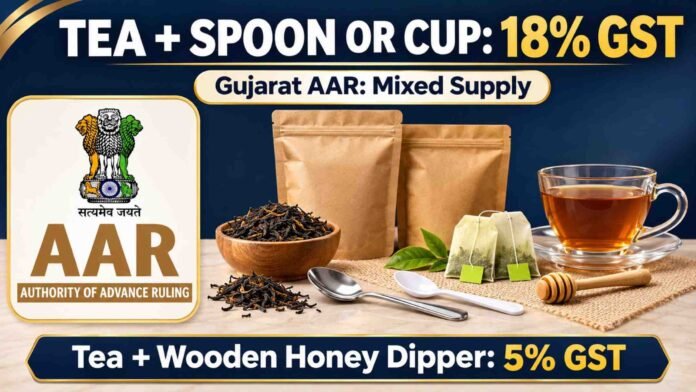
The Gujarat Authority for Advance Ruling (AAR) has held that tea supplied with stainless steel spoons, plastic spoons or glass tea cups in a single retail pack constitutes a mixed supply attracting 18% GST, rejecting the contention that the entire pack should receive the lower tax treatment applicable to tea.
However, the Authority ruled that the proposed combinations of green tea, herbal tea and pyramid tea bags with wooden honey dippers would attract 5% GST, since both components attracted that rate. These combinations were also classified as mixed supplies.
Buy Now: All 200+ GSTAT Judgements Till November 2026 | Comprehensive E-Magazine
The issue raised was whether a single price, one invoice description and the relatively insignificant value of an accompanying article are sufficient to establish a composite supply.
The Surat-based applicant manufactures, packs and supplies various tea products, including black tea, CTC tea, flavoured tea, green tea and herbal tea.
It proposed including articles such as stainless steel teaspoons, plastic teaspoons, glass tea cups, wooden honey dippers and plastic honey spoons in selected tea packs.
The proposed combinations covered five-kilogram black tea pouches, 250-gram and 500-gram CTC black tea jars, saffron and rose flavoured black tea, green tea, herbal tea and pyramid tea bags.
According to the applicant, the accompanying articles would facilitate the preparation and consumption of tea and familiarise new customers with the products.
The company sought clarification on whether these combinations constituted composite supplies or mixed supplies, their applicable GST rates and the HSN codes to be mentioned.
The applicant submitted that tea was the sole principal product offered for sale and that the customer’s primary intention was to purchase tea.
It argued that the accompanying article would be insignificant in value compared with the tea and supplied without separate consideration. The item would not be advertised as a free gift or incentive and would have no independent commercial objective in the transaction.
Each retail pack would carry a single MRP. The invoice would contain one line describing the supply as tea, without assigning a separate value, HSN code or tax rate to the accompanying article.
The applicant therefore sought composite supply treatment, with tea constituting the principal supply.
The Authority examined the definition of composite supply under Section 2(30) of the Central Goods and Services Tax Act, 2017, together with the definition of principal supply under Section 2(90).
It explained that identifying a predominant product is only part of the enquiry. The components must also be naturally bundled and supplied together in the ordinary course of business.
The Authority observed that, if the proposed combinations were assumed to constitute composite supplies, tea would represent the predominant element. However, that did not dispense with the separate requirement of natural bundling.
It referred to indicators discussed in CBIC Flyer No. 4 dated August 5, 2019, including consumer expectations, normal business practices, the relationship between the components and whether removing an item would affect the nature of the overall supply.
Applying these indicators, the Authority found that consumers purchasing tea do not ordinarily expect it to be supplied with a spoon, cup or honey dipper.
It also observed that comparable businesses do not routinely provide such combinations in the ordinary course of trade.
The accompanying articles were not integral to the supply of tea. Their removal would not change the nature of that supply.
Consequently, the Authority rejected the proposed combinations’ classification as composite supplies. Describing an article as incidental or ancillary did not establish that it was naturally bundled with tea.
The Authority next examined the definition of mixed supply under Section 2(74).
It found that the proposed packs comprised individual goods supplied together for a single price, without qualifying as composite supplies. Tea and the accompanying articles could be sold separately in the market and were not dependent on each other.
The combinations therefore satisfied the requirements of mixed supply.
Under Section 8, a composite supply is treated as a supply of its principal component. A mixed supply, however, is treated as a supply of the component attracting the highest tax rate.
The Authority recorded a 5% GST rate for the tea products covered by the application. Stainless steel spoons, plastic teaspoons, plastic honey spoons and glass tea cups attracted 18% GST.
Accordingly, packs containing tea and these accessories were held taxable at 18%, comprising 9% CGST and 9% SGST.
The wooden honey dipper was recorded as attracting 5% GST. Although the applicant had initially described this item as taxable at 18%, the Authority’s rate table and final answers applied 5%.
Since both tea and the wooden honey dipper attracted 5%, the proposed combinations of premium green tea, herbal tea and pyramid tea bags with wooden honey dippers were held taxable at 5%.
| Combination considered | Classification | GST on combined supply |
| Black tea, CTC tea or flavoured black tea with stainless steel teaspoon | Mixed supply | 18% |
| Black tea, CTC tea or flavoured black tea with plastic teaspoon | Mixed supply | 18% |
| Tea products covered by the application with glass tea cup | Mixed supply | 18% |
| Premium green tea, herbal tea or pyramid tea bags with plastic honey spoon | Mixed supply | 18% |
| Premium green tea, herbal tea or pyramid tea bags with wooden honey dipper | Mixed supply | 5% |
The 5% rate for wooden honey dipper combinations followed from the equal rates applicable to both components. It did not result from acceptance of the applicant’s composite supply argument.
The Authority also clarified the HSN treatment of the proposed mixed supplies.
Where the components attracted different GST rates, it held that the HSN code of the component attracting the highest rate should be mentioned.
The ruling recorded HSN 82159900 for stainless steel spoons, HSN 39241090 for plastic teaspoons and plastic honey spoons, and HSN 70139900 for glass tea cups. Wooden honey dippers were recorded under HSN 44199090.
Where both components attracted the same rate, the Authority observed that the CGST Act was silent on the choice of HSN code. It ruled that the HSN code of either component could be mentioned in those cases.
Membership Required to Access Case Details & Order Copy
To view the complete Case Details and Download Order Copy, you must have an active membership. Please subscribe to continue.
Read More: Biodegradable Packing Bags Attract 5% GST Subject To Proof Of Biodegradability: AAR

