
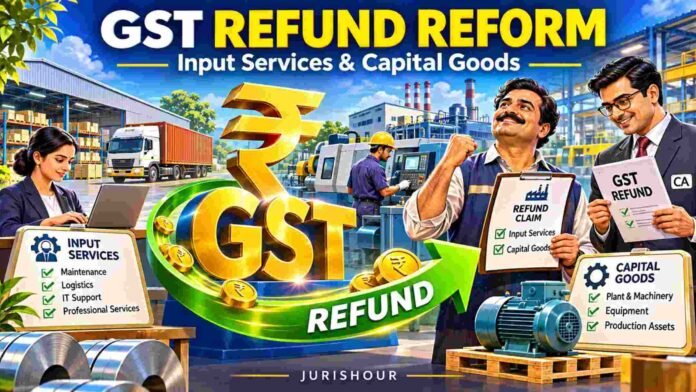
India’s move towards a broader GST refund framework could ease the financial pressure on businesses whose tax credits accumulate because of an inverted duty structure. The reform addresses a longstanding concern: manufacturers incur GST on services essential to production, but the earlier refund mechanism excluded those service credits from its principal calculation.
At its 57th meeting on October 8, 2026, the GST Council recommended widening the framework to cover input services and capital goods. It proposed relief for input-service credits availed on or after November 1, 2026, followed by capital-goods credits availed on or after April 1, 2027. The Council also recommended corresponding changes to the CGST Act and Rules.
Buy Now: All 200+ GSTAT Judgements Till November 2026 | Comprehensive E-Magazine
Why Accumulated Tax Credit Creates Difficulties
An inverted duty structure generally arises when the GST rate on inputs exceeds the rate applicable to outward supplies. A business may consequently accumulate more input tax credit than it can use against its output tax liability.
The financial effect extends beyond a balance appearing in the electronic credit ledger. Businesses pay tax when procuring goods and services, while their ability to recover that amount through utilisation or refund may remain restricted. Persistent accumulation can therefore absorb funds needed for purchases, wages and other operating expenses.
The supplied article identifies footwear, textiles, fertilisers and renewable-energy equipment among the sectors affected by this issue.
Why Service Credits Became Contentious
The dispute centres on the difference between entitlement to input tax credit and entitlement to a cash refund of unutilised credit.
Manufacturing involves expenditure on transportation, storage, testing, design, maintenance and outsourced processing. Although these services support production, the earlier inverted-duty refund formula treated their tax credits differently from credits arising from purchases of input goods.
The clipping explains that businesses challenged this distinction because the refund calculation could leave service-related credit stranded even where the expenditure formed an integral part of their taxable operations.
Supreme Court Upheld the Earlier Restriction
The controversy reached the Supreme Court after the Gujarat and Madras High Courts adopted different approaches to the exclusion of input services.
In Union of India v. VKC Footsteps India Pvt. Ltd., decided on September 13, 2021, the Supreme Court upheld the validity of Rule 89(5). It set aside the Gujarat High Court’s decision and affirmed the Madras High Court’s view.
The Court nevertheless recognised concerns surrounding the formula and called upon the GST Council to reconsider the issue. Its decision distinguished the legal validity of the existing framework from the policy question of whether that framework required improvement.
Earlier Formula Revision Offered Limited Relief
As described in the supplied article, Notification No. 14/2022–Central Tax revised the refund formula in July 2022 by changing the treatment of output tax payable within the calculation.
That adjustment addressed part of the imbalance. However, input services continued to remain outside the earlier definition of “Net ITC” for inverted-duty refunds, leaving the broader question unresolved.
New Framework Addresses Services and Capital Goods
The clipping reports that Notification No. 05/2026–Central Tax, dated October 26, 2026, subsequently amended Rule 89 to extend the calculation to eligible input-service credits availed from November 1, 2026.
Capital-goods relief follows a separate timeline. The official FAQs explain that eligible credits availed from April 1, 2027, are intended to enter the refund calculation proportionately over 60 months. This means the entire credit on machinery would not become refundable in the month it is availed. The capital-goods measure covers both specified zero-rated refunds and inverted-duty refunds.
Higher Tax on Services Alone Does Not Establish Eligibility
A significant qualification remains: including service credits in the calculation does not independently create an inverted-duty refund entitlement.
The government’s FAQs state that inversion must still be established by comparing the tax rate on input goods with the rate on output supplies. A higher GST rate on input services alone does not satisfy that requirement. Once qualifying inversion exists, eligible service credits can enter the refund computation, subject to the applicable provisions.
Statutory Consistency Will Shape the Reform’s Effect
The supplied article also raises a legislative concern: the language of Section 54(3) must align with the revised rules to provide a consistent legal foundation. It reports that the relevant statutory clause remains unamended.
The distinction matters because a Council recommendation, an amendment to the Rules and an amendment to the parent Act represent separate legal steps. The Council’s own recommendations expressly contemplated changes to both the Act and Rules.
For eligible businesses, the reform offers a route towards reducing accumulated credits and improving cash availability. Its practical impact will depend on the applicable commencement dates, admissibility of the underlying credits, the refund formula and completion of the necessary legislative alignment.
Read More: JURISHOUR | TAX LAW DAILY BULLETIN : 14 NOVEMBER, 2026

