
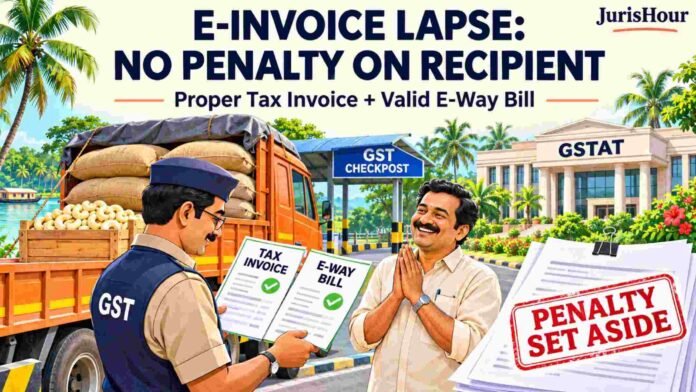
The Goods and Services Tax Appellate Tribunal (GSTAT), Thiruvananthapuram Bench, has held that a recipient of goods in an interstate supply cannot be penalised under Section 129(1) of the CGST/KGST Act merely because the supplier failed to generate an e-invoice, where the consignment was accompanied by a proper tax invoice and a valid e-way bill.
Allowing an appeal involving the interstate movement of cashew kernels, the bench of Subramanya Rayaprol (Vice-President) and Ramamoorthi Sriram (Technical Member) set aside the appellate order sustaining a penalty of ₹1,01,631. It held that the responsibility for preparing an e-invoice rests with the supplier and that the recipient could not be penalised for that omission in the circumstances of the case.
Buy Now: All 200+ GSTAT Judgements Till November 2026 | Comprehensive E-Magazine
The dispute arose from the movement of 4,182 kg of cashew kernels from the appellant’s Tamil Nadu branch to its Kerala branch by way of stock transfer.
The consignment travelled under Invoice No. 37/2021-22 dated November 13, 2021, and E-Way Bill. The vehicle was intercepted by the Mobile Squad at Ithikara in Kollam on November 14, 2021.
According to the order, there was no discrepancy in the quantity or description of the goods, and the e-way bill was valid at the time of interception. The alleged defect was that the supplier, which was covered by the e-invoicing requirement, had issued an ordinary tax invoice without generating the prescribed e-invoice.
The authorities detained the goods and imposed a penalty of ₹1,01,631 under Section 129(1), equal to the GST amount recorded in the proceedings. The Joint Commissioner (Appeals)-I, Kollam, upheld the action through an order dated April 27, 2022, prompting the appeal before GSTAT.
The department argued that Rules 48(4) and 48(5) of the CGST/KGST Rules were mandatory. It submitted that an invoice issued by a person covered by Rule 48(4), otherwise than in the prescribed manner, could not be treated as an invoice under Rule 48(5).
On that basis, the department maintained that an ordinary tax invoice and an e-way bill did not automatically cure the failure to generate an e-invoice.
It also disputed the appellant’s reliance on the transaction being a stock transfer. The department argued that supplies between separately registered branches in different States constitute taxable interstate supplies, even where the registrations belong to the same business.
The department further rejected the plea that the e-invoicing requirement was new and that the appellant had insufficient time to become familiar with it, pointing to the period between the applicable notification and the interception.
The Tribunal framed the central issue as whether a recipient could face a penalty under Section 129(1) when the transporter carried a proper tax invoice and a valid e-way bill, but the interstate supplier had not prepared an e-invoice on the date of supply.
It found that the invoice and e-way bill were available with the transporter and that their particulars were not disputed. There was no discrepancy in the goods’ quantity or description, nor any defect in the validity of the e-way bill.
On these facts, the Bench held that the vehicle should have been allowed to proceed. It concluded that the supplier’s non-issuance of an e-invoice did not justify detention and the imposition of the disputed penalty on the recipient.
The appellant produced the tax invoice and the Tamil Nadu unit’s GSTR-1 reflecting the invoice, a taxable value of ₹21,34,254 and IGST of ₹1,01,631.
The Tribunal also noted that the same invoice appeared in the recipient’s GSTR-2B. On the material before it, the Bench treated the transaction as an IGST-paid supply.
It held that, for the transit check in question, the recipient’s obligation was to carry the proper tax invoice and valid e-way bill and produce them before the checking officer.
Examining Section 31 and Rules 46 and 48, the Tribunal observed that the duty to prepare the tax invoice or e-invoice rests with the registered supplier.
The Bench reasoned that only the supplier could issue the e-invoice for the supply and that the recipient could not be implicated for the supplier’s omission merely because it received the goods.
It found that the appellant, in its capacity as recipient, had not contravened Section 31 or Rules 46 and 48 so as to attract the disputed penalty under Section 129(1).
The order also referred to Circular No. 160/16/2021-GST dated September 20, 2021, in discussing the absence of a requirement to physically carry an e-invoice. These observations formed part of the Tribunal’s reasoning on the transit proceedings; the Bench separately recognised that e-invoicing is mandatory for notified classes of suppliers.
The Tribunal observed that an omission in preparing an e-invoice under Rule 48(4) could be examined by the supplier’s jurisdictional GST officer during scrutiny, audit or assessment of its records and returns.
The competent officer could then take action as prescribed under GST law.
The decision therefore distinguishes the supplier’s compliance obligation from the recipient’s liability in the particular detention proceedings. It does not treat the e-invoicing requirement itself as optional.
Although it granted relief against the penalty, the Tribunal did not accept that the branch-transfer character of the transaction removed its taxability.
It observed that the Tamil Nadu and Kerala units held separate GST registrations and were distinct taxpayers. The movement between them constituted an interstate supply attracting IGST, despite the common PAN.
The relief thus concerned the sustainability of the Section 129 penalty on the recipient, rather than an exemption for the stock transfer.
The Bench relied on the Kerala High Court’s decision in Osel Devices Limited v. Assistant Enforcement Officer.
As reproduced in the Tribunal’s order, that decision concerned goods transported under invoices and an e-way bill, with non-generation of an e-invoice being the defect alleged. The Kerala High Court applied the reasoning in T.P. Metal Roofings on the treatment of minor discrepancies and the circumstances warranting proceedings under Section 129.
The Tribunal also referred to Nancy Trading Company v. State of U.P. and Others. The passages reproduced in the order addressed the absence of discrepancies in the accompanying documents and goods, and the lack of a finding of an intention to evade tax.
These authorities supported the Bench’s conclusion that the disputed Section 129 penalty could not be sustained on the facts before it.
The Tribunal set aside Order-in-Appeal and allowed the appeal with consequential relief.
A separately numbered rectification application was disposed of as erroneous and infructuous. The appellant’s counsel explained that it had been mistakenly filed while uploading additional documents.
The operative order does not prescribe a separate deadline for granting the consequential relief.
Membership Required to Access Case Details & Order Copy
To view the complete Case Details and Download Order Copy, you must have an active membership. Please subscribe to continue.
Read More: Export Refund Must Follow Net ITC In GSTR-3B: GSTAT

