
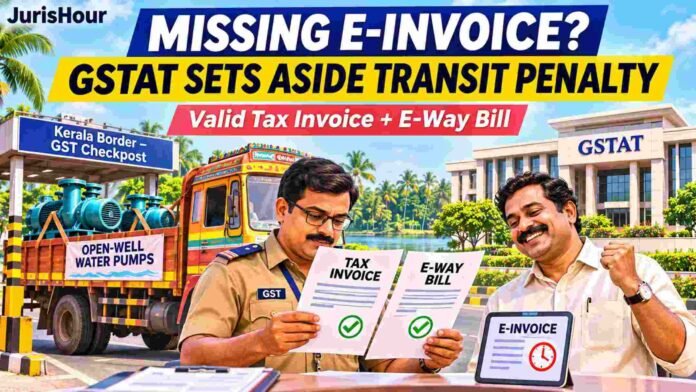
The Goods and Services Tax Appellate Tribunal (GSTAT), Ernakulam Bench, has set aside proceedings arising from the transportation of goods without an e-invoice, holding that the consignment was accompanied by a proper tax invoice and a valid e-way bill, with no discrepancy in the description or quantity of goods.
The bench of Subramanya Rayaprol (Vice-President) and Ramamoorthi Sriram (Technical Member) has observed that the Kerala tax officer lacked jurisdiction to issue the disputed notices and orders to a Tamil Nadu-registered person without first generating a Kerala temporary identification number. Subsequent generation of the temporary ID while uploading the summary of the adjudication order did not validate the earlier proceedings.
Buy Now: All 200+ GSTAT Judgements Till November 2026 | Comprehensive E-Magazine
The dispute concerned the transportation of 200 Crompton open well pumps from Coimbatore to Crompton Greaves Consumer Electronics, Kochi. The goods were covered by a tax invoice and an e-way bill, both dated February 10, 2021.
The vehicle was intercepted at Walayar, Palakkad, on February 11, 2021. Physical verification disclosed no discrepancy between the goods and the description or quantity mentioned in the accompanying documents. The e-way bill was also valid at the time of interception.
The objection related to the absence of an e-invoice. The company submitted that the e-invoice was generated on February 11, 2021, the day after the tax invoice, and furnished to the authorities. It attributed the initial failure to technical reasons and maintained that the transaction had been disclosed in GST returns and the applicable tax paid.
The goods and vehicle were provisionally released against a bond and bank guarantee. However, the adjudicating officer confirmed the tax and penalty demand on April 16, 2021. The Joint Commissioner (Appeals), Palakkad, subsequently rejected the company’s appeal on December 30, 2021.
The Revenue argued that the company’s aggregate turnover exceeded ₹100 crore and that it was required to generate e-invoices from January 1, 2021, under Notification No. 88/2020-Central Tax.
According to the Department, the invoice particulars should have been uploaded to the Invoice Registration Portal to obtain an Invoice Reference Number and the associated QR code.
The Revenue maintained that generating the e-invoice after interception did not excuse the original contravention. It further argued that, without interception, the transaction might not have been reported through the e-invoicing system, potentially resulting in tax evasion.
On this basis, it defended the detention and proceedings under Section 129.
The Tribunal examined the issuance of Form GST MOV-07 on February 11, 2021, and Form GST MOV-09 on April 16, 2021, against the company’s Tamil Nadu GST registration.
It found that a Kerala temporary ID was generated only on June 28, 2021, when Form GST DRC-07, containing the summary of the adjudication order, was issued.
The Bench held that the Assistant State Tax Officer, Palakkad, had exceeded his jurisdiction by issuing the notices and orders to the registered person in another State without first generating the temporary ID.
The subsequent generation of that ID did not cure the defect. Consequently, the Tribunal treated the disputed MOV-07 and MOV-09 proceedings as null and void from inception.
On the merits, the Tribunal emphasised that the transporter carried a proper tax invoice and a valid e-way bill. There was no mismatch in the quantity or description of goods and no discrepancy in the e-way bill.
In these circumstances, the Bench held that the vehicle should have been allowed to proceed. The absence of the e-invoice at interception, when it was subsequently generated and produced, did not justify detention and penalties on the facts before it.
The order records a taxable value of ₹7,80,158.80 and IGST of ₹93,619.06. Referring to the invoice and GST return records produced, the Tribunal accepted that the transaction was tax-paid.
While examining Section 31 and Rules 46 and 48, the Tribunal distinguished the supplier’s invoicing obligations from the position of the recipient.
In its recipient-related reasoning, the Bench held that a recipient could not be penalised under Section 129 merely because the supplier had failed to prepare an e-invoice, where the transporter carried a proper tax invoice and valid e-way bill.
The Tribunal observed that the responsibility for generating the e-invoice rested with the supplier. It held that the recipient could not be treated as having breached the supplier’s invoicing obligations merely because of that omission.
The Bench further observed that an omission under Rule 48 should be examined by the supplier’s jurisdictional GST officer during scrutiny, assessment or audit, with appropriate action under GST law.
The Bench relied on the Kerala High Court’s decision in Osel Devices Limited v. Assistant Enforcement Officer, which applied the principles discussed in T.P. Metal Roofings concerning minor discrepancies and proceedings under Section 129.
As reproduced in the Tribunal’s order, those decisions distinguished minor documentation lapses from violations involving potential tax evasion, an intention to evade tax or repeated violations. They also recognised that other penalty provisions could require consideration depending on the circumstances.
The Tribunal additionally relied on the Allahabad High Court’s decision in Nancy Trading Company v. State of U.P., concerning non-generation of an e-invoice where the goods otherwise travelled with the required documents and no finding of an intention to evade tax had been recorded.
Drawing support from these authorities, the Bench held that the disputed Section 129 penalty could not be sustained.
Membership Required to Access Case Details & Order Copy
To view the complete Case Details and Download Order Copy, you must have an active membership. Please subscribe to continue.
Read More: Digestion-Based Time-of-Death Estimates Can’t Displace Reliable Eyewitness Accounts: Supreme Court

