
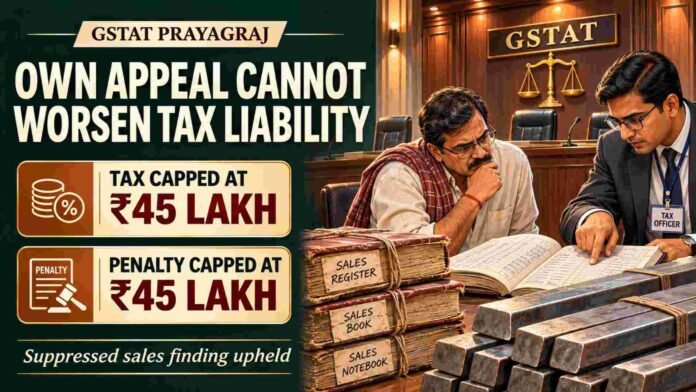
The Goods and Services Tax Appellate Tribunal (GSTAT), Prayagraj Bench, has upheld a finding of suppressed sales against an iron and steel trader while restricting the tax and penalty to ₹45 lakh each, holding that a taxpayer cannot be placed in a worse position after securing a remand through its own challenge.
The Bench of Mahtab Ahmad (Judicial Member) and Ashish Varma (Technical Member) has observed that sales notebooks recovered from the trader’s premises, supported by the proprietor’s unretracted admissions and surrounding circumstances, constituted sufficient evidence of unreported outward supplies.
Buy Now: 210+ GST Judgments E-Magazine – October 2026
However, the Tribunal modified the amounts confirmed after remand by applying the principle of no reformatio in peius, which prevents an appellant from being worse off as a consequence of pursuing its own appeal.
The dispute concerned the period September 2017 to March 2018. The taxpayer traded in iron and steel goods, including sheets, angles, channels, sariya and pipes.
On March 23, 2018, officers of the Special Investigation Branch surveyed its godown-cum-office in Prayagraj in the presence of the proprietor and two independent witnesses. Retail sales were underway, and a vehicle was unloading iron goods.
According to the Panchnama discussed in the judgment, the proprietor stated that no stock register was maintained and no tax invoice had been issued for that day’s transactions. He explained that retail sales were recorded on numbered duplicate-copy Natraj pads. Original leaves were handed to customers, while the counterparts were destroyed after use.
Officers seized stock and four packets of private records, marked Sanket-01 to Sanket-04. Sanket-02 contained three bound notebooks with 46 written pages of dated sales entries totalling ₹2,52,01,836.
A show-cause notice under Section 74 was issued on December 21, 2019. Following the taxpayer’s failure to respond to the notice and subsequent reminders, an ex parte adjudication order dated December 31, 2021 confirmed tax of ₹1.26 crore, interest of ₹1,18,98,286 and penalty of ₹1.26 crore.
The aggregate demand of ₹3,70,98,286 was based on estimated evaded sales of ₹7 crore.
The first appellate order, dated September 10, 2024, reduced the estimated evaded sales to ₹2.50 crore and fixed tax and penalty at ₹45 lakh each, along with interest of ₹56.70 lakh.
The High Court subsequently set aside that order on September 2, 2025. It noted that evaded sales had been fixed above the figure of evaded purchases without assigning reasons and directed a fresh, reasoned decision after hearing all stakeholders.
On remand, the First Appellate Authority undertook an exhibit-wise reconciliation. It accepted the taxpayer’s explanations concerning Sanket-01, Sanket-03 and Sanket-04 but rejected the explanation for Sanket-02.
Applying GST at 18% to the notebook entries, the authority confirmed tax of ₹45,36,330, an equal penalty and interest of ₹70,78,166.
Before GSTAT, the taxpayer argued that the notebooks were uncorroborated “dumb documents” left behind by visiting brokers or transporters. It relied on the absence of transport records, buyer statements and evidence of receipt of sale proceeds.
The Tribunal rejected this explanation.
It observed that the notebooks were recovered from the taxpayer’s own premises in the same seizure as other account books and invoice records which the taxpayer had accepted and reconciled.
The entries recorded dates, descriptions of iron goods, weight, rates, realisation and buyers. Several buyers appeared repeatedly, and the goods corresponded to the taxpayer’s established line of business.
The proprietor’s contemporaneous explanation of how duplicate sales pads were used also supported the connection between the notebooks and the business. The Tribunal noted that this statement had never been retracted through an affidavit or complaint.
Further, the taxpayer had not named any broker or transporter who allegedly owned the notebooks, furnished their address or GSTIN, or produced an affidavit supporting that claim.
The Tribunal accepted the general principle that loose papers, third-party records and unauthenticated electronic data cannot alone establish liability without reliable evidence connecting them to the taxpayer.
It nevertheless held that the seized notebooks stood on a different footing. They were bound records of daily sales recovered from the taxpayer’s custody, directly related to its trade and supported by the proprietor’s admissions.
The Bench also distinguished decisions concerning clandestine manufacture, where evidence relating to excess raw materials, power consumption and unrecorded production may be relevant.
Here, the taxpayer was a trader. There was no manufacturing chain to prove. The issue was whether the sales recorded in its notebooks had actually occurred, which the Tribunal answered against the taxpayer based on the records and surrounding evidence.
The taxpayer also relied on the absence of unaccounted purchases and stock discrepancies.
The Tribunal held that an unrecorded sale does not necessarily require a corresponding unrecorded purchase. A trader may purchase goods against proper invoices while failing to report some subsequent sales in its returns.
On stock reconciliation, the Bench noted that no stock register had been maintained. Consequently, there was no book record against which the physical stock could be compared. The absence of a recorded discrepancy therefore did not disprove suppressed sales.
The Tribunal also distinguished the demand based on actual notebook entries from the original authority’s estimate of ₹7 crore.
The Bench agreed with the taxpayer that Section 155, which concerns the burden of establishing eligibility for input tax credit, did not apply to the present dispute.
However, it held that the evidentiary question was governed by Rule 56(10) and general principles of evidence.
The Tribunal found that the Revenue had established sufficient circumstances connecting the records to the taxpayer. It was then for the taxpayer to explain matters concerning those records that lay within its particular knowledge.
According to the Bench, the taxpayer failed to discharge that burden.
The Tribunal upheld proceedings under Section 74, finding that the circumstances established suppression with intent to evade tax.
It relied on the failure to declare the notebook sales in GSTR-1 and GSTR-3B, the practice of destroying counterpart sales pads, the absence of a stock register and the sales without invoices observed during the survey.
The Bench distinguished these circumstances from a mere failure to pay tax, a bona fide mistake or a difference in interpretation.
It accordingly rejected the contention that proceedings should have been initiated under Section 73 and sustained the equal-tax penalty, subject to the monetary restriction.
The Tribunal’s modification turned on the difference between the first appellate order and the order passed after remand.
The earlier order had fixed tax and penalty at ₹45 lakh each. The fresh order increased both components to ₹45,36,330.
The Bench rejected the taxpayer’s objection under the provisos to Section 107(11), observing that the fresh demand remained below the original adjudicated demand and within the show-cause notice.
Nevertheless, applying the principle discussed in Saudi Arabian Airlines v. Union of India, cited in the judgment, it held that the taxpayer could not be left worse off after securing a remand through its own challenge.
Accordingly, even though the notebook entries yielded a higher tax calculation, the Tribunal capped tax and penalty at ₹45 lakh each.
The Tribunal directed that interest under Section 50 be calculated on the confirmed tax of ₹45 lakh.
For the period up to September 10, 2024, interest cannot exceed ₹56.70 lakh, the amount fixed in the earlier appellate order. Further interest remains payable thereafter until payment.
The Bench also identified a ₹27,000 arithmetic discrepancy in the total stated in the impugned order. That discrepancy did not survive the modification of the demand.
Any arithmetic error in interest computation discovered during recovery may be corrected in accordance with law after giving the taxpayer an opportunity of hearing, subject to the limits imposed by the Tribunal.
The Tribunal held that service of the notice on the common portal was valid under Section 169(1)(d). It also noted the reminders and the taxpayer’s failure to appear despite a summons.
Regarding non-supply of the SIB report and videography, the Bench observed that the taxpayer had not sought inspection or copies of the seized records under Section 67(5) and had not demonstrated how those materials would have assisted its defence.
It further relied on the detailed reconciliation undertaken with the taxpayer’s participation after remand, which resulted in relief on three of the four exhibits.
A reference to Section 63 in the preamble of the appellate order was treated as a clerical error protected by Section 160, since the proceedings substantively concerned Section 74.
GSTAT dismissed the appeal on merits while modifying the demand to ₹45 lakh tax and ₹45 lakh penalty, each divided equally between CGST and UPGST.
Membership Required to Access Case Details & Order Copy
To view the complete Case Details and Download Order Copy, you must have an active membership. Please subscribe to continue.
Read More: GSTR-3B–GSTR-2A Mismatch Alone Can’t Sustain ITC Demand: GSTAT

