
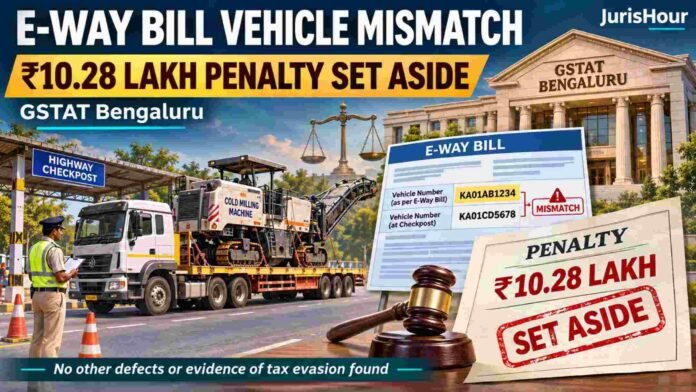
The Goods and Services Tax Appellate Tribunal (GSTAT), Bengaluru, has set aside a penalty of ₹10,28,380 imposed under Section 129 of the Central Goods and Services Tax Act, 2017, holding that a vehicle-number mismatch in an e-way bill did not, by itself, establish an intention to evade tax in the circumstances of the case.
The Bench of Srikanth Venkatraman (Judicial Member) and Sudha Koka (Technical Member) found that the machinery was accompanied by an e-way bill and a delivery challan, physical verification disclosed no defects, and the authorities had relied on no material other than the vehicle-number discrepancy to justify the penalty.
Buy Now: 210+ GST Judgments E-Magazine – October 2026
The appellant/assessee undertakes activities involving renting, leasing, subcontracting and job work relating to road-laying machinery and equipment across India.
The dispute arose when a cold milling machine was transported from Tiruvannamalai in Tamil Nadu to Mangaluru in Karnataka for subcontract work. The consignment was intercepted at the Attibele check post at approximately 2.20 a.m. on February 19, 2023.
The officers found that the machine was being carried in vehicle whereas Part B of the e-way bill.
The appellant explained that the discrepancy arose from incorrect communication by the transporter and requested release of the consignment. However, the proper officer treated the documents as defective and imposed a penalty of ₹10,28,380 under Section 129(1)(a).
The appellant paid the penalty to secure release of the consignment. The Joint Commissioner of Commercial Taxes (Appeals)-8, Bengaluru, subsequently upheld the penalty through an order dated March 31, 2025, prompting the appeal before GSTAT.
The appellant submitted that the transporter had loaded the machinery in a different vehicle without informing the appellant. Consequently, the e-way bill contained the registration number communicated earlier.
He argued that there was no intention to evade tax and that the consignment was accompanied by a delivery challan issued under Rule 55 of the CGST Rules.
The appellant relied on the Allahabad High Court decisions in BMR Enterprises v. State of UP and Varun Beverages Limited v. State of UP to contend that a documentary discrepancy, without an intention to evade tax, did not justify the penalty.
Representing the department, Assistant Commissioner Prakash submitted that an e-way bill bearing another vehicle’s registration number could not be treated as valid for the actual vehicle merely because the goods and other particulars were genuine.
The department argued that a distinction had to be drawn between a trivial documentary defect and a situation where the transport document did not correspond to the actual conveyance.
It relied on judicial decisions concerning incomplete or incorrect transportation documents, including cases involving failure to enter vehicle particulars in Part B of an e-way bill.
Examining the documents, the Tribunal noted that the e-way bill recorded the reason for transportation as “outward – Job Work”.
It referred to delivery challan PL/343/22-23, issued in the name of Vishal Infrastructure Limited, Mangaluru. The challan expressly recorded that the machine was being sent for milling job work and was not for sale.
The Tribunal found that the proper officer had identified no other defect in the transportation. It also observed that neither the proper officer nor the appellate authority had considered the appellant’s explanation concerning the transporter’s incorrect communication while confirming the penalty.
The Bench clarified that furnishing correct conveyance particulars under Rule 138 is a statutory requirement and cannot be regarded as an empty formality.
However, it held that the nature and extent of the discrepancy could not, by themselves, establish an intention to evade tax. The appellant’s explanation, accompanying documents and surrounding circumstances had to be examined cumulatively.
The Tribunal accepted the explanation because physical verification of the consignment revealed no defects and the authorities had relied on no other material to establish an intention to evade tax.
The relief thus rested on the particular facts of the movement, including the job-work documentation, the transporter’s explanation and the absence of any further discrepancy.
The Tribunal rejected the appellate authority’s reasoning that mens rea, or intention, was irrelevant to invoking Section 129 in the case before it.
It relied on the Supreme Court’s decision in Assistant Commissioner (ST) v. Satyam Shivam Papers Private Limited, which it read as supporting the requirement to examine intention before invoking Section 129.
The Bench noted that the Supreme Court had approved the reasoning that expiry of an e-way bill’s validity, without supporting material, did not establish an intention to evade tax.
It also relied on the Karnataka High Court’s decision in BVM Trans Solutions Private Limited v. Commercial Tax Officer, concerning failure to fill Part B of an e-way bill where there was no intention to evade tax.
Distinguishing the Madhya Pradesh High Court decisions cited by the department concerning unfilled Part B particulars, the Tribunal emphasised that it was bound by the jurisdictional Karnataka High Court.
The Tribunal distinguished Commercial Tax Officer v. Bajaj Electricals Limited, which concerned materially different documentation under the Rajasthan Sales Tax Act.
That case involved documents left blank except for a signature, preventing verification of the declaration particulars. The Tribunal observed that the relevance of mens rea depends on the statutory provision and the nature of the contravention.
It also found support in the Allahabad High Court rulings in BMR Enterprises and Varun Beverages. In particular, it noted that BMR Enterprises concerned a discrepancy between the vehicle registration number in the e-way bill and the actual vehicle, without other material indicating an intention to evade tax.
Holding that the penalty under Section 129 was unwarranted on the facts, GSTAT allowed the appeal and set aside the appellate order dated March 31, 2025.
The Tribunal directed the respondent to give effect to its order within eight weeks.
The demand summary records the disputed penalty of ₹10,28,380—comprising ₹5,14,190 each under central and state tax—as reduced to nil.
Membership Required to Access Case Details & Order Copy
To view the complete Case Details and Download Order Copy, you must have an active membership. Please subscribe to continue.
Read More: Madras High Court Summons GST Commissioner Over Repeated Absence Of Central Government Counsel

