
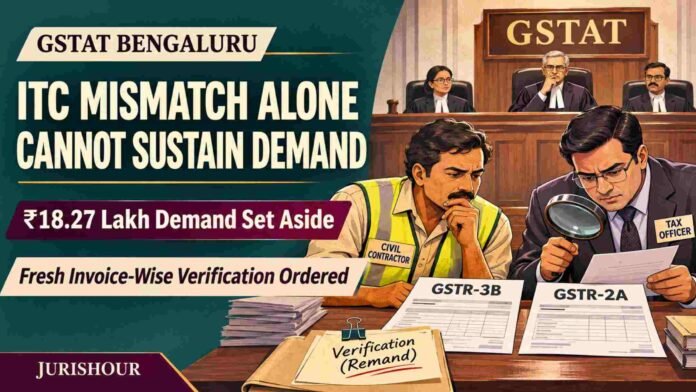
The Goods and Services Tax Appellate Tribunal (GSTAT), Bengaluru Bench, has set aside a demand of ₹18.27 lakh against a civil contractor, holding that a difference between input tax credit claimed in GSTR-3B and credit reflected in GSTR-2A cannot, by itself, justify recovery without verification of invoices and statutory eligibility conditions.
The Bench of Prabhakaran P.M. (Judicial Member) and Ravi Jesuraj S. (Technical Member) also held that the first appellate authority must decide an appeal on merits even when the taxpayer fails to attend hearings.
Buy Now: 210+ GST Judgments E-Magazine – October 2026
The bench remanded the proceedings for fresh adjudication. It expressly left the eligibility of the disputed credit and the final liability for tax, interest and penalty open.
The appellant/assessee is a civil contractor executing Public Works Department contracts at Kumta, Karnataka.
For financial year 2021-22, the taxpayer claimed ITC of ₹28.02 lakh in GSTR-3B, whereas GSTR-2A reflected ₹17.30 lakh. The department treated the difference of ₹10.72 lakh as excess credit.
The Tribunal found that the adjudication order merely recorded the annual figures and their difference without examining individual invoices or suppliers.
The taxpayer filed a first appeal after making the prescribed pre-deposit but failed to attend three hearings or submit supporting documents. The appellate authority dismissed the appeal on March 17, 2026.
The Tribunal held that this approach violated Sections 107(11) and 107(12), which require the appellate authority to decide the issues, record its conclusions and explain its reasons.
The taxpayer’s absence allowed the authority to proceed without him. It did not remove the obligation to examine whether the demand was legally sustainable.
The Bench distinguished the Allahabad High Court’s decision in Laxmi Telecom, relied upon by the appellate authority. As explained in the Tribunal’s order, that judgment concerned refusal to entertain a writ petition because a statutory appeal was available; it did not authorise dismissal of that statutory appeal without deciding its merits.
However, the Tribunal did not excuse the taxpayer’s repeated defaults. It recognised portal service as valid under Section 169(1)(d) and observed that leaving compliance to a consultant did not remove the taxpayer’s responsibility to monitor communications.
The Tribunal held that a mismatch between GSTR-3B and GSTR-2A provides a starting point for inquiry, rather than a sufficient basis for confirming the entire demand.
For April–December 2021, it examined Circular No. 183/15/2022-GST dated December 27, 2022, read with Circular No. 193/05/2023-GST dated July 17, 2023.
The prescribed procedure required the officer to obtain invoice details and examine compliance with Section 16, including possession of tax invoices, receipt of goods or services, payment to suppliers and the prescribed evidence concerning payment of tax by suppliers.
The Tribunal noted that the circulars contemplate a Chartered Accountant or Cost Accountant certificate where the annual difference relating to a supplier exceeds ₹5 lakh, and a supplier certificate where the difference is up to ₹5 lakh.
The relevant verification procedure applied to the pending proceedings, subject to Rule 36(4). The proper officer had failed to undertake that examination.
The Bench also found that the financial year 2021-22 required examination under different requirements for different months.
For April–December 2021, the applicable five per cent restriction under Rule 36(4) required verification, including cumulative application for April–June 2021.
From January 1, 2022, Section 16(2)(aa) and the substituted Rule 36(4) required supplier reporting and communication of invoice details through GSTR-2B.
A single annual comparison could not properly apply these differing requirements. The Tribunal further noted that the adjudication order did not record that a hearing had been offered and failed to provide the factual basis required by Section 75(6).
Before the Tribunal, the taxpayer produced reconciliation details, invoices, e-way bills, supplier declarations, bank statements and electronic credit ledger records.
The reconciliation identified invoices carrying ITC of ₹4,30,958.06, while ₹6,41,041.94 remained unexplained.
The explanations included supplies reported as B2C, an incorrect recipient GSTIN and January 2022 invoices appearing in GSTR-2B for April 2022.
The Tribunal declined to accept these documents without verification. It identified defects in supplier declarations, an invoice-number discrepancy and questions about the period in which credit on the January 2022 invoices had actually been claimed.
Referring to Section 155 and the Supreme Court’s decision in Ecom Gill Coffee Trading, the Bench reiterated that the claimant must establish ITC eligibility.
Consequently, the officer’s failure to investigate did not establish entitlement to credit, while the taxpayer’s failure to respond did not establish that the entire mismatch represented tax payable.
The Tribunal held that interest under Section 50(3) requires findings that credit was both wrongly availed and utilised.
The proper officer had imposed interest on the entire disputed credit without determining utilisation from the electronic credit ledger.
The Bench directed that any interest payable after fresh adjudication must be calculated under Rule 88B(3), with the computation expressly shown in the order. The taxpayer’s claim that sufficient ledger balances existed also remained subject to verification.
Penalty under Section 73(9) would depend on the tax ultimately determined and therefore required reconsideration alongside the principal demand.
The Tribunal set aside both the adjudication order and the appellate order, restoring the show cause notice to the proper officer at Local GST Office-375, Kumta.
Membership Required to Access Case Details & Order Copy
To view the complete Case Details and Download Order Copy, you must have an active membership. Please subscribe to continue.
Read More: GSTR-2A Amendment Entries Can’t Be Ignored: GSTAT Quashes ITC Demand

