
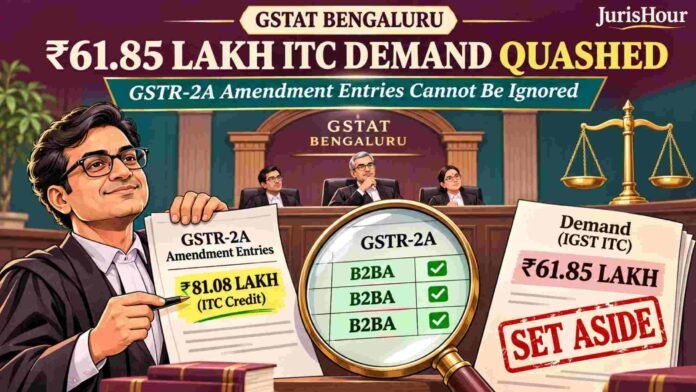
The Goods and Services Tax Appellate Tribunal (GSTAT), Bengaluru Bench, has set aside a demand for reversal of ₹61.85 lakh in Integrated GST input tax credit (ITC), finding that the department had overlooked credit reflected in the B2BA amendment table of GSTR-2A while comparing the taxpayer’s returns for financial year 2018-19.
The Bench of Prabhakaran P M (Judicial Member) and Ravi Jesuraj S (Technical Member) has observed that an aggregate difference between GSTR-3B and GSTR-2A could not, by itself, justify denial of ITC for the period concerned. It also ruled that the first appellate authority could not dismiss a statutory appeal merely for non-appearance without examining the written grounds and supporting documents already on record.
Buy Now: 210+ GST Judgments E-Magazine – October 2026
The bench annulled both the adjudication order and the first appellate order, along with the consequential interest and penalty.
The appellant/assessee is a Bengaluru-based company engaged in trading hardware, software and network-related equipment.
Following an audit for FY 2018-19, the department alleged that the company had availed excess IGST credit of ₹61,85,093 in GSTR-3B compared with the credit appearing in GSTR-2A. A show cause notice under Section 73 was issued on December 30, 2023, after an earlier intimation in Form GST DRC-01A.
In its reply, the company disputed both the factual calculation and the legal basis for treating a return mismatch as ineligible credit. It maintained that credit relating to FY 2018-19 had subsequently appeared in the July 2019 amendment table of GSTR-2A and supplied invoice-wise particulars to explain the reconciliation.
Nevertheless, the adjudicating authority confirmed the demand on April 6, 2024, together with interest and penalty. In rejecting the explanation, it relied on the July 2019 B2B table, which showed IGST of only ₹1,71,086, without examining the separate B2BA amendment entries relied upon by the company.
The company challenged the adjudication order before the first appellate authority on May 21, 2024. Its appeal included a reconciliation statement and a specific explanation that ₹81.08 lakh in credit was reflected in the B2BA amendment table for July 2019.
The appellate authority fixed hearings on January 28, March 11 and July 8, 2025. The company did not attend those hearings or seek adjournments. By an order dated August 18, 2025, the authority dismissed the appeal for non-prosecution without deciding the substantive ITC dispute.
Before GSTAT, Advocate Anmol Gupta argued that the absence from oral hearings did not permit the appellate authority to ignore the written submissions, documentary evidence and reconciliation already filed.
The department initially defended the dismissal, arguing that the taxpayer had failed to use the hearing opportunities provided and that its presence was necessary to complete the appeal proceedings.
The Tribunal held that Sections 107(11) and 107(12) required the appellate authority to decide the appeal through a reasoned order. Such an order must identify the points for determination, record the decisions on those points and explain the reasons.
Even in the appellant’s absence, the authority was required to examine the grounds of appeal and the supporting documents. A general statement that the taxpayer had failed to produce necessary evidence could not substitute for assessing material already on record.
The Bench distinguished the decisions relied upon to justify dismissal for non-prosecution. It found that those decisions could not override the express statutory obligation to decide the GST appeal on its merits.
The Tribunal explained that an appellate authority could reject grounds if the evidence was insufficient, provided it gave reasons. It could not avoid deciding the pleaded issues altogether merely because the appellant did not appear.
On the substantive demand, the Tribunal noted that the notice rested on a comparison of aggregate ITC figures. The department had not identified the particular invoices giving rise to the alleged mismatch or specified which conditions under Section 16 had been violated.
The Bench observed that a mismatch could provide a basis for verification proceedings, but invoice-level verification had not been undertaken. Nor had the adjudicating authority identified any defaulting suppliers or verified their returns to establish a failure of the statutory conditions.
“The difference between GSTR-2A and GSTR-3B alone cannot be a ground for denial of ITC in the hands of the receiver,” the Tribunal held.
The finding concerned FY 2018-19, when reflection of credit in GSTR-2A was not itself a statutory condition for availing ITC. The Tribunal treated GSTR-2A as a facilitative statement for that period and referred to the Supreme Court’s decision in Union of India v. Bharti Airtel Ltd. on its role in self-assessment.
The Bench also noted that Rule 36(4) was introduced in the CGST Rules with effect from October 9, 2019, after the financial year in dispute. Its analysis nevertheless recognised that auto-drafted data could be used to initiate an examination of whether the conditions under Section 16 were satisfied.
The Tribunal referred to CBIC Circular No. 183/15/2022-GST dated December 27, 2022, which addressed differences between GSTR-3B and GSTR-2A for FY 2017-18 and FY 2018-19.
It noted that the circular required the proper officer first to obtain details of invoices on which ITC had been availed but which did not appear in GSTR-2A, and then verify the relevant conditions under Section 16.
The circular also prescribed certificates for verifying payment of tax by suppliers: a Chartered Accountant or Cost Accountant certificate where the difference for a supplier exceeded ₹5 lakh in the financial year, and a supplier certificate where the difference was up to ₹5 lakh.
In the present case, the Tribunal found that the relevant details had not been shared with the taxpayer and the prescribed procedure had not been followed. It held that the circular bound the officers administering the IGST demand through Section 20 of the IGST Act.
The decisive factual issue was the omission of nine invoices issued by Inflow Technologies Private Limited, involving IGST of approximately ₹81.08 lakh on a taxable value of approximately ₹4.50 crore.
These invoices were dated between April 3 and August 21, 2018. Amendments reported through Table 9A of the supplier’s GSTR-1 for July 2019 brought them into the updated GSTR-2A data relating to FY 2018-19.
The taxpayer’s reconciliation before the appellate authorities showed approximately ₹1.97 crore in IGST credit in the updated data, including the amendment entries, compared with approximately ₹1.78 crore availed in GSTR-3B during FY 2018-19. On the rounded figures presented in that reconciliation, credit availed was lower by ₹19,22,905.
The Tribunal acknowledged that the figures presented by the taxpayer had varied at different stages, but found that its central explanation had remained consistent: the department had failed to consider ₹81.08 lakh reflected through the B2BA amendments.
When directed by GSTAT to verify the supporting documents, the departmental representative confirmed at the September 30, 2026 hearing that the updated figures were correct and that the ITC availed was within the credit available in GSTR-2A.
The Tribunal also examined the July 2019 GSTR-3B, which showed IGST ITC of only ₹3,34,196.57. It found that this confirmed that credit relating to the nine invoices had not been availed a second time in FY 2019-20.
The Bench observed that the adjudicating authority should have considered the amendment table rather than relying only on the B2B table. Calling for invoice-wise details under the CBIC circular would have brought the amendment entries to light.
At the same time, it noted that the taxpayer could have avoided the litigation by responding to the audit observations and explaining the B2BA position at that stage with figures consistent with the audit data.
On the verified material, however, the Tribunal concluded that there was no excess availment of IGST credit as alleged in the adjudication order.
The Tribunal set aside the adjudication order dated April 6, 2024, its DRC-07 summary, the first appellate order dated August 18, 2025, and the related APL-04 summary dated August 21, 2025.
The bench quashed the ₹61,85,093 ITC reversal demand, interest under Section 50 and penalty under Section 73(9). With the principal demand failing, the taxpayer’s alternative request for waiver of interest for a period when GSTAT appeal filing was allegedly unavailable did not require consideration.
Membership Required to Access Case Details & Order Copy
To view the complete Case Details and Download Order Copy, you must have an active membership. Please subscribe to continue.
Read More: Wrong Vehicle Number In E-Way Bill Alone Doesn’t Establish Tax Evasion: GSTAT

