
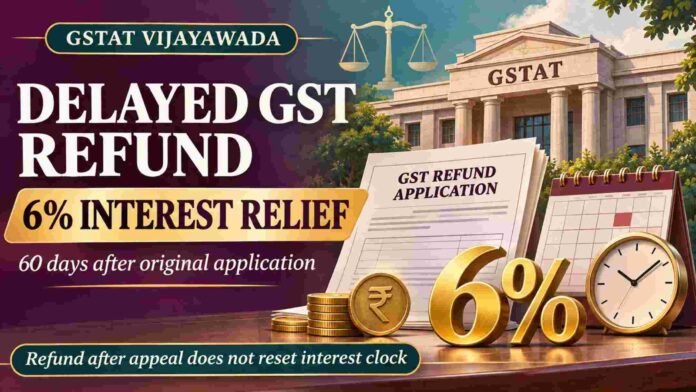
The Goods and Services Tax Appellate Tribunal (GSTAT), Andhra Pradesh State Bench at Vijayawada, has held that the department cannot deny interest on delayed refunds merely because the principal amount was paid within 60 days of the consequential applications filed after a successful appeal.
The Bench of Bhaskar Reddy Vemireddy (Judicial Member) and Satish Agrawal (Technical Member) has observed that ordinary statutory interest at 6% per annum must be calculated from the day immediately following the expiry of 60 days from receipt of the respective original refund applications until actual disbursement.
Buy Now: 210+ GST Judgments E-Magazine – October 2026
The entitlement is subject to verification that the original applications were complete in all respects and that the other statutory conditions were satisfied.
Allowing eight connected appeals through a common order dated November 11, 2026, the Tribunal directed the proper officer to calculate and disburse the interest payable within eight weeks of receiving its order.
The taxpayer, engaged in executing works contracts and allied services, had filed eight applications seeking refunds of accumulated input tax credit under the inverted duty structure. The claims concerned tax periods between December 2018 and March 2020.
The original refund applications were submitted on various dates between January 18 and March 29, 2023. The original authority rejected them by relying on Notification No. 15/2017-Central Tax (Rate), dated June 28, 2017, concerning specified construction services.
The taxpayer challenged those decisions before the First Appellate Authority, which set aside the rejection orders and allowed the refund claims through separate orders dated September 23, 2023.
Following the favourable appellate decisions, the taxpayer filed consequential refund applications on September 25 and 26, 2023. It also sought interest under Section 56 from the expiry of 60 days after the original applications.
The principal refunds were subsequently sanctioned in November 2023. However, interest was denied on the ground that the refunds had been sanctioned within 60 days of the consequential applications.
The taxpayer argued that the consequential applications were procedural steps required to implement the appellate orders. They could not be treated as fresh claims that reset the starting point for calculating statutory interest.
According to the taxpayer, the department’s erroneous rejection of the original applications could not deprive it of interest for the resulting delay.
It submitted that the main provision of Section 56 provides ordinary interest at the notified rate of 6%, while the proviso addresses an enhanced rate of 9% for a qualifying subsequent period where a refund arising from a final appellate or other specified order remains unpaid beyond the prescribed period.
The department maintained that the consequential applications had been processed within 60 days and therefore no interest was payable. It also emphasised that interest must follow the statutory framework, including the requirements concerning completeness and admissibility of the original claims.
Rejecting the department’s principal contention, the Tribunal held that payment within 60 days of the consequential applications did not extinguish ordinary interest accrued with reference to the original applications.
The later applications facilitated implementation of the appellate orders and payment of refunds already claimed. Their filing did not, by itself, eliminate the legal consequences flowing from the original applications.
The Bench concluded that the department could not rely solely on timely processing of the consequential applications to deny interest for the earlier qualifying period.
However, the Tribunal made clear that interest was subject to statutory verification. The original applications must have been complete, accompanied by the prescribed documents, and compliant with Section 54 read with Rule 89.
Interest would apply to the qualifying refund amounts ultimately sanctioned and actually disbursed.
The Tribunal distinguished ordinary interest under the main provision of Section 56 from enhanced interest under its proviso.
It explained that the absence of liability to pay enhanced interest does not eliminate ordinary interest already accrued. Therefore, payment within 60 days of a consequential application may prevent the enhanced rate from becoming applicable, while leaving the earlier entitlement to 6% interest intact.
In these appeals, the Tribunal recognised entitlement to ordinary interest at 6%, subject to verification. It did not award interest at 9%.
The Bench examined several judgments concerning delayed refunds and the commencement of statutory interest.
It referred to Ranbaxy Laboratories Ltd. v. Union of India for the principle linking statutory interest to the refund application rather than the eventual date of the refund order.
In the GST context, the Tribunal discussed Lupin Limited v. Union of India, Qualcomm India Private Limited v. Deputy Commissioner (ST), SBI Cards & Payment Services Ltd. v. Union of India, Bansal International v. Commissioner of DGST, and Altisource Business Solutions India Pvt. Ltd. v. Union of India.
As explained in the order, these decisions supported the conclusion that reversal of an incorrect refund rejection does not deprive a taxpayer of interest for the earlier qualifying period.
The department relied on Union of India v. Willowood Chemicals Pvt. Ltd. to contend that interest must remain within the statutory framework.
The Tribunal accepted that general principle but distinguished the applicable rate of interest from the date on which interest begins to accrue. It held that the judgment did not directly resolve the precise controversy concerning original and consequential refund applications.
The Bench also examined Rule 93, which concerns re-credit of amounts debited from the electronic credit ledger following rejection of refund claims.
It observed that Rule 93 does not independently determine when interest begins. That question is governed by Section 56 and the applicable statutory provisions.
Nevertheless, the Explanation to Rule 93 supported the continuing legal significance of the original refund claim during appellate proceedings.
The Tribunal also referred to CBIC Circular No. 111/30/2019-GST dated October 3, 2019. As discussed in the order, the circular requires a fresh application to implement a favourable appellate decision, while recognising that a second debit is unnecessary where the amount debited against the original claim has not been re-credited.
The Bench held that this procedural requirement does not extinguish accrued statutory interest merely because the consequential application was filed later.
The Tribunal set aside the impugned orders insofar as they denied interest solely because the principal refunds were sanctioned within 60 days of the consequential applications.
It directed the proper officer to calculate interest separately for each of the eight claims, considering the receipt and completeness of the original application, supporting documents, the refund ultimately sanctioned and disbursed, and the actual payment date.
The calculation must begin immediately after the expiry of 60 days from receipt of the respective qualifying original application. Any period lawfully excluded under the relevant statutory provisions must also be considered.
Membership Required to Access Case Details & Order Copy
To view the complete Case Details and Download Order Copy, you must have an active membership. Please subscribe to continue.
Read More: GSTR-2A Mismatch Alone Can’t Prove Wrong ITC Claim: GSTAT

