
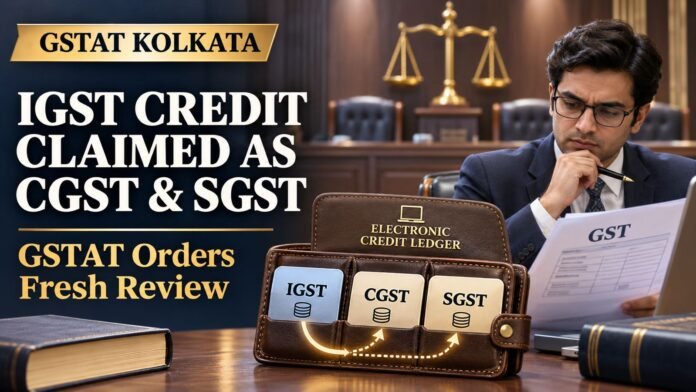
The Goods and Services Tax Appellate Tribunal (GSTAT), Kolkata Bench, has set aside an appellate order requiring a taxpayer to reverse input tax credit (ITC) inadvertently claimed and utilised under CGST and SGST instead of IGST, along with interest and penalty and directed fresh consideration in light of Kerala High Court judgments addressing similar errors.
The bench of Satya Gopal Chattopadhyay (Judicial Member) and Anindya Mitra (Technical Member) directed the First Appellate Authority to complete the reconsideration within three months from communication of the order, after providing the taxpayer a reasonable opportunity of hearing.
Buy Now: 210+ GST Judgments E-Magazine – October 2026
The appellant/assessee is the Kolkata-based chemical trader and the dispute was related to financial year 2017–18, the first year of the GST regime. The taxpayer explained that it had mistakenly availed and utilised approximately ₹1,43,404 each under CGST and SGST instead of IGST. It maintained that the aggregate credit claimed across the tax heads did not exceed the tax paid and declared by its suppliers.
A show cause notice dated February 28, 2023, was issued under Section 73(1) of the CGST Act. The adjudicating authority subsequently confirmed demands through an order dated May 29, 2023.
The adjudicating authority took the position that it had no authority to adjust ITC from one tax head to another. Consequently, it required reversal of the credit treated as excess under CGST and SGST, together with interest. Its order also addressed other proposed ITC reversals for which it recorded that adequate explanations or reconciliation had not been produced.
The taxpayer challenged the adjudication order under Section 107(1).
By an order dated August 25, 2023, the First Appellate Authority modified the demand but maintained that ITC claimed under CGST and SGST instead of IGST could not be adjusted between the heads.
Its computation retained ₹1,43,403.74 each under CGST and WBGST towards excess ITC on inward B2B supplies. It also retained a further ₹4,176 under each head, treating that credit as reversible under Section 16(4).
The resulting tax demand was rounded to ₹1,47,580 under each head. The appellate order also imposed penalty of ₹14,758 under each head and interest.
Aggrieved, the taxpayer approached the GSTAT under Section 112(1).
The taxpayer submitted that the mistake occurred during the initial year of GST implementation. It argued that GSTR-2A became available only towards the end of 2018 and that it therefore lacked an opportunity to detect the error through that statement at the relevant time.
The taxpayer maintained that the error was inadvertent and technical and that claiming and utilising credit under CGST and SGST instead of eligible IGST credit caused no revenue loss.
It relied on Kalleppuram Metals, reported in 2024 SCC OnLine Ker 7751, and Rejimon Padickapparambil Alex v. Union of India, reported in 2024 KHC OnLine 7215.
The department opposed the appeal, contending that the CGST Act contained no provision permitting the relief sought.
The tribunal examined the Kerala High Court judgments concerning eligible IGST credit mistakenly reported under CGST and SGST.
As discussed in the order, the High Court had viewed the electronic credit ledger as a pool of funds with separate compartments for IGST, CGST and SGST. In the circumstances before it, the overall eligible credit position had to be considered when assessing the consequences of the reporting error.
The tribunal noted that Kalleppuram Metals treated the claim of eligible credit under CGST and SGST instead of IGST as a technical mistake, without wrongful availment or utilisation causing revenue loss.
It also referred to Rejimon Padickapparambil Alex, where the taxpayer had inadvertently shown the IGST component as nil in GSTR-3B and split the amount between CGST and SGST.
In that case, the High Court held that proceedings under Section 73 were unfounded on the facts because there was no wrongful availment of credit and the mistake was inadvertent and technical.
The GSTAT concluded that these judgments squarely applied to the appeal before it.
The tribunal separately considered the direction to reverse ₹4,176 each under CGST and SGST for breach of Section 16(4).
It held that this dispute stood resolved following the insertion of the overriding provision in Section 16(5). Accordingly, the taxpayer was absolved of liability to reverse those amounts.
After deciding that issue, the tribunal identified the remaining question as whether the approximately ₹1,43,404 claimed under each of CGST and SGST instead of IGST required reversal with interest and penalty.
The tribunal set aside the First Appellate Authority’s order and remanded the matter for fresh consideration in light of the two Kerala High Court judgments.
Membership Required to Access Case Details & Order Copy
To view the complete Case Details and Download Order Copy, you must have an active membership. Please subscribe to continue.
Read More: SEZ Units Can Claim Refund Of Unutilised ISD Credit: GSTAT Dismisses 8 Dept. Appeals

