
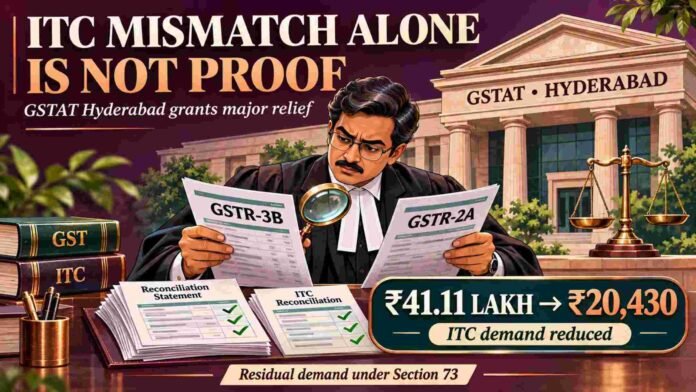
The Goods and Services Tax Appellate Tribunal (GSTAT), Hyderabad, has substantially reduced an input tax credit demand arising from a mismatch between GSTR-3B and GSTR-2A, holding that documentary evidence cannot be rejected merely by describing it as unverified, without undertaking verification or producing contrary material.
The Bench of A. P. Ravi (Judicial Member) and Duvvuri Krishna Srinivas (Technical Member) partly allowed the appeal, setting aside the disputed CGST and SGST demands and most of the IGST demand. Only ₹20,430 in IGST credit remained inadmissible because the company failed to establish its eligibility for that amount.
Buy Now: 210+ GST Judgments E-Magazine – October 2026
The bench rejected the invocation of Section 74, finding that fraud, wilful misstatement or suppression of facts to evade tax had not been established. It sustained the residual demand under Section 73 through Section 75(2), with appropriate interest if the credit was utilised and penalty to be computed by the proper officer.
The dispute concerned July 2017 to March 2018. The company, which provides IT software, business-support and hosted services, had claimed ITC of ₹53,53,143 in Table 4A(5) of GSTR-3B.
The department identified a corresponding credit of ₹16,09,050 in GSTR-2A. After adjusting credit notes of ₹3,66,573 issued by Hewlett Packard Enterprise India Private Limited, it reduced the corresponding credit figure to ₹12,42,477 and alleged excess ITC of ₹41,10,666.
Following scrutiny proceedings, the department issued a show cause notice dated February 23, 2023, invoking Section 74. The adjudicating authority confirmed the demand with interest and an equal penalty. The first appellate authority upheld the decision.
The company contended that non-reflection of invoices in GSTR-2A did not, by itself, establish that the credit was inadmissible for the period concerned. It relied on the verification mechanism prescribed in CBIC Circular No. 183/15/2022-GST dated December 27, 2022.
Before the first appellate authority, the company produced an amended B2B entry appearing in GSTR-2A for FY 2018-19 concerning an August 2017 invoice issued by E-Support Solutions Private Limited.
The entry covered CGST and SGST of ₹12,72,387 each, totalling ₹25,44,774.
The company also furnished certificates relating to Tata Communications, STT Global Data Centres, Vodafone Mobile Services and Crayon Software, together with invoices and ledger extracts. It explained that it had held two GST registrations and that certain suppliers had reported invoices against its erstwhile GSTIN.
The Tribunal found that the amended entry and certificates established CGST and SGST credit of ₹20,75,420 each, exceeding the respective demands of ₹20,24,184. The Crayon Software certificate separately supported IGST credit of ₹41,869.
Consequently, the entire disputed CGST and SGST demands, along with the supported IGST amount, were set aside.
The Tribunal acknowledged that Section 155 places the burden of proving ITC eligibility on the claimant. However, the company had produced amended invoice particulars, certificates prescribed by the circular and ledger extracts.
Once that material was on record, a general assertion that it remained unverified could not displace it without an attempt at verification or contrary evidence.
The department also argued that payment to suppliers had not been proved. The Tribunal noted that the company had identified payment entries in vendor ledgers, while the department neither controverted those entries nor identified any specific invoice for which payment was lacking.
The Bench agreed that a difference between GSTR-2A and GSTR-3B may justify verification, but cannot, without more, conclusively establish wrongful availment of ITC.
It distinguished cases involving doubts about transaction genuineness or the complete absence of supporting records. Here, the existence of the suppliers and the genuineness of the transactions were not disputed.
The Tribunal examined Circular No. 183/15/2022-GST, which provides a procedure for examining specified ITC mismatches relating to FY 2017-18 and FY 2018-19.
As reproduced in the judgment, the circular contemplates a CA or CMA certificate bearing UDIN where the supplier-wise annual difference exceeds ₹5 lakh. Where the difference is up to ₹5 lakh, a certificate from the supplier is contemplated.
The circular also addresses supplies reported against an incorrect recipient GSTIN. It provides for separate action concerning any credit claimed by the incorrectly identified recipient, while clarifying that allowance to the actual recipient does not depend on completion of that action.
The Tribunal rejected an objection that introduced a requirement absent from the circular. It also treated an incorrect reference to the circular’s date in the Vodafone certificate as a clerical error that did not affect the substance of the certification.
The Tribunal found that the first appellate authority had rejected the certificates without explaining their defects and had failed to give reasons for rejecting the company’s reconciliation.
The appellate order also did not address the company’s reliance on the circular and judicial decisions. Further, it incorrectly recorded the amount covered by the Tata Communications certificate.
Referring to Section 75(6) and the requirement of reasoned quasi-judicial decisions, the Bench held that rejection of evidence without reasons undermines an effective hearing.
The Tribunal also accepted the company’s objection to the department seeking to support the demand on grounds beyond the show cause notice. It referred to Section 75(7), which prohibits confirmation of a demand on grounds other than those specified in the notice.
The company acknowledged that no certificate was available for the remaining IGST credit of ₹20,430.
The Tribunal found that the company had also failed to furnish other evidence establishing payment of the relevant tax by the suppliers to the government. Accordingly, the burden under Section 155 had not been discharged, and compliance with Section 16(2)(c) had not been established for that amount.
The Bench reasoned that, having relied on the circular’s mechanism for the other disputed credits, the company could not disclaim its conditions for the unsupported balance.
The residual ₹20,430 was therefore held inadmissible.
On the invocation of Section 74, the Tribunal held that fraud, wilful misstatement or suppression of facts to evade tax must be supported by foundational facts.
The show cause notice had reasoned that the discrepancy would have remained unnoticed without departmental verification and that the company appeared to have wilfully suppressed facts.
The Tribunal rejected that inference. Detection of a discrepancy by the department did not itself establish suppression by the taxpayer.
The notice did not identify any fact that the company was required to declare but had withheld, information requested in writing that it had failed to furnish, or conduct showing that it knowingly availed inadmissible credit to evade tax.
The Bench noted that the credit had been disclosed in statutory returns and that the company had responded to departmental communications. There was no allegation of fictitious invoices, non-receipt of supplies or collusion with suppliers.
It further held that failure to produce evidence in defence during adjudication could not retrospectively supply an allegation of suppression missing from the notice.
Applying Section 75(2), the Tribunal treated the notice as one issued under Section 73. It recorded that the February 2023 notice and December 2023 adjudication order fell within the extended timelines discussed in the judgment.
Membership Required to Access Case Details & Order Copy
To view the complete Case Details and Download Order Copy, you must have an active membership. Please subscribe to continue.
Read More: GST Dept. Can’t Use S. 73 To Recover Pre-GST CENVAT Credit On Eligibility Grounds: GSTAT

