
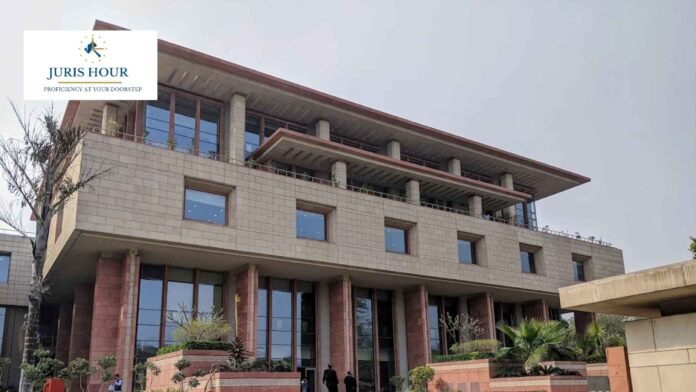
The Delhi High Court has declined to interfere with a GST adjudication order confirming a demand of ₹4.49 crore, along with applicable interest and an equivalent penalty, holding that a dispute over service of personal hearing notices could appropriately be examined by the statutory appellate authority.
A Division Bench of Justice Anil Kshetarpal and Justice Bharat Parashar observed that merely alleging a violation of natural justice does not, by itself, justify bypassing the appellate remedy under Section 107 of the Central Goods and Services Tax Act, 2017. The court emphasised that the nature of the grievance, the supporting material and the suitability of appellate examination must be considered.
Buy Now: 210+ GST Judgments E-Magazine – October 2026
According to the facts recorded in the judgment, the department conducted an audit under Section 65 of the CGST Act for the financial years 2019-20 to 2023-24. An audit memo dated September 6, 2025 raised discrepancies concerning alleged short payment of tax, classification of services and availment of input tax credit.
The company responded on September 17, 2025, explaining its position on the audit observations. A final audit report in Form GST ADT-02 followed on September 19, 2025, and an intimation in Form GST DRC-01A was issued on September 23, 2025.
The department subsequently issued a show cause notice dated September 29, 2025 under Section 74 of the CGST Act, proposing recovery of tax, interest and penalty. The proceedings culminated in the March 16, 2026 order confirming a demand of ₹4,49,93,111, together with applicable interest and an equivalent penalty.
The company’s principal contention was that the adjudication order had been passed ex parte without an effective opportunity of personal hearing.
Although the adjudication order recorded that hearings had been fixed for February 3, February 11 and February 19, 2026, the company maintained that it had received no notice of those hearings through email, physical communication or the GST portal.
Relying on an email screenshot and its GST registration particulars, the company argued that the notices had been sent to an incorrect email address rather than its registered address. It also asserted that its email particulars had been updated.
The company questioned whether the department had established valid service under Section 169 of the CGST Act and whether the links and time slots for the proposed virtual hearings had actually been communicated. It further alleged that its explanations had not received due consideration before the demand was confirmed.
The department opposed the writ petition on the ground that an effective alternative remedy was available under Section 107 of the CGST Act.
It submitted that notices for the three hearing dates had been emailed on February 2, February 5 and February 16, 2026 to the email address available in its records. Those emails had not bounced back, the department stated.
The department further contended that the company neither availed itself of the hearing opportunities nor filed a reply to the show cause notice, leaving the adjudicating authority to decide the matter on the material available.
In rejoinder, the company disputed that dispatch of emails, or the absence of a bounce-back message, was sufficient to establish valid service. It argued that service had to be examined against the relevant registration particulars and contemporaneous communications.
The High Court explained that judicial restraint where a statutory appeal is available concerns the discretionary exercise of writ jurisdiction, rather than an absence of constitutional power.
Referring to the Supreme Court’s decision in Assistant Commissioner of State Tax and Others v. Commercial Steel Limited, (2022) 16 SCC 447, the Bench recognised that writ jurisdiction may still be exercised in established exceptional circumstances. These include breach of fundamental rights, violation of natural justice, proceedings in excess of jurisdiction and challenges to the validity of legislation.
However, whether an exception applies must be assessed on the facts of the individual case. The court held that invoking natural justice alone does not dispense with the ordinary requirement to pursue the statutory remedy.
Here, the competing accounts of service required scrutiny of the registration records, email communications and other relevant material. The existence of that dispute did not, by itself, require the High Court to undertake a detailed factual inquiry when an appellate remedy was available.
The Bench observed that the issue extended beyond whether the department had dispatched emails. What required examination was whether the notices had been communicated in accordance with the applicable statutory provisions and to the relevant email address attributable to the company at the material time.
The company’s assertion that it had updated its email particulars, and the department’s reliance on the address in its records, had to be considered against the relevant registration particulars and contemporaneous communications.
The court also said that the company’s screenshot required consideration in its factual context. Equally relevant were the department’s email communications and the registration particulars it maintained.
Questions concerning communication of virtual hearing links and time slots, and whether the procedure afforded a meaningful hearing, could be examined by the appellate authority on the relevant record. The Bench did not decide that the emails constituted valid service or that their failure to bounce back conclusively established service.
The company had also alleged that the demand was confirmed mechanically, without proper consideration of its response to the audit memo and the material supplied to the department. The department disputed those allegations.
The court held that the treatment of the company’s explanations, the basis of the demand and the correctness of the determination under Section 74 were matters that could also be raised in appeal. It therefore declined to return findings on the merits of the adjudication order.
Disposing of the petition, the High Court relegated the company to the statutory appellate remedy under Section 107 of the CGST Act.
All contentions, including those concerning service of notices, the alleged violation of Section 75(4), consideration of the company’s explanations and the merits of the demand, were left open. The appellate authority was directed to consider them independently and in accordance with law.
The Bench further clarified that if the company filed an application under Section 14 of the Limitation Act, 1963 seeking exclusion of the period during which the writ petition remained pending, the appellate authority would consider it in accordance with law. The court did not itself grant exclusion of that period or direct automatic admission of an appeal.
Membership Required to Access Case Details & Order Copy
To view the complete Case Details and Download Order Copy, you must have an active membership. Please subscribe to continue.

