
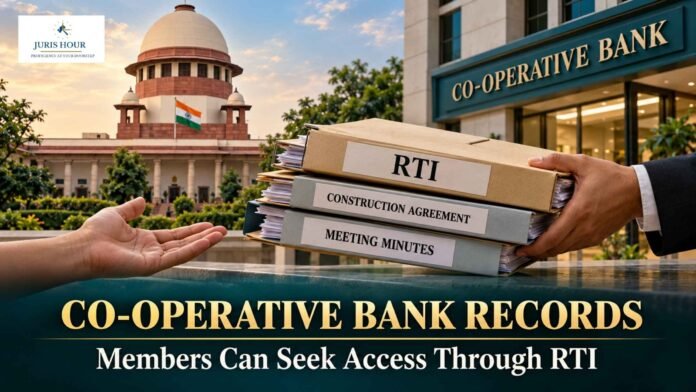
The Supreme Court has held that a member of a co-operative bank can obtain its construction agreement and general body meeting minutes through the Registrar under the Right to Information Act, 2005, even where the bank itself is not a public authority.
The Bench of Justice J.B. Pardiwala and Justice K. Vinod Chandran ruled that information accessible to a public authority under its statutory powers falls within the RTI framework, even if the documents are not already in that authority’s physical possession. The Court also rejected the argument that the Registrar must first initiate an inquiry before accessing the society’s records.
Buy Now: 90+ Supreme Court Judgments – September 2026
Dismissing the appeals filed by The Muppathadam Service Co-Operative Bank Ltd., the Court directed the Joint Registrar to call for the two documents immediately, in any event within two weeks, and supply them to the applicant.
The proceedings arose from an RTI application filed by a member of the appellant bank before the Joint Registrar (General) of Co-operative Societies.
The member sought a copy of the construction agreement between the bank and a labour co-operative society entrusted with constructing a building. He also requested a copy of the minutes of the bank’s last general body meeting.
His initial application was rejected through the statutory proceedings, and his challenge before a Single Judge of the High Court also failed. However, a Division Bench directed reconsideration.
In the second round, the State Information Commissioner, the Single Judge and the Division Bench upheld the member’s entitlement to the documents. The bank challenged the Division Bench’s judgment before the Supreme Court.
The bank relied on Thalappalam Service Cooperative Bank Limited and Others v. State of Kerala and Others, arguing that it was not a “public authority” under the RTI Act.
It further contended that the Registrar’s access to its records under Sections 65 and 66 of the Kerala Co-operative Societies Act, 1969, depended on the satisfaction necessary to conduct an inquiry.
According to the bank, since no such satisfaction had been recorded, the Registrar could not access the documents merely to answer the member’s RTI application.
The bank also relied on the Constitution Bench judgment in Central Public Information Officer, Supreme Court of India v. Subhash Chandra Agarwal concerning statutory conditions and restrictions governing access to information relating to private bodies.
The central question was whether the Registrar could obtain the documents using powers under the co-operative societies legislation and furnish them under the RTI Act.
The Supreme Court answered this in the affirmative.
Examining Section 2(f) of the RTI Act, the Court explained that “information” includes material relating to a private body that a public authority can access under another law.
The provision, therefore, extends beyond documents already held by the authority. Statutory access to records maintained by a private entity can bring those records within the definition of information.
The ruling did not require the co-operative bank itself to be treated as a public authority. The relevant route was access through the Registrar, whose powers under the governing legislation enabled him to obtain the records.
The Court rejected the bank’s contention that access could arise only after the Registrar recorded satisfaction that an inquiry should be initiated.
It explained that the Registrar’s satisfaction could not be formed in a vacuum. Access to the society’s documents may itself be necessary to decide whether an inquiry is warranted.
Section 65 permits an inquiry on the Registrar’s own motion and in other circumstances specified in the provision. The Court observed that an authority vested with suo motu powers may also act when another person brings relevant circumstances to its attention.
However, deciding whether to invoke those powers requires an examination of the available material. Conditioning access to records on a decision already having been taken to initiate an inquiry would undermine that process.
The Court accordingly held that the requirement of prior satisfaction concerned the initiation of an inquiry and did not impose the restriction on access asserted by the bank.
It also relied on Section 66, which independently confers supervisory and inspection powers on the Registrar or an authorised person. Such supervision includes inspection of the society’s books and may be undertaken as frequently as the Registrar considers necessary.
The bank’s objections also extended to the exemptions under Sections 8(1)(d) and 8(1)(j) of the RTI Act.
On commercial confidentiality, the Court found that the requested documents did not involve trade secrets, intellectual property or commercial confidence affecting a third party’s competitive position.
The bidding process had already concluded, and a labour contract society had secured the construction contract. A member of the bank would have a legitimate concern with the terms of that agreement.
The Court therefore found no basis to withhold these documents on the commercial confidentiality ground raised.
The Supreme Court also rejected the personal information objection in the circumstances of the case.
The construction agreement and general body meeting minutes were sought by a member of the society. The bank could not deny that member access merely by describing the records as personal to the society or asserting that they did not concern a public activity.
At the same time, the Court expressly distinguished an identical request made by an outsider with no connection to the society.
It observed that the concept of personal information was not confined to natural persons and could also apply to a private entity. Every citizen could not automatically claim an interest in a private entity’s affairs.
The judgment therefore does not establish unrestricted public access to all co-operative bank records. The applicant’s membership, the nature of the documents, the Registrar’s statutory powers and the applicable RTI exemptions were material to the decision.
Addressing Thalappalam, the Supreme Court explained that the earlier decision preserved the Registrar’s ability to seek information from co-operative societies to the extent permitted by law.
Such information may be supplied under the RTI Act where it is not barred by the exemptions in Section 8(1).
The Court distinguished information concerning members’ bank deposits, which had attracted the personal information exemption in the earlier case, from the construction agreement and meeting minutes sought in the present proceedings.
Finding the High Court’s judgment consistent with the statutory provisions and precedents, the Supreme Court dismissed both appeals.
Membership Required to Access Case Details & Order Copy
To view the complete Case Details and Download Order Copy, you must have an active membership. Please subscribe to continue.

