
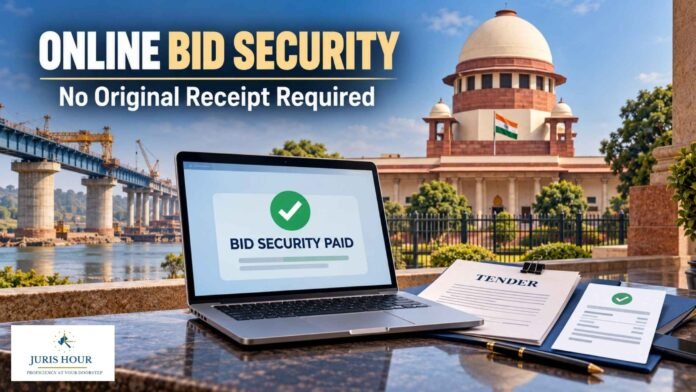
The Supreme Court has held that a tender cannot be rejected for failure to physically submit an “original” bid security receipt when the security amount has already been paid through the tendering authority’s electronic payment gateway and the digital receipt has been uploaded with the bid.
The Bench of Justices J.B. Pardiwala and K. Vinod Chandran found that insisting on an original document in these circumstances amounted to a perverse application of the tender conditions. The physical submission serves a purpose when bid security is furnished through instruments such as bank guarantees or demand drafts, but the same requirement cannot be mechanically applied to an electronic payment already received by the authority.
Buy Now: 90+ Supreme Court Judgments – September 2026
The dispute concerned a tender for the engineering, procurement and construction of guide bunds, launching aprons and associated river protection works for the Bikramshila–Katareah New Line Rail Link Project.
The Request for Proposal permitted bidders to furnish bid security through several modes, including a bank guarantee, account payee demand draft, fixed deposit receipt, banker’s cheque or the authority’s electronic payment gateway.
The petitioner deposited the bid security through the electronic payment gateway. It also scanned and uploaded the digital payment receipt along with its bid documents.
Nevertheless, the bid was rejected for non-submission of the original bid security document under Clause 2.20.6(ii) of the tender conditions. That clause required the instrument through which the security was furnished to be physically delivered to the nominated official.
The Patna High Court upheld the rejection, prompting the company to approach the Supreme Court.
The company argued that there was no separate original instrument to submit because the security amount had already been transferred to the respondents’ account. It maintained that uploading the digital receipt established compliance with the payment requirement.
The Ministry of Railways defended the rejection on the ground that the tender clause expressly required physical submission of the original document.
The successful tenderer also opposed the appeal, relying on the Supreme Court’s decision in Prakash Asphaltings and Toll Highways (India) Ltd. v. Mandeepa Enterprises and Others, reported in (2026) 4 SCC 310. It argued that the authority issuing a tender is best placed to interpret its requirements and that constitutional courts should ordinarily defer to that interpretation.
The petitioner additionally claimed that its financial bid was substantially lower than that of the successful tenderer and that its exclusion would cause a loss to the public exchequer. The Ministry, however, pointed out that this comparison could not be made because the company had been disqualified at the technical stage and its financial bid had never been opened.
Accepting the company’s principal contention, the Supreme Court examined why the tender required the original bid security instrument to be handed over.
It explained that where security is furnished through a bank guarantee, demand draft, fixed deposit receipt or banker’s cheque, physical possession of the instrument enables the authority to exercise control over or enforce the security. Uploading a scanned copy alone would not fulfil that purpose.
Electronic payment stands on a different footing. Once the amount has been transferred into the authority’s account, the authority already has control over the money.
The Court therefore found that nothing further was required to be physically produced in relation to the electronic payment, particularly when the digital payment receipt had already been uploaded with the bid.
The Bench held that rejection of the bid solely for failure to produce an original receipt, despite valid electronic payment and uploading of the digital receipt, reflected a clearly perverse application of the tender conditions.
“Rigid adherence to the letter of a document cannot be countenanced, especially when there is a clear impossibility in compliance of the same,” the Court observed.
The reasoning turned on the purpose of the requirement: securing the authority’s control over the bid security. In the case of an electronic transfer, that purpose had already been achieved because the money was in the respondents’ account.
The Supreme Court distinguished the Prakash Asphaltings ruling cited by the successful tenderer.
That case involved a toll collection tender in which a bidder quoted ₹9,72,999 and subsequently claimed that it had mistakenly provided a daily collection figure instead of the total amount for the 1,095-day contract. The bidder sought to have the figure treated as ₹100.65 crore for the entire contract period.
The Court explained that the earlier ruling concerned an attempt to reinterpret a financial quotation contrary to the express tender requirement. It did not justify demanding an original physical document where the permitted method of payment generated a digital receipt and the authority had already received the money.
The Bench also noted that Prakash Asphaltings, while recognising judicial deference to a tendering authority’s interpretation, preserved an exception for mala fide or perverse understanding and application of tender documents.
The Supreme Court allowed the appeal and set aside the impugned order.
The Supreme Court states that the contract should be awarded to the appellant. The subsequent directions, however, require restoration of the bid security, opening of the company’s financial bid, consideration of that bid alongside the other bids, and finalisation of the tender under the remaining conditions.
These further directions followed the company’s submission that the security amount had been refunded after its bid was rejected.
The Court directed the Union of India and the railway authorities to facilitate fresh electronic payment within two weeks of the judgment. If technical difficulties prevented electronic payment, the company would be required to furnish the security through another permitted mode within a further two weeks.
Membership Required to Access Case Details & Order Copy
To view the complete Case Details and Download Order Copy, you must have an active membership. Please subscribe to continue.
Read More: Second E-Way Bill Alone Doesn’t Prove Another Supply: GSTAT

