
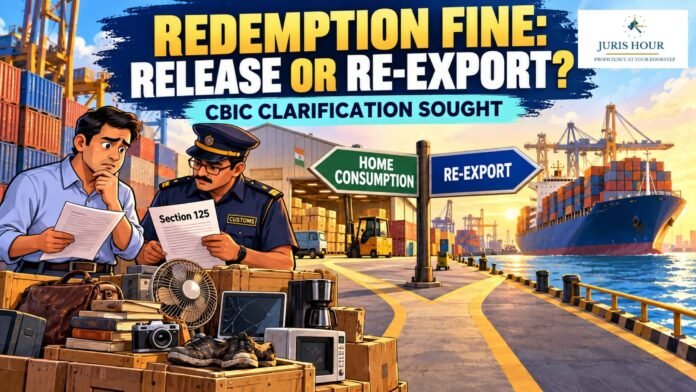
A request addressed to the Central Board of Indirect Taxes and Customs (CBIC) has raised an important question concerning confiscated second-hand imports: whether payment of redemption fine under Section 125 of the Customs Act, 1962 permits clearance for home consumption or whether release can be restricted to re-export.
The request specifically concerns restricted second-hand goods other than capital goods. It flags what it describes as inconsistent practices across Customs formations, creating uncertainty for importers and officers regarding the consequences of redemption.
The central issue is the distinction between allowing an importer to redeem confiscated goods and permitting those goods to enter the domestic market. The representation seeks a clear CBIC instruction or circular explaining the scope and conditions of redemption under Section 125.
Buy Now: Legal & Taxation Combo – 4 Premium E-Magazines
Concern Over Differing Treatment of Confiscated Goods
According to the supplied representation, uncertainty arises when Customs authorities allow redemption on payment of a fine but differ on whether the goods may subsequently be cleared for use or sale within India.
Clearance for home consumption allows goods to enter the domestic market, subject to applicable requirements. Re-export, by contrast, requires the goods to leave India. For an importer, these outcomes have substantially different commercial consequences.
The representation does not identify particular adjudication orders, Customs ports or consignments demonstrating the alleged inconsistency. Its concern is therefore a request for administrative clarification, rather than an announcement of a new policy or a finding that any specific Customs authority has acted unlawfully.
What Section 125 Provides
Section 125 provides an option to pay a fine in lieu of confiscation. Its wording distinguishes between goods whose import or export is prohibited under the Customs Act or another applicable law and other goods.
For prohibited goods, the adjudicating officer has discretion to offer redemption. For other goods, the provision requires the officer to offer that option. The section also limits the fine by reference to the market price of the confiscated goods, after deducting the duty chargeable in the case of imported goods.
This framework makes the legal classification of the goods and the nature of the import violation relevant. A redemption fine addresses confiscation; the separate question raised in the representation is what conditions should govern the goods’ release.
Why Second-Hand Goods Require Separate Examination
The Foreign Trade Policy, 2023 contains a specific import regime for second-hand goods under paragraph 2.31. It classifies second-hand goods other than capital goods as restricted and importable against authorisation.
The policy treats second-hand capital goods separately, with different conditions for different categories. It also provides a distinct route for second-hand goods imported for repair, refurbishing, reconditioning or re-engineering, subject to conditions that include re-export.
Consequently, describing a consignment merely as “second-hand goods” does not fully establish its import treatment. The category, purpose of import and applicable authorisation requirements must also be considered.
Does Paying a Fine Automatically Permit Domestic Clearance?
The issue should not be reduced to an assumption that payment of redemption fine automatically settles every requirement governing an import.
As a legal distinction, redemption concerns the consequences of confiscation, while clearance for home consumption concerns permission for the goods to enter the domestic market. The relationship between these steps must be assessed against the applicable statutory provisions, import policy, adjudication order and binding judicial decisions.
The Foreign Trade Policy also states that domestic laws, technical specifications, and environmental, safety and health norms apply to imports unless specifically exempted. This reinforces the need to examine requirements beyond the confiscation proceedings alone.
Equally, the supplied representation does not establish a universal rule that every restricted second-hand consignment must be re-exported. That is precisely the uncertainty on which clarification is sought.
Commercial Implications for Importers
The difference between domestic clearance and re-export can determine whether an importer can fulfil customer commitments or must arrange return shipment.
Uncertainty over the permitted outcome may also complicate decisions about paying a redemption fine, challenging an adjudication order or negotiating with an overseas supplier. Delays can potentially increase storage, handling and shipping expenses, although the representation provides no figures quantifying such losses.
For Customs officers, clearer guidance could help explain when redemption is available, which conditions may accompany it and how those conditions should be recorded in a reasoned order.
Clarification Sought on Scope and Conditions
The representation calls for uniformity, transparency and consistency across Customs formations. A useful clarification would address the circumstances in which restricted second-hand goods other than capital goods may be released for home consumption, when re-export may be required, and how applicable authorisation requirements affect that decision.
It would also help distinguish redemption from import-policy compliance, allowing importers to understand the practical effect of an order before exercising the option to pay a fine.
The supplied material records a request to CBIC for clarification. It does not contain a CBIC response, a newly issued circular or an amendment changing the existing legal framework.
Read More: JURISHOUR | TAX LAW DAILY BULLETIN : 9 OCTOBER, 2026

