
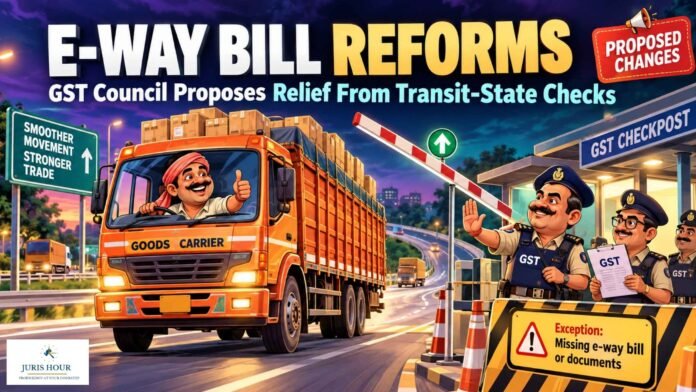
The GST Council has recommended significant changes to the e-way bill enforcement framework, proposing restrictions on interception of goods vehicles in transit states and requiring specific intelligence and senior-level authorisation before a conveyance is stopped.
The recommendations seek amendments to Sections 68, 129 and 130 of the Central Goods and Services Tax Act, 2017, with the stated objective of ensuring smoother movement of goods and improving transportation efficiency. The official release confirms the proposed restriction on interception in transit states.
Buy Now: E-Way Bill Judgements From 2020–2026 [Includes Orders of GSTAT]
Specific Intelligence and Joint Commissioner-Level Authorisation
Under the proposed framework, a conveyance carrying goods would be intercepted only on the basis of specific intelligence and with authorisation from an officer not below the rank of Joint Commissioner.
The recommendation would introduce two conditions for interception: an intelligence-based ground for stopping the vehicle and approval at a prescribed senior level. This is intended to make enforcement more targeted and reduce disruption to legitimate movement of goods.
Inspection and Detention Restricted to Supplier or Recipient State
The Council has recommended that inspection and further action involving detention or seizure should be permitted where either the supplier or the recipient is located or registered in the state in which interception takes place.
Accordingly, a state through which goods merely pass would not ordinarily be permitted to intercept the conveyance under the proposed framework.
For example, where goods move from a supplier in Maharashtra to a recipient in Delhi through other states, the proposed restriction would prevent interception in those intermediate states, subject to the exception relating to missing e-way bills or transport documents.
Exception Where E-Way Bill or Origin–Destination Documents Are Missing
The proposed restriction would not provide an unconditional exemption from checks during transit.
Where no e-way bill has been generated, or where the conveyance carries no document showing the origin or destination of the goods, as applicable, inspection, detention or seizure would be permitted irrespective of jurisdiction.
This exception preserves enforcement powers where the documentation needed to establish the movement of goods is absent. Businesses and transporters would therefore need to continue ensuring that the applicable e-way bill and supporting documents accompany the consignment.
Confiscation Under Section 130 Proposed to Be Excluded for Goods in Transit
The Council has also recommended that the confiscation provisions under Section 130 should not apply to goods or conveyances in transit.
This proposal is distinct from the recommendations governing inspection, detention and seizure. It would exclude confiscation under Section 130 for goods and vehicles during transit, while allowing inspection, detention or seizure in the circumstances contemplated by the proposed framework.
Expected Relief for Businesses and Transporters
The Council expects the changes to facilitate smoother movement of goods and improve supply and transportation efficiency.
If implemented, fewer interruptions in intermediate states could help businesses plan deliveries more reliably. The combination of specific intelligence, senior authorisation and clearer territorial limits could also make roadside GST enforcement more predictable.
Implementation Depends on Legislative Changes
These measures are recommendations for amendments to the CGST Act. They should not be treated as restrictions already in force merely because the Council has recommended them.
The final scope, conditions and commencement of the revised framework will depend on the enacted amendments and the relevant implementation provisions.
Membership Required to Access Recommendation Details & Copy
To view the complete Recommendation Details and Download Copy, you must have an active membership. Please subscribe to continue.

