
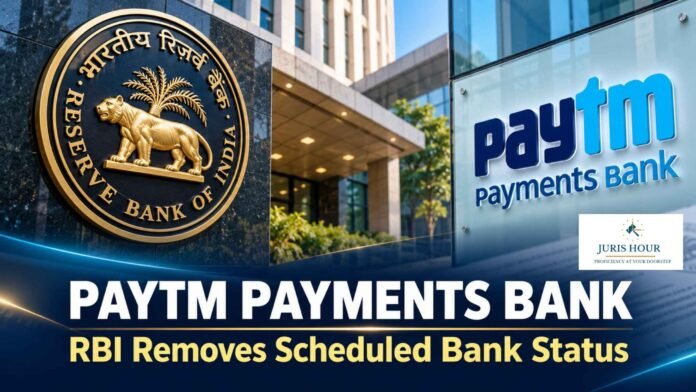
The Reserve Bank of India (RBI) has announced the exclusion of Paytm Payments Bank Limited (PPBL) from the Second Schedule to the Reserve Bank of India Act, 1934, removing its status as a scheduled bank following the cancellation of its banking licence and court-ordered winding up.
The October 7 release does not independently set out reasons for the exclusion. However, the RBI’s April 24, 2026 licence-cancellation release identifies the substantive concerns behind its decision to end the bank’s banking operations.
The RBI found that the bank’s affairs were being conducted in a manner detrimental to the interests of the bank and its depositors. It also concluded that the character of its management was prejudicial to depositor interests and the public interest.
Buy Now: Legal & Taxation Combo – 4 Premium E-Magazines
The regulator further determined that allowing the bank to continue would serve no useful purpose or public interest, and that PPBL had failed to comply with conditions attached to its payments-bank licence. These findings were linked to Section 22(3)(b), (c), (e) and (g) of the Banking Regulation Act, 1949. The licence was cancelled under Section 22(4), effective from the close of business on April 24, 2026.
Read against this background, the removal from the Second Schedule reflects the bank’s changed regulatory position after losing its licence and entering winding-up proceedings. This is an inference from the sequence of official actions; the October release itself provides no fresh account of misconduct.
Regulatory Action Began With A Ban On New Customers
The restrictions on PPBL began well before the latest announcement.
On March 11, 2022, the RBI directed the bank to stop onboarding new customers immediately, citing material supervisory concerns. It also required PPBL to appoint an IT audit firm to conduct a comprehensive audit of its information technology systems.
Resumption of customer onboarding was made conditional on specific RBI permission after examination of the auditors’ report. The direction therefore restricted the bank’s expansion while its systems were subjected to regulatory scrutiny.
Audit Findings Led To Wider Restrictions In 2024
On January 31, 2024, the RBI escalated its action after a comprehensive system audit and subsequent external-auditor compliance validation revealed continuing failures to comply with requirements and significant unresolved supervisory concerns.
Acting under Section 35A of the Banking Regulation Act, the regulator imposed restrictions on further deposits, credit transactions and top-ups in customer accounts and instruments, including wallets, FASTags and National Common Mobility Cards.
The initial deadline of February 29, 2024 was subsequently extended to March 15, 2024 to give customers and merchants additional time to arrange alternatives. Specified credits, including interest, cashback, refunds and sweep-ins from partner banks, remained permissible.
The February directions allowed customers to withdraw or use available balances, subject to restrictions affecting accounts frozen or marked with liens by law-enforcement or judicial authorities. They also required the bank to facilitate withdrawal of customer deposits held with partner banks through automatic sweep arrangements. These were the arrangements under the 2024 restrictions and should be distinguished from the later liquidation process.
Delhi High Court Ordered Winding Up
Following cancellation of the banking licence, the RBI approached the Delhi High Court for winding up of PPBL.
In an order dated July 8, 2026, Justice Anish Dayal accepted the RBI’s winding-up prayer under Section 38 read with Section 39 of the Banking Regulation Act, 1949. The court appointed Girikumar M. Nair as Official Liquidator and directed that he exercise the powers of the board with immediate effect.
The order also recorded that the bank’s board and shareholders had approved resolutions consenting to winding up after licence cancellation. Subsequently, the bank resolved not to make a further proposal or representation to the RBI.
The proceedings continued with the court’s August 19, 2026 order permitting the appointment of EY Restructuring LLP to assist the Official Liquidator as a process and winding-up adviser.
What Does Removal From The Second Schedule Mean?
The Second Schedule is the statutory list of scheduled banks under the Reserve Bank of India Act, 1934. PPBL’s exclusion means that it no longer holds scheduled-bank status.
Scheduled status and a banking licence are distinct. The April cancellation had already prohibited PPBL from conducting banking business and additional business covered by Sections 5(b) and 6 of the Banking Regulation Act. The October announcement concerns its removal from the scheduled-bank list.
What Happens To Depositors’ Money?
When cancelling the licence in April, the RBI stated that PPBL had sufficient liquidity to repay its entire deposit liability upon winding up. That assurance addressed the bank’s repayment capacity; it did not announce a universal repayment date.
The August court order recorded the Official Liquidator’s submission that PPBL had more than 14 crore customers, including depositors and wallet holders, and that many accounts were frozen under law-enforcement directions. Certain customers could require fresh KYC verification and confirmation of balances during winding up.
The order illustrates why repayment and closure involve verification of claims, account restrictions and customer records, alongside management of the bank’s assets and liabilities.
Does This Affect The Paytm App And UPI Services?
One97 Communications Limited, which operates Paytm, has distinguished its services from the separate payments-bank entity.
In its April 24, 2026 stock-exchange disclosure, the company stated that it had no material business arrangements with PPBL and that none of its services were being provided in partnership with the bank. It also said that its investment in PPBL had already been impaired as of March 31, 2024.
According to that disclosure, the Paytm app, Paytm UPI, QR services, Soundbox, card machines, Payment Gateway and other identified services would continue operating uninterrupted. The company stated that the licence cancellation had no direct financial impact on it.
The latest development therefore concerns Paytm Payments Bank’s scheduled-bank status, following a prolonged regulatory process involving compliance concerns, licence cancellation and judicial winding up.
Membership Required to Access Notification Details & Copy
To view the complete Notification Details and Download Copy, you must have an active membership. Please subscribe to continue.
Read More: GST Payable Under Reverse Charge On Road Restoration Fees For Gas Pipelines: GSTAT

