
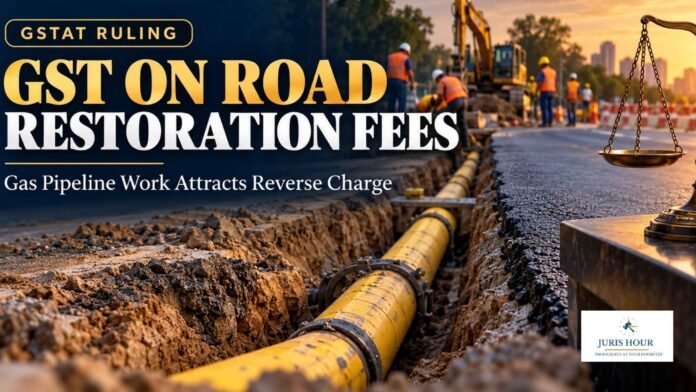
The Goods and Services Tax Appellate Tribunal (GSTAT), Lucknow State Bench, has held that road restoration charges paid to the Public Works Department (PWD) for laying a commercial gas pipeline constitute consideration for a taxable service and attract GST under the reverse charge mechanism.
The bench comprising Santosh Kumar Srivastava (Judicial Member) and Arvind Kumar (Technical Member) upheld the rejection of its ₹7,264 refund claim and distinguished routine maintenance of public roads from restoration work undertaken for a specific business entity under a planned, fee-based arrangement.
Buy Now: 160+ GST E-Magazine September 2026
The central issue was whether charges recovered for restoring roads excavated to lay gas pipelines were merely compensation for damage to public property or payment for a service supplied by the government. The Tribunal accepted the latter position and rejected the company’s claims for exemption.
The appellant/assessee which supplies natural gas through a pipeline network, obtained permission from the Uttar Pradesh PWD to lay gas pipelines. The permission required payment of charges for road restoration activities.
The company paid these charges in October 2020 and discharged GST of ₹7,264 under reverse charge through its GSTR-3B return for that month. The payment comprised ₹3,632 each towards CGST and SGST.
It subsequently sought a refund under Section 54 of the Central Goods and Services Tax Act, 2017, arguing that the payment did not relate to a taxable supply.
Following a show cause notice and the company’s reply, the adjudicating authority rejected the refund on May 6, 2024. The Additional Commissioner (Appeals), CGST and Central Excise, Allahabad, upheld that decision through an order dated August 8, 2025. The company then approached the Tribunal.
The assessee contended that the charges recovered by PWD were compensatory payments for damage to public roads rather than consideration for goods or services.
According to the company, payment of restoration charges was a condition attached to permission to lay pipelines and lacked the reciprocal relationship necessary to constitute a supply under Section 7 of the CGST Act.
It relied on the Bombay High Court’s decision in Bai Mamubai Trust v. Suchitra and CBIC Circular No. 178/10/2022-GST dated August 3, 2022, concerning the treatment of liquidated damages and compensation.
The company also argued that road repair and maintenance were functions connected with Articles 243G and 243W of the Constitution. It sought the benefit of Notification No. 14/2017-Central Tax (Rate), concerning specified activities treated as neither a supply of goods nor services, and Entries 4 and 5 of Notification No. 12/2017-Central Tax (Rate).
Its case was that the expression “in relation to” covered ancillary activities such as road restoration, and that the exemption could not be confined to the original construction of roads.
Rejecting the compensation argument, the Tribunal held that the transaction arose from a voluntary and planned administrative arrangement.
The company had applied for permission to cut open existing public roads for laying its pipeline network. PWD undertook a specific physical restoration activity to return those roads to their earlier condition, with the charges calculated according to the work required.
The Tribunal relied on the definition of “consideration” under Section 2(31) of the CGST Act, which covers payments made in respect of, in response to, or for the inducement of a supply.
It found a direct reciprocal relationship between the restoration work and the payment. The charges were therefore consideration for a service under Section 7(1), rather than damages arising from a wrongful act or breach of contract.
On that basis, the Tribunal distinguished the authorities cited by the company on compensation and liquidated damages. Those decisions, it held, did not govern the fee-based restoration service involved in this dispute.
The Tribunal acknowledged that routine upkeep of public roads falls within local government functions. However, it distinguished maintenance undertaken for the public generally from targeted restoration work connected with a private company’s commercial pipeline project.
In the Tribunal’s view, PWD’s repairs in this case were undertaken at the company’s request and against a specific fee to facilitate its business operations. The company could therefore not claim the benefit of the non-supply treatment or exemptions invoked for public authority functions.
The bench also clarified that the decisive distinction was not whether the roadwork involved “original construction” or “restoration.” Instead, it examined the nature of the recipient and the circumstances of the transaction.
Although restoration ordinarily forms part of road maintenance, the Tribunal held that the work here was supplied to a business on a fee-for-service basis.
The assessee relied on Doypack Systems (P.) Ltd. v. Union of India to support a broad interpretation of the expression “in relation to.”
The Tribunal held that an expansive reading of that expression could not override the restrictions in the GST exemption framework. It stressed that exemption notifications must be construed according to their text.
The bench relied on Serial No. 6(d) of Notification No. 12/2017-Central Tax (Rate), which excludes specified services supplied by government or local authorities to business entities from the general exemption under that entry.
It also addressed the lower authority’s use of the expression “noble cause.” While treating that wording as interpretive, the Tribunal held that removing it did not alter the nature of the transaction: restoration had been undertaken for a particular business against consideration.
The company submitted that its registrations in Rajasthan and Punjab had received refunds on identical facts and sought consistency in the department’s approach.
The Tribunal rejected this ground, holding that a refund sanction order issued by a proper officer in another State did not constitute a binding precedent for the bench.
It reasoned that an administrative refund decision in another jurisdiction could not require the Tribunal to adopt an interpretation it considered contrary to the applicable notification.
The assessee also argued that the recipient should not be required to pay GST under reverse charge if the supplier had already collected and deposited tax on the same transaction.
The Tribunal found no clear evidence that PWD had issued a formal GST invoice under forward charge or deposited tax specifically for the road-cutting permission involved in the appeal.
It consequently rejected the plea of a dual tax incidence. On the facts before it, the bench held that the applicable reverse charge liability under Notification No. 13/2017-Central Tax (Rate) could not be displaced by an unsubstantiated assertion that tax had already been paid.
The company raised procedural objections, including the absence of a Document Identification Number (DIN) on the show cause notice and adjudication order. It also alleged that the notice was vague and that the orders travelled beyond its scope.
The Tribunal found that the notice sufficiently disclosed the factual and legal basis for rejecting the claimed relief. It noted that the company had submitted an extensive, point-wise reply on April 30, 2024, demonstrating that it understood the issues raised.
On the DIN objection, the bench emphasised that the refund application, notice, reply and order had all been processed through the authenticated GST portal.
In those circumstances, it held that the absence of a physical DIN did not, by itself, invalidate the adjudication. The Tribunal relied on the electronic record and the company’s participation to reject the allegation of procedural prejudice.
The Tribunal concluded that the ₹7,264 paid through the October 2020 GSTR-3B return was a valid statutory payment under reverse charge.
It upheld the rejection of the refund under Section 54 and dismissed the appeal. The ruling treats the specific road restoration arrangement as a taxable government service supplied to a business entity, while distinguishing it from general public road maintenance and compensation unconnected with a supply.
Membership Required to Access Case Details & Order Copy
To view the complete Case Details and Download Order Copy, you must have an active membership. Please subscribe to continue.
Read More: Electricity Subsidy Reducing Manufacturing Costs Is Taxable Revenue Receipt: Supreme Court

