
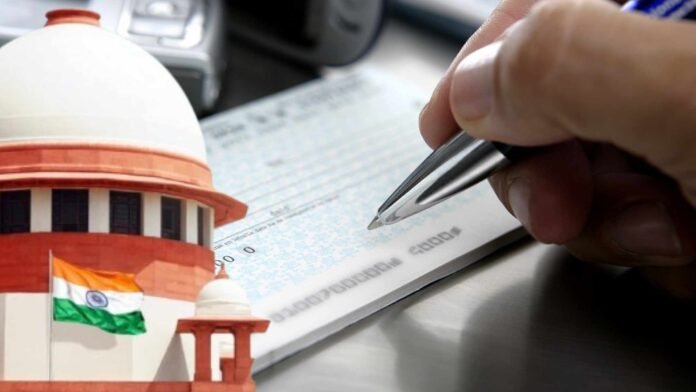
The Supreme Court has held that a statutory demand notice in a cheque dishonour case cannot be treated as unserved merely because it was received by the accused’s mother at his correct residential address. Once the notice is dispatched by registered post to the correct address, a rebuttable presumption of service arises, and the accused must produce material to displace that presumption.
A bench of Justice Ahsanuddin Amanullah and Justice Manmohan set aside a Kerala High Court judgment that had overturned a conviction under Section 138 of the Negotiable Instruments Act, 1881, on the ground that the demand notice was received by the accused’s mother rather than by the accused personally.
Buy Now: Supreme Court Judgments E-Magazine – 5 Month Combo (2026) (1st February – 30th June 2026)
The Court restored the trial court’s sentence of six months’ simple imprisonment and a fine of ₹3 lakh, together with the stipulated further imprisonment in default of payment.
In a significant ruling on precedent, the Court also declared its earlier decision in M.D. Thomas v. P.S. Jaleel, (2009) 14 SCC 398, per incuriam, holding that it had overlooked binding decisions on the presumption of service, including the larger bench ruling in C.C. Alavi Haji v. Palapetty Muhammed, (2007) 6 SCC 555.
The dispute arose from a complaint filed by Sainaba alleging that the accused had borrowed ₹3 lakh and issued a cheque towards repayment. The cheque, drawn on the Catholic Syrian Bank’s Perumbavoor Branch, was dishonoured when presented.
The complainant sent a statutory demand notice dated August 31, 2016, by registered post to the accused’s correct address. His mother received the notice. However, the accused neither paid the amount nor replied to the notice, following which the complainant initiated proceedings under Section 138.
During his examination under Section 313 of the Code of Criminal Procedure, the accused stated that he had borrowed a total of ₹7 lakh from the complainant but had repaid the entire amount. He also claimed that he had supplied a blank signed cheque when borrowing ₹3 lakh.
On July 10, 2019, the trial court convicted him and imposed six months’ simple imprisonment and a ₹3 lakh fine, with further imprisonment in default.
The trial court found that the address on the demand notice and postal acknowledgement matched the address in the complaint and the accused’s vakalatnama. It also noted that the accused had appeared and contested the proceedings after court summons were sent to the same address.
The Additional District and Sessions Judge dismissed his appeal on February 16, 2023, affirming that the notice had been sent to the correct address and received by his mother.
The Kerala High Court, in its judgment dated July 29, 2025, allowed the accused’s criminal revision petition and set aside the conviction and sentence.
Its reasoning was that receipt of the notice by the accused’s mother did not, by itself, establish service on the accused. The High Court considered it necessary for the complainant to show that the accused knew about the notice.
Challenging that ruling, the complainant argued before the Supreme Court that dispatch by registered post to the correct address attracted the statutory presumption of service. She contended that the accused had never disputed the address and that receipt by his mother did not rebut the presumption.
The accused did not appear before the Supreme Court despite service of notice in the appeal. The Court proceeded to hear the matter in his absence.
Justice Manmohan, writing the judgment, explained that proviso (b) to Section 138 requires the payee to demand payment through a written notice within 30 days of receiving information about the cheque’s dishonour. The cause of action for prosecution arises when the drawer fails to pay within 15 days of receipt of the notice.
The Court distinguished the complainant’s obligation to give notice from a requirement to establish personal delivery in every case.
Relying on Section 27 of the General Clauses Act, 1897, Section 114 of the Indian Evidence Act, 1872, and its earlier decisions, the Court held that sending the notice by registered post to the drawer’s correct address raises a presumption of valid service.
That presumption remains rebuttable. The drawer may establish, for instance, that the address was incorrect, the letter was never tendered, the postal report was inaccurate, or that he had no knowledge of the notice being brought to his address.
However, the complainant is not required to separately prove that the accused deliberately avoided service or actually knew about the notice before the presumption can arise.
The Supreme Court found substantial material establishing that the notice had been delivered to the accused’s correct address.
The accused had appeared after receiving summons at that address. His vakalatnama, appeal and revision petition also carried the same address. He had not disputed its correctness during his examination under Section 313 CrPC.
Further, it was not his case that he and his mother lived separately or that their relationship was hostile.
The Court therefore held that the accused had failed to rebut the presumption. The fact that his mother received the notice could not, by itself, justify overturning the conviction.
The High Court had wrongly placed the burden on the complainant to prove the accused’s awareness of the notice, contrary to the rule laid down in C.C. Alavi Haji.
The Court separately examined M.D. Thomas v. P.S. Jaleel, in which a two-judge bench had set aside a Section 138 conviction because the statutory notice was served on the drawer’s wife rather than on the drawer himself.
The present bench held that the earlier decision had not considered the binding three-judge bench ruling in C.C. Alavi Haji. It had also failed to meaningfully examine whether the notice was correctly addressed or whether the wife lived with the drawer.
Explaining the inconsistency, the Court noted that established precedents permit a presumption of service even where a correctly addressed notice is not actually delivered, subject to rebuttal. Denying that presumption where the notice is delivered to a family member at the same address would produce an anomalous result.
The Court accordingly declared M.D. Thomas per incuriam—meaning that it was decided in ignorance of binding precedent—and held that it could not be treated as binding law under Article 141 of the Constitution.
The judgment also reiterated the principle from C.C. Alavi Haji concerning a drawer who claims not to have received the postal notice.
Under that decision, such a drawer can pay the cheque amount within 15 days of receiving court summons accompanied by a copy of the complaint and inform the court of the payment.
A drawer who does not use that opportunity cannot simply ignore the statutory presumption of service and seek to defeat the proceedings by alleging that the original notice was not properly served.
The Supreme Court held that the statutory requirement of giving notice had been satisfied when the demand notice was dispatched by registered post to the accused’s correct address.
Since the accused failed to rebut the presumption of service, the Kerala High Court had erred in reversing the conviction solely because the notice was not delivered to him personally.
Membership Required to Access Case Details & Order Copy
To view the complete Case Details and Download Order Copy, you must have an active membership. Please subscribe to continue.
Read More: SARFAESI Auction Can’t Override Mandatory Safeguards: Supreme Court

