
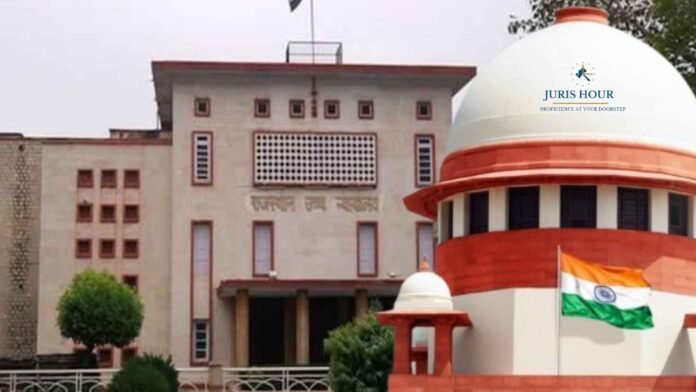
The Supreme Court has issued notice on a petition challenging a Rajasthan High Court judgment that upheld the constitutional validity of Section 16(2)(c) of the Central Goods and Services Tax Act, 2017, in a dispute involving a GST demand of ₹56.44 crore.
Section 16(2)(c) remains one of the most controversial provisions relating to indirect taxation. The ability of the State to block ITC, for both the buyer and the supplier on the non-payment of the tax to the Government, despite several other provisions safeguarding the interests of the Government, remains a grave concern. While some judgments have tried reading down the provision, there is still some cause for concern and therefore it will be better that the provision may be overhauled in the coming future to prevent unnecessary harassment of the buyers.
The Bench of Justice J.B. Pardiwala and Justice K. Vinod Chandran directed that no coercive steps shall be taken against the assessee in the meantime. The Court made the notice returnable in four weeks and permitted dasti service in addition to the ordinary mode of service.
The petition arises from the Rajasthan High Court’s judgment. The dispute concerns the conditions for claiming input tax credit, the consequences of a supplier’s failure to deposit tax, and proceedings alleging credit availed through bogus supplies.
The Supreme Court’s order provides interim protection against coercive action while the petition remains under consideration.
The order is brief and does not record any findings on the constitutional validity of Section 16(2)(c), the genuineness of the transactions or the correctness of the tax demand. It also does not expressly stay the Rajasthan High Court’s judgment or set aside the adjudication order. The operative protection is the direction against coercive steps pending further consideration.
Background: Inspection Followed by ₹56.44 Crore Demand
According to the background supplied with the order, Sumetco Alloys manufactures pure lead and lead ingots. It purchases raw materials from suppliers in Haryana, Delhi and Rajasthan, besides procuring materials through imports.
State tax authorities inspected the company’s premises on March 20, 2024, and raised questions about purchases from certain suppliers whose GST registrations were subsequently cancelled.
During the proceedings, the company submitted documents including ledgers, financial statements, stock records, creditors’ details, ITC ledgers, bank statements, tax invoices, e-way bills, transport documents, payment records and weighment slips.
The company also deposited ₹50 lakh through Form GST DRC-03, which it maintained was paid under protest and without admitting liability. Its director appeared in response to summons under Section 70, and his statement was recorded on April 22, 2024.
A show cause notice dated September 26, 2025, was subsequently issued under Section 74 for financial years 2020-21 to 2023-24. The notice alleged wrongful availment of ITC on purchases from certain suppliers. Following the company’s reply, the adjudicating authority passed an order on April 10, 2026, confirming a demand of ₹56,44,08,265. Pasted markdown
High Court Upheld Actual Tax Payment Condition for ITC
Before the Rajasthan High Court, the company challenged Section 16(2)(c), which makes actual payment of the tax charged on a supply to the government a condition for the recipient’s entitlement to ITC.
The Bench of Justice Arun Monga and Justice Ashutosh Kumar held that Section 16(1) does not create an unconditional or vested right to credit. The entitlement remains subject to the conditions and restrictions prescribed under the GST law.
The High Court observed that the conditions under Section 16(2) are cumulative. Possession of invoices, receipt of goods and payment through banking channels could not, by themselves, dispense with the requirement concerning actual payment of tax to the government.
It further read Section 16(2)(c) with Section 41. Under the statutory mechanism discussed in the judgment, credit must be reversed where the supplier has not paid the corresponding tax, but the recipient may re-avail it once the supplier discharges that liability.
The High Court therefore treated the denial of credit on account of supplier default as contingent and reversible. It held that Parliament had allocated the risk of supplier default to the recipient, while providing for restoration of credit when the default is cured. Pasted markdown
Reliance on Earlier Supreme Court Decisions
The background records that the High Court relied on the Supreme Court’s decision in Bhandari Scrap Traders v. Union of India, which affirmed the Gujarat High Court’s ruling upholding Section 16(2)(c).
The company argued that dismissal of special leave petitions did not constitute a binding declaration of law. The High Court rejected that submission, observing that the Supreme Court had passed a speaking order expressing agreement with, and affirming, the Gujarat High Court’s judgment.
The High Court also referred to State of Karnataka v. Ecom Gill Coffee Trading Private Limited while discussing the claimant’s burden to establish eligibility for credit. It noted that invoices and cheque payments do not automatically establish the genuineness of a transaction, and that evidence of actual movement of goods and genuine supplies is relevant.
On that basis, the High Court rejected both the constitutional challenge and the alternative request to read down Section 16(2)(c) to protect bona fide purchasers. Pasted markdown
Allegations of Fake Invoices Required Examination of Evidence
A significant aspect of the dispute was the department’s allegation that credit had been claimed through fake invoices, bogus supplies and multilayered paper transactions without actual movement of goods.
The High Court did not decide whether those allegations were ultimately established. It held that determining whether the transactions were genuine and bona fide required examination of evidence, which could not be undertaken on affidavits in writ proceedings.
The company also contended that the requirements for invoking Section 74 were absent because fraud, wilful misstatement or suppression attributable to it had not been established.
While accepting that Section 74 cannot be invoked mechanically, the High Court found that the 33-page show cause notice contained detailed allegations about the alleged routing of transactions through bogus suppliers. If proved, those allegations could fall within Section 74.
The High Court consequently treated the dispute as one concerning the sufficiency of evidence and the merits of the demand, rather than a complete absence of jurisdiction. Pasted markdown
Procedural Challenges Rejected by High Court
The company had also challenged the proceedings because no pre-notice intimation in Form GST DRC-01A had been issued.
The High Court noted that Notification No. 79/2020-Central Tax dated October 15, 2020, substituted “may” for “shall” in Rule 142(1A). It therefore held that such an intimation was an enabling facility and not a mandatory prerequisite to a notice under Section 74.
The High Court rejected the further argument that the investigating officer could not act as the adjudicating authority. It observed that the statutory framework assigns investigative and determination functions to the proper officer, and that the performance of both functions does not, by itself, establish bias.
On the allegation that the company’s reply had not been adequately considered, the High Court noted that a notice had been issued, a detailed reply submitted, a hearing granted and a reasoned order passed. It held that objections to the treatment of the reply could be examined by the statutory appellate authority. Pasted markdown
Appeal Liberty and Adjustment of ₹50 Lakh Deposit
While rejecting the challenges, the High Court allowed the company to file an appeal under Section 107 within 30 days of uploading of its judgment.
It directed exclusion of the period spent pursuing the writ petition for calculating limitation and instructed the appellate authority to decide the appeal on merits without raising a limitation objection.
The High Court also directed that the ₹50 lakh deposited through Form GST DRC-03 be credited and adjusted against the mandatory pre-deposit under Section 107(6). Pasted markdown
The Supreme Court has now issued notice on the company’s challenge and granted interim protection against coercive steps. The substantive issues remain open for consideration in the pending proceedings.
Membership Required to Access Case Details & Order Copy
To view the complete Case Details and Download Order Copy, you must have an active membership. Please subscribe to continue.

