
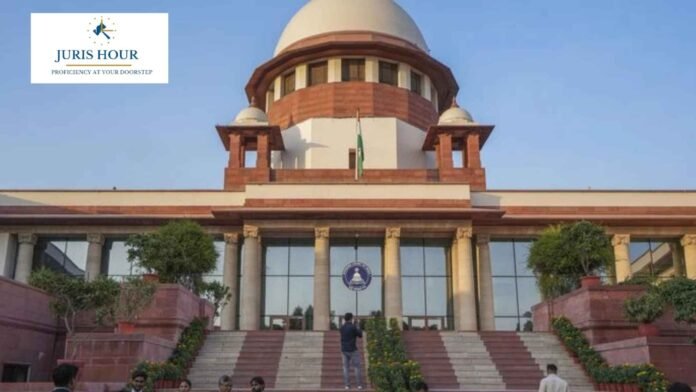
The Supreme Court on September 29, 2026, set aside the preventive detention of a man accused in connection with the November 2024 violence during a mosque survey in Sambhal, Uttar Pradesh and directed his immediate release unless he is required in another case and ordered the State to pay him ₹10 lakh in costs within a month.
A Bench of Justices Dipankar Datta and Sheel Nagu overturned the Allahabad High Court’s June 8, 2026 judgment, the District Magistrate’s detention order of October 13, 2025, and the State Government’s subsequent order confirming detention for 12 months.
Buy Now: Supreme Court Judgments E-Magazine – 5 Month Combo (2026) (1st February – 30th June 2026)
Violence broke out during a survey of a mosque in Sambhal on November 24, 2024, resulting in four deaths. Several criminal cases were registered. Afroz was not named in the first FIR cited by the Supreme Court, but was arrested about 54 days later, on January 17, 2025. The police said that a confessional statement was recorded during his custody and that a .32 bore pistol was subsequently recovered.
Afroz obtained bail in one connected case on September 9, 2025. While he remained in custody in other cases, the District Magistrate ordered his detention under Section 3(2) of the National Security Act (NSA). By June 2026, he had secured bail in all the criminal cases in which he had been implicated.
The Allahabad High Court had upheld the detention, finding that the authority’s assessment of the threat to public order was based on relevant material. Afroz challenged that decision before the Supreme Court.
The Supreme Court found that Afroz’s alleged confession was one of the basic grounds of the detention order. Afroz had consistently claimed that police obtained it through torture and threats to his life. The judgment noted that the respondents had not refuted that allegation in their reply affidavit or addressed it in their written submissions. The Court therefore could not treat the statement as voluntary.
Examining Article 20(3) of the Constitution and Section 23 of the Bharatiya Sakshya Adhiniyam, the Bench held that a confession made before a police officer cannot, by itself and without independent supporting material, provide the basis for the assessment required to order preventive detention. On the facts of this case, it held that the detaining authority should not have relied on the disputed statement.
The Court also disagreed with an earlier Full Bench ruling of the Madras High Court to the extent that it permitted reliance on a police confession in support of a detention order.
The detention grounds stated that CCTV footage and videos had helped investigators identify accused persons and ultimately identify Afroz as a principal figure in the violence. Yet the recordings were absent from the 22 documents relied on for the order. They had not been supplied to Afroz or produced before either the High Court or the Supreme Court.
The grounds also referred to alleged mobile communications between Afroz and a person described as his “Boss”. The Court found no explanation of how those messages had been retrieved when the grounds themselves said that data on the recovered phone had been erased. Neither the phone nor the alleged messages formed part of the relied-on documents.
In those circumstances, the Bench held that the undisclosed recordings and unsubstantiated communications could not provide valid grounds for detention. It also questioned why, if contemporaneous footage showed Afroz’s role, investigators had arrested him only 54 days after the first FIR; the Court said no satisfactory answer was given.
The detaining authority had treated the filing of a chargesheet as confirming Afroz’s involvement. The Supreme Court rejected that reasoning. A chargesheet represents the investigating agency’s conclusion that a case should proceed, the Bench explained; it is neither a finding of guilt nor conclusive proof of participation.
The detention grounds further referred to information about alleged discussions inside jail and a supposed plan to commit violence after release on bail. Considering the record as a whole, the Court found that the order appeared to be an attempt to keep Afroz in custody despite the grant or prospect of bail. The existence of multiple criminal cases, it added, does not by itself justify preventive detention without cogent and reliable material.
The Bench clarified that pending criminal proceedings do not legally bar a preventive detention order. Such an order must, however, be supported by material showing a need to prevent future conduct. The Court found the necessary link between the material and that purpose absent here. It did not decide whether the alleged offences themselves amounted to a threat to public order or national security.
Calling preventive detention an exceptional measure that curtails personal liberty, the Supreme Court held that the order in this case had taken on a punitive character. Afroz had remained detained despite obtaining bail in the connected criminal cases. The Bench observed that “the process was made the punishment” and imposed ₹10 lakh in costs on the State, payable to him within one month.
The Court expressly left the merits of the criminal cases open. Those proceedings will continue according to law, unaffected by its observations on the preventive detention order.
Membership Required to Access Case Details & Order Copy
To view the complete Case Details and Download Order Copy, you must have an active membership. Please subscribe to continue.

